Vietnam Business Forum reporter Nam Pham conducts an interview with Mr. Hirokazu Yamaoka, Chief Representative of JETRO Hanoi Office, about Japan’s investment and attention to Vietnam’s industrial sector and the development of supporting industries.
What is your point of view about Japanese investment to Vietnam’s industrial sector?
I would like to focus on three points. Firstly, Japan always considers Vietnam a very important partner and the outlook will never change. Secondly, many Japanese companies are wishing to invest in Vietnam and many others are moving their production bases, mainly from China, to Vietnam. Thirdly, many Japanese enterprises operating in Vietnam plan to expand their production scale annually and the number of Japan’s newly-invested companies is quickly increasing.
Can you forecast the trend of Japan’s investment in Vietnam this year?
As you know, the powerful earthquake and tsunamis in March has made Japan’s investment to Vietnam slowdown. However, I believe that in the coming time when Japanese economy becomes stable, Japanese investment projects to Vietnam will be on the rise. Statistics from the Japanese Business Association in Vietnam show that the increase in the number of Japan’s companies investing in Vietnam was modest in the period of 2010 up to now, at only 7-9%, while the increase in the previous periods was very high, around 20-25%.
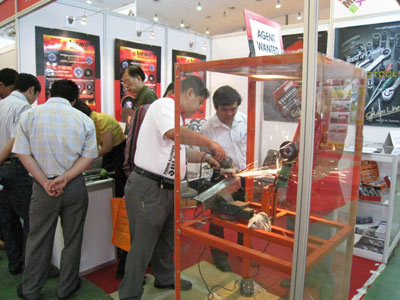
At Vietnam Manufacturing Expo 2010 in Hanoi
What is the role of JETRO in promoting Vietnam’s supporting industries?
JETRO is an external trade and investment promotion organization of Japan, particularly JETRO Hanoi focuses on promoting trade and investment between Japan and Vietnam. In fact, when Japanese companies invest capital and technologies in Vietnam, local companies will have good opportunities to obtain valuable experience and technology transfers from Japan. So they can apply the experience and technologies in developing their own manufacturing fields. For example, Japanese companies also need to buy accessories and parts from many suppliers to complete their industrial products. To meet the selling and buying orders, JETRO acts as a bridge to connect Japanese buyers and Vietnamese sellers and, therefore, Vietnamese makers will know how to meet the demands of Japanese buyers.
The investment in trade promotion will help create a business development for enterprises of the both two sides.
Every year, Vietnam witnesses several exhibitions on industrial components, manufacturing and engineering products. However, the most comprehensive exhibition of manufacturing technologies, industrial components, and supporting industries jointly organized by the Hanoi Trade Promotion Center, JETRO and Reed Tradex is regarded as the largest. What is your opinion?
This year’s event will take place with a large scale by gathering many parties to organize their shows at the same time and the same venue. It is quite different compared to the previous events. The event is a combination of Industrial Components & Subcontracting Vietnam 2011, Vietnam Manufacturing Expo and the 4th Vietnam-Japan Exhibition on Supporting Industries. This will be a good chance for not only companies of Vietnam and Japan but also for those from other countries because they will be able to join together and showcase diversified ranges of products at the event. Therefore, it will attract lots of visitors from many countries to seek business opportunities with Japanese and Vietnamese exhibitors, creating a big increase in business relations.
All related parties have prepared detailed plans and been ready for organizing the joint event. In my opinion, the large-scale show will gain a remarkable success, and surpass many other previous events’ results, making a strong foundation for our larger, higher standard events in the near future.
What are the most typical features of the 4th Vietnam-Japan Exhibition on Supporting Industries in Hanoi?
Normally, fairs and exhibitions offer places for sellers to display and sell products and services to buyers. However, the most remarkable feature of the exhibition on supporting industries is to help buyers seek potential sellers and suppliers. Japanese enterprises attending the event aim to find out Vietnamese partners who are makers and suppliers of accessories and equipment.
The 4th Vietnam-Japan Exhibition on Supporting Industries will have 100 booths, including 50 booths for Japan’s manufacturers and assemblers (buyer) and 50 booths for Vietnam’s parts and accessories makers (seller).
This is a valuable opportunity for Vietnamese companies because the local firms, in fact, find it difficult to make their products by themselves and then introduce and sell to buyers. Through such a event, Vietnamese firms will be able to understand and grasp Japanese buyers’ real demands in terms of design, quality, technical standards and others, and then improve their production capacity the meet the demands. Japanese makers really want to buy industrial products from Vietnam, however local firms have failed to meet quality and technical standards. Comparing with industrial products made in China and Thailand, the quality of the same products made in Vietnam meets only less than 50% of the general technical standards.
Could you please propose some ideas in order to improve the competitiveness of Vietnam’s manufacturing industry and to further develop the country’s supporting industries?
To meet demands of Japanese buyers for standardized accessories and equipment, Vietnamese manufacturing firms need to be equipped with modern machines and have skillful workforces to operate these machines. The requirements are big hindrances for Vietnam’s small and medium-sized enterprises (SMEs) who always face with lacks of capital or experienced technicians and professionals. We do hope that SMEs will be able to get support from the Vietnamese Government and have access to JICA’s assistance programs on vocational training and human resource development.
In the near future, ASEAN will remove all kinds of tariffs among its member countries under the commitments of ASEAN Free Trade Area. The move will surely create a big pressure on Vietnamese manufacturing firms to find the way to make products which can compete with the same ones from other ASEAN countries. Therefore, Vietnam needs to quickly sped up the progress of industrialization and modernization to enhance the competitiveness of local firms in order to avoid imports of high-quality, low-price machineries and accessories from ASEAN countries. This is a very high risk of losing the competitiveness for the country’s industrial sector.
The Government and large-scale companies should select the list of industrial products which have competitive advantages and then pay special attention and investment to develop these products.
Thank you very much!


 April 24–25, 2026
 Kinh Bac Cultural Center, Bac Ninh Province


 Vietnamese





