Universal Robots, the leading collaborative robotics company,is improving productivity, output quality and workers’ safety, with yearly cost savings of over USD 80,000 at PT JVC Electronics Indonesia - a subsidiary of theglobal leader in electronics and entertainment products, JVCKENWOOD Group. Universal Robots is present in over 23,000 production environments, benefiting businesses globally, across various industries. In Vietnam, collaborative robots (cobots) have strong adoption in the consumer electronics, textiles, oil and footwear sectors.
Shermine Gotfredsen, General Manager, Southeast Asia and Oceania, Universal Robots said, “We are working with JEIN to accelerate the transition to smarter production and sustainable growth. JEIN’s automation success is reflective of how cobot integration continues to help businesses across Southeast Asia enhance their manufacturing processes and remain competitive. Cobot adoption is high in the electronics industry, enabling greater productivity, improving safety and relieving employees of repetitive and strenuous tasks. They are also applied in other sectors including automotive, pharma and chemistry, and food and agriculture.
Vietnam is one of the fastest growing economies in Asia and is expected to overtake China this year. Automation can amplify Vietnam’s economic position amid rising operational costs. For JEIN, cobots reduced yearly operational cost by USD 80,000, simultaneously improving productivity and output quality. This has also fostered employee upskilling, such that existing workers are now equipped to operate and program the cobots.”
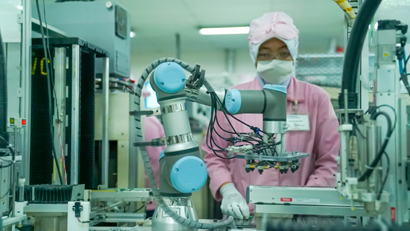
PT JVC Electronics Indonesia (JEIN)’s engineering team evaluates the various processes at the manufacturing facility
“To support robotics education, we have the UR Academy, offering free online learning modules to aid businesses in robotics training and adoption. More than 20,000 users from 132 countries have signed up for the training which includes hands-on learning via interactive simulations,” she added.
Unlike bulky traditional industrial robots, cobots are lightweight and mobile, more affordable, and can be modified for different applications. The electronics industry uses cobots in a wide variety of processes including handling, assembling, inspection and testing, packing, dispensing and even populating and coating circuit boards. Electronics is the second largest integrator of collaborative industrial robots, accounting for 18 per cent of global demand in 2015. By 2021, the electronics industry is forecast to invest approximately USD 475 million in cobots.
UR cobots, designed with a patented safety system, allow employees to work in close proximity without the need for safety fencing (subject to
risk assessment)
Growth of Vietnam’s Electronics Industry Drives Demand for Collaborative Robots
Electronics is the largest export sector in Vietnam, contributing USD 71 billion in 2017. The country’s electronics enterprises have risen four-fold in the last decade while workers have increased to more than 500,000. The Vietnamese government unveiled the Strategy for Science and Technology Development from 2011-2020 to enhance its economic competitiveness and speed up industrialisation, prioritising the importance of industrial robots and hi-tech automation.
The electronics industry in Southeast Asia is expected to grow as demand for tech gadgets and electrical devices rise. Electronics is the largest export sector in the region, comprising 25 per cent of total exports in goods. The ASEAN Economic Community is harmonising trade and production within the region. This provides manufacturers lower trade restrictions and promotes the integration of regional value chains to effectively capture global demand.
UR3 Cobots at JEIN
JEIN, a manufacturer of car audio-visual and navigation devices, was heavily dependent on manual processes. The company deployed seven units of Universal Robots’ UR3 cobots to increase productivity and achieve consistent output quality.
The small, lightweight and compact nature of the UR3 cobots complemented the company’s production facility, which was limited in space. The cobots were installed without needing to make drastic changes to the workspace layout and supported the use of various end effectors – grippers, soldering irons, screwdrivers. This allowed the team to customise the cobots to undertake three different tasks at the facility – screwing, soldering, and pick and place.
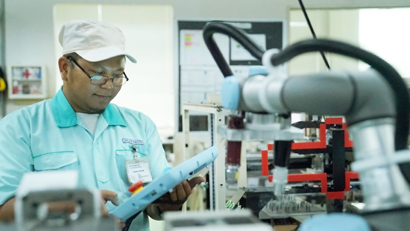
An employee at PT JVC Electronics Indonesia (JEIN) programs
a UR cobot
Safety was an important contributing factor for JEIN when purchasing the cobots. UR cobots, designed with a patented safety system, allow employees to work in close proximity without the need for safety fencing (subject to risk assessment). Moreover, the cobots relieved workers from handling high risk tasks such as soldering and separating cut Printed Circuit Board (PCB) parts, which emit hazardous fumes and dust particles.
Agustinus P. Simanullang, General Manager, Engineering Division at JEIN said, “Through the adoption of cobots, we were able to improve production efficiency and our output quality is now more consistent. With the move towards automation, our manpower can be redeployed to other higher-value processes, and we have been able to reduce operational costs by more than USD 80,000 yearly.”
The successful adoption of Universal Robots at JEIN convinced the company and group management of the ease of automation. The JVCKENWOOD Group is now looking to adopt UR cobots at its operations in Japan, China, Malaysia and Thailand.
For more details on how JEIN is using UR3 robots please click here for the English version and here for the Vietnamese version.
PV





 Vietnamese





