9:22:49 AM | 7/4/2025

In three decades since the establishment of diplomatic relations, Vietnam-United States relationship has continuously expanded and achieved strong progress across various fields, thus further building and consolidating mutual trust. Key areas of cooperation include education and training, people-to-people exchange, defense and security, war legacy remediation, and regional and global issues of common interests and concerns.
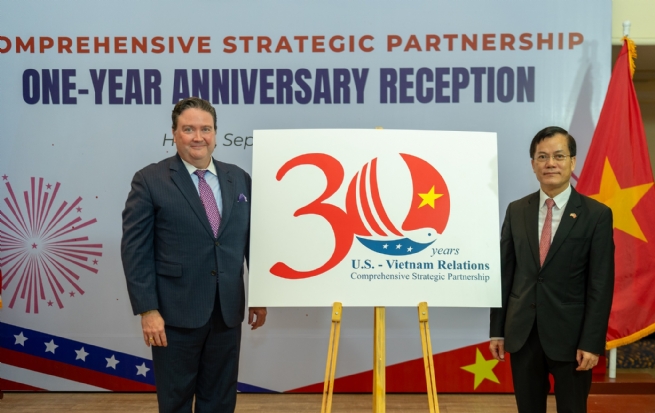
In September 2024, Ambassador Marc Knapper and Vietnam Vice Foreign Minister Ha Kim Ngoc unveil the 30th anniversary logo at the celebration of the U.S.-Vietnam Comprehensive Strategic Partnership’s first anniversary
Vietnam-U.S. cooperation in education, training, science, technology and innovation has been defined as a key pillar and has yielded many positive outcomes. Currently, approximately 30,000 Vietnamese students are studying in the U.S., making Vietnam the fifth-largest source of international students in the U.S.
Notably, in 2025, the International Academic Partnership Program (IAPP), an activity to strategically connect Vietnamese universities with U.S. universities, was launched to support universities from both sides in building practical, effective, and sustainable cooperation plans. At IAPP 2025, as many as 21 U.S. universities and 30 Vietnamese universities exchanged ideas for collaboration, focusing on such areas as STEM, digital transformation, green transition, information and communication technology, semiconductors and microchips, artificial intelligence, automation, biotechnology, advanced materials, green energy, international law, agriculture and sustainability, public health, education, Southeast Asian studies, and Vietnamese language studies.
Many U.S. universities highly value Vietnam’s development strategies, particularly in education and training, and have expressed a strong willingness to collaborate and side with Vietnam to carry out its socioeconomic development strategies, especially in education, training science, technology, innovation, and workforce quality improvement, thus contributing to the deepening of the Vietnam-U.S. Comprehensive Strategic Partnership.
Defense and security cooperation, along with war legacy remediation, is a critical component of the bilateral relationship, with many specific and effective activities already implemented.
In the past time, based on signed agreements and directions of high-level leaders and the Ministries of Defense of the two countries, Vietnam-U.S. defense cooperation has been promoted actively and effectively, and produced tangible outcomes in various areas such as delegation exchanges, contacts at all levels - especially high level, and dialogue-consultation mechanisms. In particular, cooperation in war legacy remediation remains a highlight of Vietnam-U.S. relations, with strong commitment by both countries’ leaders and being considered a priority in the bilateral relationship.
To date, the U.S. government has provided over US$430 million in non-refundable aid for Vietnam for dioxin remediation at Bien Hoa Airport and support programs for people with disabilities affected by Agent Orange.
The search for U.S. military service members missing in action (MIA) has also been carried out effectively. Accordingly, Vietnamese authorities have cooperated with the U.S. side to search for, identify and repatriate the remains of 733 missing U.S. service members.
Since August 2024, with support from Harvard University (U.S.), both countries have worked together to return 43 sets of personal artifacts and documents of Vietnamese veterans to the families of martyrs.
In the coming time, based on existing agreements signed between the Vietnamese Ministry of Defense and the U.S. Department of Defense, both sides will continue to enhance cooperation and effectively implement key areas of cooperation such as multi-level delegation exchanges, existing dialogue-consultation mechanisms, training, and military medicine.
Regarding international and regional cooperation, Vietnam and the U.S. have made remarkable progress. Both countries have actively co-organized major international and regional events and activities and have effectively participated in various initiatives and mechanisms under the United Nations (UN) and the Association of Southeast Asian Nations (ASEAN). Vietnam and the U.S. have also promoted mutual support within the framework of the ASEAN-U.S. Comprehensive Strategic Partnership, the Asia-Pacific Economic Cooperation (APEC), and coordinated in addressing global challenges. The two countries share a common vision for strengthening the role of multilateral institutions in the region, such as ASEAN, the East Asia Summit (EAS), and the Lower Mekong Initiative (LMI). The U.S. has supported Vietnam’s stance and promoted key moves and policies aligned with Vietnam’s interests in matters such as the East Sea, the Greater Mekong Subregion, and response to climate change, and has valued its coordination with Vietnam in other key regional issues.
Indeed, Vietnam and the U.S. have become important factors and strategic partners in each other's foreign policies. A new chapter in the bilateral relationship promises to elevate the Vietnam-U.S. Comprehensive Strategic Partnership to a higher, stronger, deeper, more practical and more effective level. Together, the two countries will realize their peoples' aspirations for a bright and dynamic future, contributing to peace, stability, cooperation and development in the region and around the world.
By Quynh Anh, Vietnam Business Forum




 Vietnamese