

10:57:52 AM | 12/2/2025

As Vietnam accelerates its energy transition and implements new mechanisms such as DPPA, SC RTS, and the revised Power Development Plan VIII, energy storage systems (ESS/BESS) are emerging as a strategic solution that strengthens energy security, integrates renewable energy, and supports corporate ESG commitments.
At the workshop “BESS as a Game Changer for ESG Goals,” organized by LS ELECTRIC Vietnam with participation from EGP Vietnam, PECC2, and LG Energy Solution (LGES), energy experts, businesses, and government representatives gathered to discuss the pivotal role of ESS/BESS in Vietnams green transition.

Delegates attending the workshop pose for a group photo
ESG becomes a mandatory standard - ESS takes on a central role
At the workshop, Nguyen Dinh Thai, CEO of EGP Vietnam, provided important updates on ESG, the carbon market, and technical solutions that help businesses move toward Net Zero. He emphasized that ESG is becoming a mandatory criterion in corporate development strategies and has a direct impact on investment, credit, and global supply chains. Vietnam aims to operate its pilot carbon market from 2025 to 2028, with participation expected from about 200 major emitters.
He affirmed that ESS is an essential component of ESG strategies and the journey toward Net Zero 2050. Energy storage systems not only optimize renewable energy and reduce indirect emissions but also create a transparent data foundation for measurement, reporting, and verification (MRV), enabling businesses to generate and trade carbon credits.

Panoramic view of the workshop
Revised Power Development Plan VIII: BESS becomes an urgent requirement
Tran Huynh Ngoc, Deputy Director of the Training, Research and Development Center at PECC2, shared key insights on Vietnams energy trends for the 2025 to 2035 period, highlighting a strong shift aimed at ensuring energy security and sustainable development.
Vietnams power system currently has nearly 89 GW of installed capacity. Renewable energy accounts for 26% of total capacity but contributes only 13% of electricity generation. The uneven distribution of renewable energy potential and limitations in transmission are creating significant operational challenges.

Nguyen Dinh Thai, CEO of EGP Vietnam, provides key updates on ESG
The revised Power Development Plan VIII sets out major targets: renewable energy must account for at least 28% of electricity generation by 2030; national emissions must fall below 200 million tons of CO2; green electricity exports must reach 5 to 10 GW by 2035; renewable energy capacity added between 2025 and 2030 must double the current level; and at least 10 GW of BESS must be deployed to ensure system stability.
At the same time, the DPPA mechanism under Decree 57/2025/ND CP opens the door for businesses to purchase renewable electricity directly, promoting growth in the green power market. BESS is identified as a central element that enables more effective absorption of renewable energy, reduces curtailment, eases pressure on transmission systems, and stabilizes the power grid.
LS ELECTRIC and LG Energy Solution: A leading technology duo in the region
With more than 1.5 GW of power capacity and 3,100 MWh of ESS installations across 24 countries, LS ELECTRIC brought to the workshop a clear perspective on global BESS application trends in modern power systems. The company highlighted several key applications: Frequency Regulation, which helps maintain system stability when loads fluctuate; Smoothing, which stabilizes renewable output and reduces sudden variations; Peak Shaving and Load Leveling, which cut peak demand and optimize electricity bills; Microgrid solutions that provide energy autonomy for industrial zones, factories, hospitals, and islands; and Emergency Backup systems that replace diesel generators with high reliability.
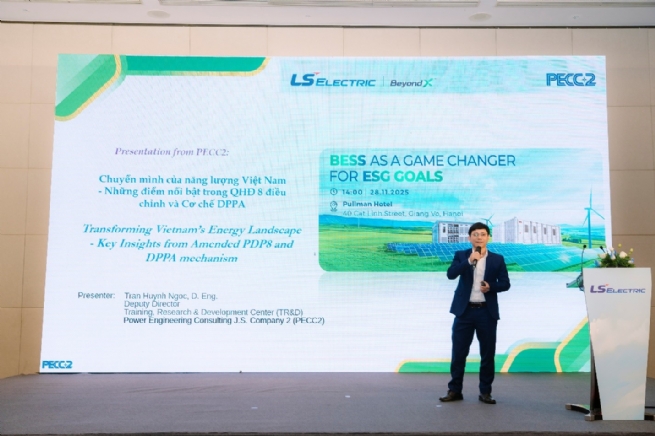
Tran Huynh Ngoc, Deputy Director of the Training, Research, and Development Center at PECC2, shares insights on Vietnam’s energy trends for 2025-2035
LS ELECTRIC’s ESS solutions are built on a modern BESS architecture that includes lithium-ion batteries, AC/DC PCS converters, BMS for safety monitoring, PMS for overall control, and SCADA/EMS integration. The round-trip efficiency exceeds 85%, and equipment lifetime ranges from 10 to 20 years. Real-world projects have demonstrated strong results, including lower operating costs, more stable renewable energy output, improved voltage quality, and greater system reliability.
Flagship projects include the Yeongam PV plus ESS complex in South Korea with 93 MW of solar power and 251 MWh of storage, the Botley frequency regulation project in the United Kingdom at 50 MW and 114 MWh, and two demonstration models in Vietnam, the Bac Ninh Smart Factory and the PECC2 Innovation Hub, which help businesses reduce electricity costs, improve stability, and secure uninterrupted backup power.

LS ELECTRIC representatives present a clear perspective on BESS applications in modern power systems
Through its capabilities in design, integration, and full EPC delivery, LS ELECTRIC is solidifying its leadership position in the ESS sector, contributing to a greener, more flexible, and more sustainable power system across the Asia Pacific region and globally.
Meanwhile, LG Energy Solution (LGES), one of the worlds’ leading ESS battery manufacturers, introduced its next generation LFP (Lithium Iron Phosphate) technology based on its proprietary Lamination and Stacking process, offering a lifespan of 15 to 20 years with superior safety. LGES ESS products meet UL9540A and NFPA 855 standards and have passed large scale fire testing without flame propagation or explosion.
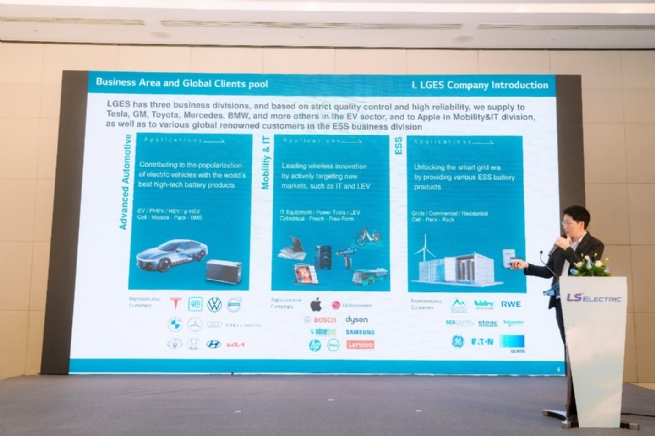
LG Energy Solution (LGES), a leading global ESS battery manufacturer, introduces next generation LFP technology for ESS
LGES demonstrated reliable operation in harsh environments, supported by its experience supplying ESS batteries in hot climate regions such as California and Arizona. The systems are engineered to operate from minus 30 degrees Celsius to 50 degrees Celsius with container temperature management using HVAC and chiller systems.
The collaboration between LGES and LS ELECTRIC, from long duration energy storage projects in Jeju, South Korea (10 MW and 40 MWh) to co-development of String PCS and E panel solutions for the United States market, is expected to expand into Vietnam, combining LS ELECTRIC’s equipment portfolio and local presence with LGES high quality battery technology.
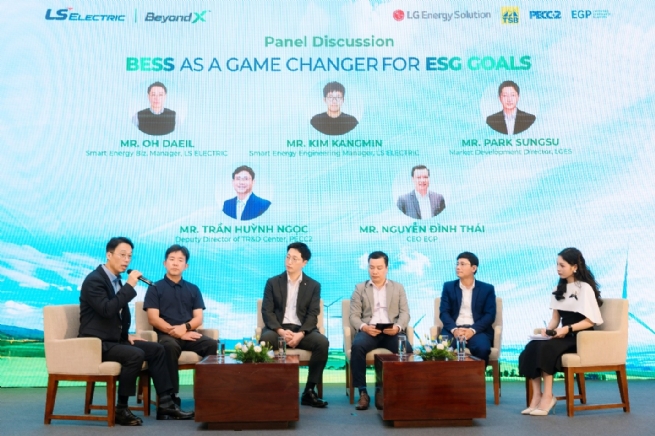
Panel discussion on “BESS as a Game Changer for ESG Goals”
In the final panel discussion titled “BESS As a Game Changer for ESG Goals,” all five experts reached a consensus that BESS will soon become a mandatory requirement for operating renewable energy sources. It will be especially important for participating in DPPA programs, the competitive wholesale electricity market, and ESG commitments. Vietnamese businesses gain clear advantages from BESS investment, including ensuring continuous green energy supply, which is a key requirement when working with global corporations such as Samsung, Apple, and Lego; optimizing electricity costs and production models by avoiding peak load purchases; and strengthening competitiveness in the green supply chain, an increasingly mandatory aspect of export markets.
The workshop emphasized that BESS is no longer an optional technology but a prerequisite for Vietnam to achieve sustainable development, emissions reduction, and expansion of renewable energy. With the participation of leading organizations such as LS ELECTRIC Vietnam, EGP Vietnam, PECC2, and LGES, the BESS ecosystem in Vietnam is gaining strong momentum and opening significant opportunities for businesses as the green economy and the carbon market become more clearly defined.
Nguyen Bach (Vietnam Business Forum)


 Vietnamese




