

8:05:35 AM | 1/22/2026

In 2025, agricultural, forestry, and fisheries exports reached a record US$70 billion, confirming the sector’s role as a backbone of the economy. However, growing pressure from climate change and international technical standards posed increasing challenges. Green value chains and regional linkages are no longer just guiding ideas but essential requirements for Vietnamese enterprises seeking long-term growth.
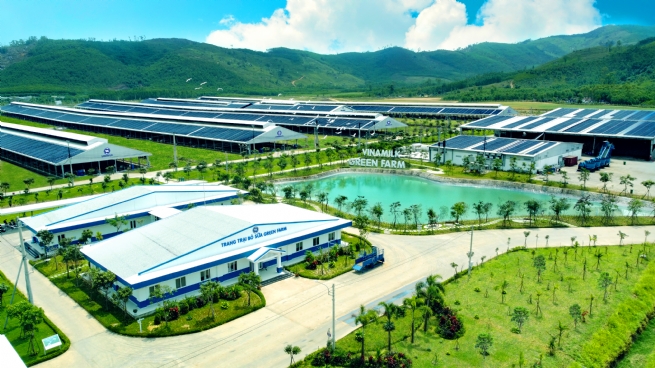
Vinamilk Green Farm applies a circular ecological model, featuring a fully “green” process from farm to product
New mindset on green value chains
According to Minister of Agriculture and Environment Tran Duc Thang, full-year GDP growth for the agricultural, forestry, and fisheries sector exceeded 3.9%, while exports reached US$70 billion, surpassing the US$65 billion target. These results reflected not only the sector’s scale but also its increased adaptability and enhanced competitiveness amid external uncertainties.
This growth did not stem from land expansion or resource-intensive practices seen in earlier periods, but from the early formation of green value chains. “Green value chains encompass the entire cycle of production, harvesting, processing, transportation, distribution, consumption, and waste treatment, aiming to reduce environmental impact, conserve resources, and cut emissions while ensuring sustainable livelihoods for farmers,” said Dr. Tran Cong Thang, Director of the Institute of Strategy and Policy on Agriculture and Environment.
The approach to agricultural economics had therefore shifted. National strategies such as the Net-zero 2050 target and the one-million-ha program for high-quality, low-emission rice had moved into implementation. Dr. Dao Xuan Hung, Editor-in-Chief of Agriculture and Environment Magazine, said the foundation of this transition lay in regional linkages, the development of concentrated and synchronized raw-material zones, deeper processing, logistics optimization, lower post-harvest losses, standardized production processes, and traceability to expand access to demanding markets.
From the business perspective, Phung Ngoc Bo, Director of the Technical Department at Vietnam National Chemical Group (VINACHEM), said that to meet its net-zero commitment from COP26, VINACHEM launched a green transition program for 2025-2030 with a vision toward 2050. By 2030, the program aims to reduce CO₂ emissions by at least 5% compared with 2024 and increase renewable energy to 5-10% of total consumption. By 2050, it targets a 20% emissions reduction, carbon neutrality, and a renewable energy share of 20-30%.
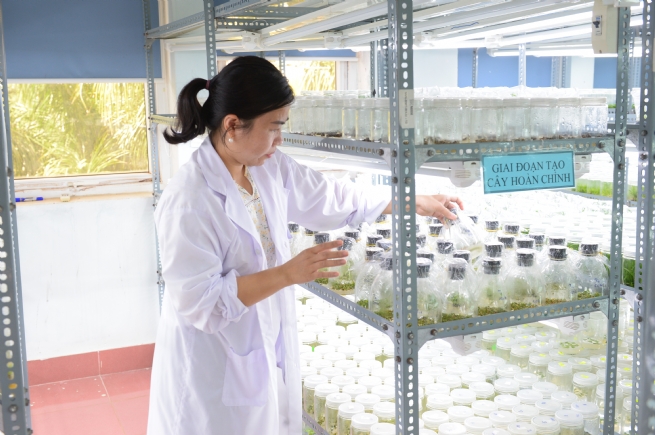
Using modern technologies to boost productivity and ensure sustainable agricultural development
Institutional and technological challenges
Despite many positive developments, the path toward greening remained challenging, particularly for foundational industries such as chemicals and for access to capital. First, weak linkages continued to be a major constraint. Dr. Tran Cong Thang said the scale of linkages remained limited, with low participation from farmers, enterprises, and cooperatives; many models lacked durability, contracts did not ensure binding commitments, and value chains were therefore vulnerable.
Second, supporting industries, especially chemicals, faced significant difficulties. Pham Huy Nam Son, Deputy Director of the Chemicals Department under the Ministry of Industry and Trade, said investment costs for green technologies remained high, while small and medium-sized enterprises were constrained by limited technological and management capacity and relied heavily on imported technologies.
Phung Ngoc Bo acknowledged that many plants continued to rely on outdated technologies with high energy consumption and emissions. Integrating green technologies was difficult due to incompatibility with existing systems. Circular technologies had yet to be applied at scale, including the treatment of PG gypsum waste and the reprocessing of apatite tailings. Fossil fuels still dominated because of lower costs, while green, environmentally friendly products were positioned in higher-priced segments and struggled to compete. In addition, green and circular economy projects required substantial capital outlays, increasing costs and weighing on business efficiency.
Third, capital flows for the green transition remained misaligned. Nguyen Xuan Vinh, Deputy General Director of Agribank, said the bank had invested more than VND28 trillion (US$1.12 billion) in clean energy and green agriculture. However, key constraints included the absence of standardized data on green projects for risk assessment, the lack of refinancing mechanisms from the State Bank of Vietnam for green credit, limited ESG implementation capacity among small and medium-sized enterprises, and an underdeveloped green bond market.
According to experts, awareness of the long-term benefits of sustainable development remained incomplete, and policy mechanisms, despite the Chemical Law 2025 and the Cooperative Law 2023, still required more specific guidance to move into practice.
Digital technology and PPP solutions
Amid growing challenges, green growth pathways are emerging through practical models based on two pillars: technology and public-private partnerships (PPP).
On technology and regional governance, Dr. Pham Thi Thanh Nga, Director of the Institute of Meteorology, Hydrology, and Climate Change, said that climate impacts are intensifying and spreading across regions, requiring localities to strengthen regional linkages through shared data platforms and integrated basin-ecosystem planning. Incorporating climate risk maps into socio-economic decision-making has become essential for proactive risk management.
Dr. Pham Anh Tuan, Director of the Institute of Agricultural Engineering and Post-Harvest Technology, said deep-processing technologies and logistics were key drivers of higher value creation. He proposed accelerating mechanization and digitalization through automated irrigation systems, environmental sensors, electronic farm diaries, QR and blockchain-based traceability, alongside the development of advanced processing technologies such as cold drying, freeze-drying, and essential oil extraction.
A critical solution in the green transition was the effectiveness of public-private partnership models. Participation by multinational groups and domestic organizations had delivered clear quantitative improvements. A notable example was the Bayer ForwardFarming project in the Mekong Delta, which reduced greenhouse gas emissions by 24.7%, saved 50% of irrigation water, cut nitrogen fertilizer use by 30-50%, while yields rose 13.5% and profits increased 13.1-54.9%.
The Pronutiva model implemented by UPL Vietnam in Tay Ninh (now Long An), which integrates biological and chemical solutions, delivered positive outcomes. Production costs declined by VND1-1.5 million (US$40-60) per ha, while yields increased by 500-700 kg per ha. Farmer representatives said that traditional farming had previously involved high costs and unstable output; after adopting the Pronutiva model, yields reached 5.8 tons per ha, and income rose to VND19 million (US$760) per ha.
From the public management perspective, the approach was also shifting from encouragement to requirement and compliance. Pham Sinh Thanh, a representative of the Ministry of Industry and Trade, said: “At present, greening remains largely voluntary. Once it is codified into law with mandatory provisions, enterprises will give it serious attention.”
It is clear that achieving the Net-Zero 2050 commitment requires a coordinated ecosystem, from a binding legal framework and expanded green credit flows to changes in mindset among farmers and enterprises. “Developing green value chains is not just the responsibility of the agricultural sector but of society as a whole. Only with the participation of all stakeholders can the agricultural production ecosystem transform fundamentally toward sustainable value,” said Deputy Minister of Agriculture and Environment Phung Duc Tien.
By Huong Ly, Vietnam Business Forum
 April 24–25, 2026
 Kinh Bac Cultural Center, Bac Ninh Province


 Vietnamese





