

10:38:44 AM | 1/22/2026

In the transition toward a green and sustainable growth model, the circular economy has become an unavoidable requirement for major industrial centers such as Hai Phong. For nearly 20 years, Song Da Cao Cuong Joint Stock Company (SCL) has remained committed to its objective: pioneering the conversion of industrial waste into secondary resources, developing green building material product lines, and contributing to sustainable growth linked to environmental protection.
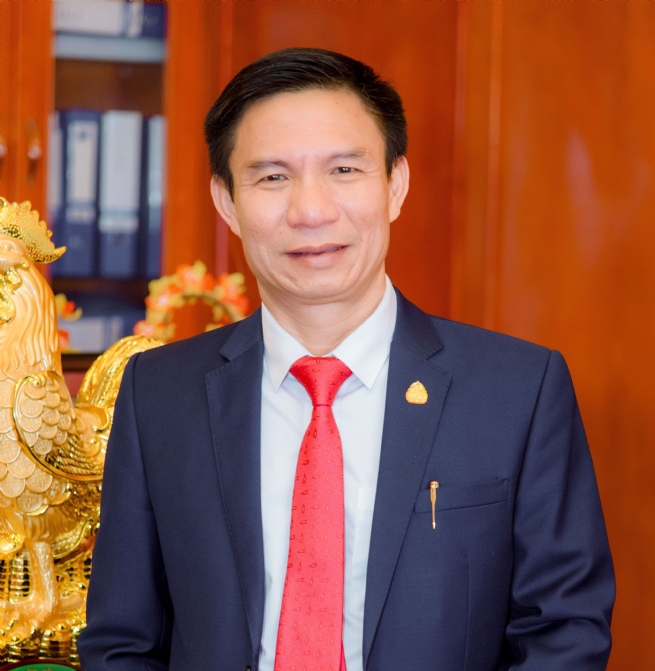 |
| Chairman of the Board of Directors of SCL Kieu Van Mat |
Circular economy - a pillar of green growth
Established in 2007, Song Da Cao Cuong Joint Stock Company chose a distinct path: researching and processing fly ash, coal slag, and many types of industrial waste from thermal power plants, chemical facilities, and fertilizer plants to produce new construction material products. With this approach, SCL was recognized by the People’s Committee of Hai Duong Province (now Hai Phong City) as a science and technology enterprise, confirming its pioneering role in a field still relatively new in Vietnam.
Under the leadership of Chairman of the Board of Directors Kieu Van Mat and with the collaboration of construction material scientists, the company has shown that industrial waste is not “discarded material,” but a high-quality secondary resource when properly processed.
A major milestone was the company’s research and mastery of a fly ash production technology line, which won First Prize at the Vietnam Science and Technology Award - WIPO in 2008. With this achievement, SCL processed more than 20 million tons of accumulated ash and slag at the storage ponds of Pha Lai Thermal Power Plant, returning over 90 ha of pond area to local use for clean water storage. The enterprise is also processing daily ash and slag emissions from several large thermal power plants in the North, including Pha Lai, Uong Bi, Mong Duong, Ha Khanh, and Hai Phong, contributing to safe plant operations and national energy security.
Processed fly ash from SCL has been widely used in construction as an additive for cement and concrete. Notably, this product accounts for over 95% of the fly ash market used for roller-compacted concrete (RCC) in major hydropower projects such as Son La, Lai Chau, Ban Chat, Trung Son, and Song Tranh II, as well as in many projects in Laos, and is also exported to international markets.
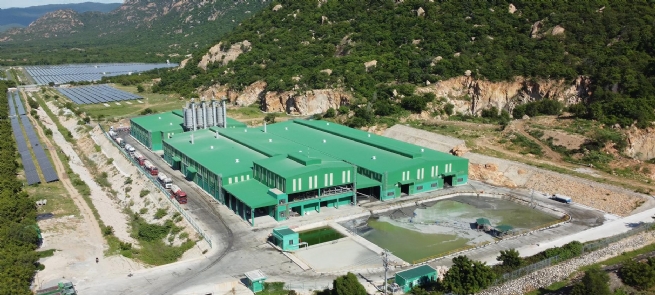
SCL’s factory complex operates under a closed-loop circular model
Building on this foundation, the company has continued to invest in closed-loop technology lines to develop a range of new construction materials, including autoclaved aerated concrete (blocks and lightweight panels), ready-mixed dry mortar, tile and stone adhesive, grout, wall putty powder, and others. These products incorporate a high proportion of processed ash, slag, and gypsum, helping reduce natural resource extraction, save energy, and lower construction costs. SCL has gradually established its role as a pioneering enterprise in construction material production under the circular economy model, balancing economic efficiency with environmental responsibility.
“Green factory, green technology, and green products”
Construction material lines produced by SCL offer several advantages: light weight, high durability, effective sound and thermal insulation, fire resistance that meets strict standards, reduced structural load, shorter construction time, and lower construction costs. In particular, the use of Biomass furnace technology, which burns sawdust, rice husk, and agricultural by-products instead of fossil fuels, has significantly reduced CO₂ emissions and other greenhouse gases.
As a result, the company’s products have been applied in many large-scale projects nationwide, including urban areas, industrial zones, hospitals, and manufacturing plants. At the same time, the SCL brand has been widely adopted by major contractors such as Vinhomes, Vincons, Delta, Cotechcons, Hoa Binh Group, Alphanam, and Newtecons in their key projects.
In addition to thermal power ash and slag, SCL has pioneered the processing of phosphogypsum waste from the DAP Plant at Dinh Vu Industrial Park (Hai Phong City), producing artificial gypsum that meets national standards. This solution addresses environmental challenges in this key industrial park of the city while enabling the cement and construction materials sector to secure domestic raw material sources.
Building on these results, the company has continued to expand its ash and slag processing and green construction material production model in the southern region. The factory complex in Vinh Tan (Lam Dong) has been developed under a closed-loop circular model to process the full volume of accumulated and daily-emitted ash and slag from the Vinh Tan Thermal Power Center. Processed products are used to produce high-quality fly ash, autoclaved aerated concrete, concrete components, ready-mixed dry mortar, and materials for coastal and island embankment construction.
| According to SCL Chairman Kieu Van Mat, the research and production of products derived from fly ash and coal slag still face many challenges, as this is a new field, the market remains limited, and economic efficiency is not yet high. The company seeks continued attention and cooperation from management bodies and Hai Phong City authorities through support policies on preferential credit, taxation, and land, providing additional resources to collaborate with society in addressing environmental challenges and advancing the circular economy. |
According to Chairman Kieu Van Mat, in the next phase, SCL will continue to expand capacity, strengthen scientific and technological content, and move toward exporting green construction material products to markets with high standards. At the same time, the company is committed to supporting Vietnam’s Net Zero target by 2050.
With a series of reputable awards and titles in the construction materials and environmental fields, SCL has gradually established its position as a leading science and technology enterprise in the green transformation of the construction sector. More importantly, the company’s work has contributed to addressing environmental challenges, advancing the circular economy, and supporting sustainable development. This also provides a reference for the long-term direction of Hai Phong City’s industrial sector in pursuing green growth and sustainable integration.
Ngoc Tung (Vietnam Business Forum)


 Vietnamese




