11:04:57 AM | 12/3/2025

Major policies, specific initiatives, and sustainable development support models have been strongly implemented, creating favorable conditions for businesses to actively integrate, adopt ESG practices, and transition to green and circular business models.
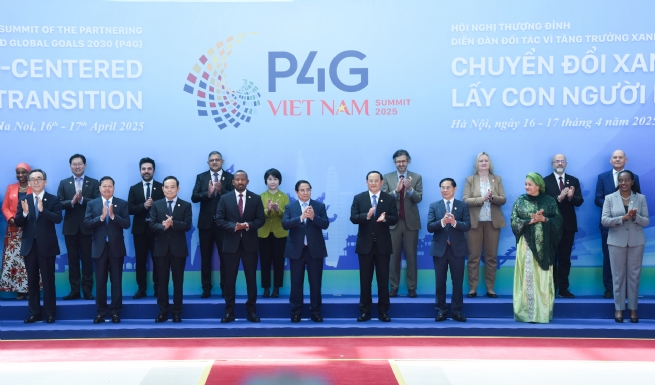
Prime Minister Pham Minh Chinh welcomes leaders of delegation to P4G Summit, Hanoi, April 2025
Facilitating policies - Foundation for sustainable business
Businesses are not only the main actors in production and trade but also play a central role in achieving national sustainable development goals. Emphasizing this, Deputy Prime Minister Ho Duc Phoc, Chairman of the National Council for Sustainable Development, said that the government will continue to play a facilitating role, accompanying businesses and promoting the implementation of comprehensive policies.
On this basis, numerous facilitative regulations have been issued. Notably, Resolution 58/NQ-CP outlines key policies and measures to support businesses in proactively adapting, quickly recovering, and developing sustainably by 2025. This includes promoting new business models based on circular economy, green economy, and sustainable business practices.
Alongside policies, support programs have been created to guide businesses in adopting ESG and sustainable practices. For example, the Vietnam Environmental, Social, and Governance (ESG) Initiative, implemented jointly by the Ministry of Planning and Investment (now the Ministry of Finance) and the United States Agency for International Development (USAID), focuses on small and medium enterprises, providing technical assistance, training, and scaling sustainable business models. Governance tools are also crucial. The Vietnam Chamber of Commerce and Industry (VCCI) developed the Corporate Sustainability Index (CSI) and runs an evaluation and publication program for businesses based on sustainability criteria, encouraging companies to enhance governance and transparency.
Additional support mechanisms include tax incentives, green credit, and administrative reforms. Mac Quoc Anh, Director of the Institute for Economics and Enterprise Development and Vice Chairman and General Secretary of the Hanoi Small and Medium Enterprises Association (HANOISME), recommended establishing green credit guarantee mechanisms of 30 to 50 percent, simplifying green criteria while learning from international models, promoting enterprise data digitization, offering tax incentives during the first two to four years for green businesses, and building ESG advisor networks along the value chain.
These measures convey a clear message from the government: businesses are not alone in the transition process. The state will accompany, support, and remove obstacles to promote sustainable development.
From commitment to action: Local momentum for sustainable development
At the local level, engagement with businesses on sustainable development is increasingly reflected in practical actions.
Vu Xuan Truong, Chairman of Viet Hung Ward People’s Committee (Hanoi), said: “The ward recognizes enterprises, cooperatives, and business households as key drivers of the local economy. The ward government always listens, shares, and accompanies businesses to resolve difficulties and support sustainable development in the new context.”
Nguyen Van Hung, Chairman of the People’s Council of Pham Su Manh Ward (Hai Phong), also affirmed the commitment to accompany businesses, providing the most favorable conditions for development. He emphasized the principle of “no refusals, no empty promises, no promises without action,” ensuring a transparent, open, and business-friendly environment that supports sustainable local economic growth.
At the provincial level, Gia Lai places businesses at the center of sustainable development strategies. Truong Van Dat, Standing Vice Chairman of the Gia Lai Provincial People’s Council, stressed that the business community should continue to foster innovation, creativity, social responsibility, and ethical practices. The province is committed to improving the investment environment, advancing administrative reforms, reducing unofficial costs, enhancing dialogue, and supporting businesses in overcoming challenges. It also encourages businesses to list publicly, join global value chains, and develop green and sustainable operations.
Local authorities do not just issue regulations, they actively engage with businesses by identifying challenges, streamlining procedures, connecting resources, and promoting the application of technology and green business models. For example, digital transformation support policies include establishing provincial digital support centers where businesses receive advice, technical assistance, and practical training.
When businesses enter international value chains, participate in green, circular, or inclusive economic models, local authorities and management agencies become the “bridge” that enables success. In Viet Hung Ward, preferential loan programs and the creation of local business associations have been launched, helping to scale supportive models.
Nationally, central and local authorities have outlined a clear development path: creating a favorable business environment, connecting financial, technical, and training resources, and enabling enterprises to transition to green, digital, and responsible business practices.
Cooperation between ministries, local governments, and businesses in sustainable development has moved beyond slogans into practice. Through policies, programs, and support models such as Resolution 58/NQ-CP, the Vietnam ESG Initiative, and the CSI, the government has become a true partner of businesses. Moving forward, enterprises need to take a more proactive role in implementing ESG strategies, while regulatory agencies continue to improve the framework and create favorable conditions for sustainable development to spread and become a driver of long-term growth.
|
Sustainable Development as Inevitable Path for Jewelry and Gemstone Industry
Sustainable development and ESG are increasingly important for the jewelry and gemstone industry. They provide a framework for businesses to reduce risks, create opportunities for long-term responsible growth, strengthen reputation with customers, minimize environmental impact in production and craftsmanship, ensure safe waste management, and maintain product traceability. Effective ESG implementation also supports smooth supply chains, generates additional jobs, and contributes positively to society. In recent years, Hai Phong Gemstones Jewelry and Art Craft Association has proactively implemented practical initiatives, including training courses for members on labor safety, environmental protection, marketing, and brand development; vocational training programs to encourage young generations to inherit traditional jewelry-making skills; and active participation in trade fairs, exhibitions, skill competitions, and artisan recognition programs to promote the reputation of craft villages and local products. In the coming period, we will continue to raise awareness of sustainable development among our members, build reputable brands for businesses and artisans, and link products to the One Commune One Product (OCOP) program as well as craft village culture and tourism. We also plan to propose policies to the Hai Phong People’s Committee to support artisans and craft villages in accordance with Decision 801/QD-TTg dated July 7, 2022, issued by the Prime Minister on the conservation and development of Vietnamese craft villages for the 2021-2030 period.
Sustainable growth for people and planet With the National Green Growth Strategy and the goal of achieving Net Zero emissions by 2050, Vietnam is undergoing a strong transformation toward building an economy that balances growth with environmental responsibility. In this context, Unilever Vietnam continues to embrace sustainability as our guiding principle, because we believe that growth only truly matters when both people and the planet benefit. We commit to transparency in setting targets, updating our roadmap to reflect reality, and linking every pledge to measurable action plans. Guided by this principle, we have achieved many proud milestones in recent years – from protecting public health during the pandemic, pioneering comprehensive digital transformation, to delivering on our green growth and sustainability commitments across the entire production and consumption value chain. ESG must become part of a company’s DNA
ESG is not a trend or a way to make reports look better. It is the foundation for sustainable growth and long-term competitiveness. Companies that ignore ESG today risk losing their place in the global supply chain tomorrow. At Nestlé, ESG is not treated as a separate project. It is a mindset and operational approach applied across all functions. Every decision, from product design and ingredient selection to partnerships with farmers and suppliers, is guided by the three ESG pillars: Environment, Social, and Governance. On the environmental side, Nestlé Vietnam follows a circular economy model and aims for Net Zero by 2050. All factories are landfill-free, and packaging is designed to be recyclable. On the social side, Nestlé is committed to creating shared value through programs that empower women, develop youth, support sustainable coffee farming, and promote healthy nutrition. In governance, the key factor is genuine commitment from leadership. ESG cannot succeed as a slogan or marketing message. It requires consistency, transparency, and close collaboration across the entire value chain. No company can achieve a green future alone. Only when businesses share responsibility and act together can Vietnam truly achieve sustainable development goals. Practicing ESG through local herbal products: a sustainable path for remote cooperatives
Sustainable development and ESG (Environment, Social, Governance) are essential in the era of integration. For mountain cooperatives like ours, ESG brings both challenges and opportunities. We see ESG not just as standards for large companies but as a guide for small cooperatives to pursue long term growth, linking economic benefits with social responsibility and environmental protection. In production, we use local materials such as star anise, cinnamon, and medicinal herbs to make clean, green products like star anise tea, cinnamon and star anise foot soak, and herbal pillows. Deep processing reduces waste burning and emissions, supporting ecological protection, which reflects the “E” in ESG. At the same time, we provide stable jobs for ethnic minority residents, giving them extra income and improving their livelihoods, reflecting the “S” aspect. We believe that when each cooperative applies ESG in ways suited to its scale and local conditions, Vietnam’s green economy and sustainable development can become a reality.
Human capital - the core engine driving ESG strategy ESG is not just reports or metrics; it is a new mindset for running a responsible business. Human capital is the core engine that turns this mindset into reality. To embed this approach across the organization, employees need knowledge and empowerment to turn sustainability goals into concrete actions, from optimizing energy use to building a fair and transparent work environment. They are the ones generating initiatives that create real impact, not just commitments. Corporate culture acts as the organization’s operating system and a solid foundation for sustainable development. Without ethics in environmental practices, transparency in governance, and social responsibility as the base, ESG strategies cannot be effectively implemented. Culture serves as the glue that ensures sustainable values are maintained consistently. CareerViet’s “Most Loved Companies 2025” survey, with over 88,000 respondents, shows that in companies with fewer than 1,000 employees, environmental awareness is seen as a key indicator of sustainability. In larger companies, fairness, diversity, and inclusion are rated more highly. This demonstrates that investing in people and responsible action is the key to attracting and retaining talent on the path to sustainable growth. Sustainability embedded at the core
At DKSH, sustainability is embedded at the core of our business strategy. Our sustainability framework provides clear direction and accountability, uniting all business units and functions to identify strategic priorities and translate them into actionable initiatives. This collaborative approach ensures alignment, ownership, and measurable progress across the organization. Guided by four key objectives, Enable Our People to Flourish, Make Our Value Chains More Sustainable, Achieve Net-Zero Emissions, and Make a Positive Local Impact, we deliver tangible results that create long-term value for our stakeholders and communities. Our commitment to sustainability extends beyond business operations to social impact, supporting education, health, gender equality, and fostering a diverse and inclusive workplace. DKSH has joined the United Nations Global Compact, committing to responsible business conduct aligned with its Ten Principles and actively contributing to the Sustainable Development Goals (SDGs). Sustainability is the foundation of how we operate, enabling both DKSH and our partners to advance shared ambitions across the value chain. Through this commitment, DKSH demonstrates that every business decision can help shape a sustainable, equitable, and prosperous future for all stakeholders.
Sustainable growth through shared values, Cao Thi Ngoc Dung, Chairwoman of the Board of Directors, Phu Nhuan Jewelry Joint Stock Company (PNJ) Throughout 37 years of establishment and development, we have consistently upheld our sustainable development philosophy: “Integrate the customer and society interests into the company’s interests”. We strongly believe that PNJ’s growth is intrinsically linked to the shared prosperity of the community and society. Innovation remains central to our approach, enabling resource optimization and promoting a circular economy model with reduced greenhouse gas emissions. PNJ recognizes the environment not merely as a matter of legal compliance but as a strategic pillar in building a sustainable enterprise. Environmental responsibility is integrated across all operations from production and distribution to business management and customer experience. Concurrently, we maintain our commitment to social welfare initiatives, expanding community impact through strategic partnerships and scalable CSR programs that lay the foundation for long-term positive transformation. Sustainability must be driven by purposeful actions
At SABECO, sustainability is more than an operational goal. It is a long-term strategic approach that strengthens our adaptability, reinforces our values, and ensures that we grow responsibly in the face of constant change. We place ESG at the center of how we operate and how we plan. It guides the way we invest, the way we innovate and how we connect with our stakeholders. As one of Vietnam’s leading companies in sustainability, we are determined to build a more resilient SABECO that is aligned with national priorities and global aspirations. We believe that sustainability must be driven by purposeful actions that are implemented consistently throughout every areas, achieving stable and sustainable growth while creating positive values for communities. SABECO is proud to be at the forefront of that journey. |
By Giang Tu, Vietnam Business Forum


 Vietnamese