

10:35:46 AM | 12/21/2025

On December 20, at the headquarters of the Chuyên Mỹ Commune People’s Committee, the Hanoi Department of Agriculture and Environment, in coordination with the Chuyên Mỹ Commune People’s Committee and the Hanoi Handicraft and Craft Village Association, organized a workshop entitled “Solutions for Preserving and Developing Craft Villages in Connection with Tourism and Digital Transformation.”
Chuyên Mỹ craft village, a land that brings together many distinctive handicraft trades, has been identified as one of the exemplary localities where traditional cultural values are gradually being revived, linked with tourism and digital transformation, toward sustainable development and international integration. In 2025, the city of Hanoi will continue to submit to the World Crafts Council for consideration and recognition two craft villages - Sơn Đồng wood sculpture and lacquer craft village, and the mother-of-pearl inlay and lacquer craft village of Chuyên Mỹ Commune as members of the World Creative Craft Cities Network in 2025.
Considerable room for development
Speaking at the workshop, Mr. Nguyễn Đình Hoa, Deputy Director of the Hanoi Department of Agriculture and Environment, affirmed that the preservation and development of craft villages is not only a cultural mission but also a socio-economic requirement in the capital’s development process. According to him, Hanoi is gradually bringing exemplary craft villages into participation in the World Creative Craft Cities Network of the World Crafts Council, with Chuyên Mỹ being one of the localities expected to play a key role. The city’s promulgation of the Master Plan for Craft Village Development for the 2025–2030 period, with a vision to 2050, has created an important policy framework, featuring synchronized solutions ranging from preserving traditional values and training human resources to developing markets, tourism, and technological applications. On that basis, Chuyên Mỹ is oriented to develop not only as a production space but also as a cultural and craft village tourism destination of the capital.

Mr. Nguyễn Đình Hoa, Deputy Director of the Hanoi Department of Agriculture and Environment
According to Ms. Hoàng Thị Hòa, Head of the Rural Development Division (Hanoi Department of Agriculture and Environment), the capital’s craft villages have been increasingly deeply involved in the One Commune One Product (OCOP) Program. To date, about 100 craft villages and villages with crafts have had 929 out of 3,463 OCOP products rated three stars or higher. The city has also recognized 10 models of commune-level creative design centers for the introduction, promotion, and sale of OCOP products linked with tourism; formed 70 industrial clusters, including 25 craft village industrial clusters, attracting more than 4,000 production facilities and creating jobs for nearly 80,000 workers.
In the tourism sector, Hanoi has recognized 55 city-level tourist sites and zones, including 26 sites associated with craft villages; 7 craft villages have been recognized as craft village tourism destinations. Hanoi’s handicraft products are currently exported to 89 countries and territories. Across the city, there are 351 artisans along with an active network of associations, federations, and craft village clubs. Notably, the official recognition of the two craft villages of Bát Tràng ceramics and Vạn Phúc silk weaving as members of the World Creative Craft Cities Network of the World Crafts Council is considered an important milestone, opening up major opportunities for brand promotion, trade promotion, and the development of high-quality tourism. Hanoi has also proactively introduced its craft villages to the world through international trade fairs and the International Festival on the Preservation and Development of Craft Villages in 2025, with the participation of 30 countries.
Preservation linked with livelihoods and tourism
From a local perspective, Ms. Nguyễn Thị Thùy Hương, Vice Chairwoman of the Chuyên Mỹ Commune People’s Committee, said that more than 70% of households in the area earn their living from handicrafts. Craft villages not only create stable jobs for local residents but also attract tens of thousands of workers from surrounding areas, with relatively stable incomes. In recent years, the commune has gradually linked handicraft production activities with experiential tourism, thereby expanding the development space for craft villages.

Ms. Nguyễn Thị Thùy Hương, Vice Chairwoman of the Chuyên Mỹ Commune People’s Committee
The consistent viewpoint of the locality is that preserving craft villages must be closely associated with the livelihoods of local people. Preservation is not only about keeping the craft or the products, but more importantly about retaining the people who practice the craft, creating motivation for the younger generation to carry on the tradition. The work of craft transmission, vocational training, and honoring artisans is considered a core solution to maintaining the vitality of craft villages in the context of many fluctuations in the market and labor. Ms. Hương emphasized this point.
Ms. Nadia Meer, Vice President of the World Crafts Council for the Africa region, noted that Chuyên Mỹ has advantages in developing sustainable craft village spaces associated with natural materials and ecological factors. According to her, creatively exploiting traditional materials not only contributes to heritage preservation but also creates products with high added value, in line with the global trend toward green consumption.
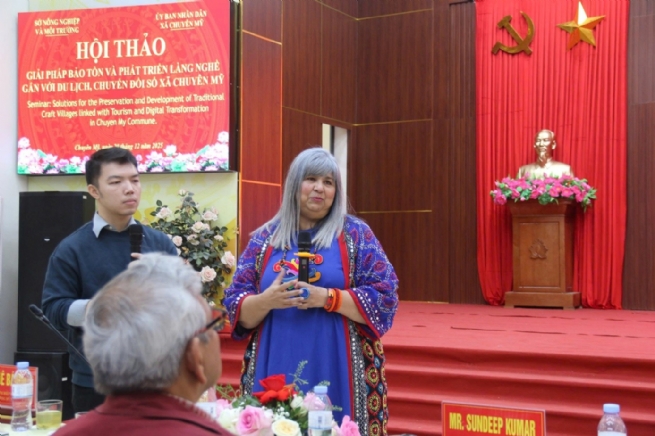
Ms. Nadia Meer, Vice President of the World Crafts Council for the Africa region
Meanwhile, Mr. Sundeep Kumar, Vice President of the World Crafts Council for the Asia–Pacific region, emphasized the role of branding and communication in craft village development. According to him, to attract the public and the market, craft villages need to be told through clear and consistent stories that reflect their unique cultural identities. Craft village tourism is only truly sustainable when local people become the storytellers of their own cultural narratives.
Ms. Hoàng Thị Hòa – Head of the Rural Development Division, representing the Organizing Committee – assessed that the geographical conditions and spatial layout of Chuyên Mỹ are highly favorable, creating an important foundation for developing craft villages in connection with tourism. According to her, with the concerted involvement of local leaders, artisans, along with the support of architects, design experts, and digital transformation specialists, Chuyên Mỹ is gradually being shaped into a distinctive and memorable craft village space. She emphasized that in the coming period, Chuyên Mỹ will not only have stories worth telling but also concrete and practical actions to develop craft villages. Because if there is no direct participation from local residents and artisans, orientations from state management agencies such as the Department of Cooperative Economy, the Department of Agriculture and Environment, along with experts, will remain only ideas. It is the engagement of the local community that is the decisive factor in creating the Chuyên Mỹ story worthy of comparison with famous craft villages such as Hội An and Bát Tràng.
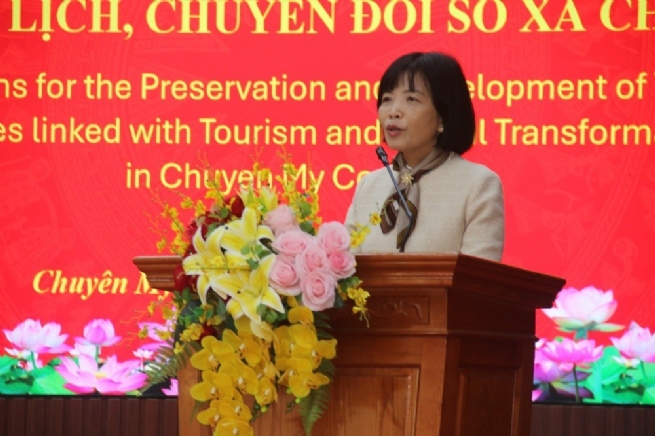
Ms. Hoàng Thị Hòa – Head of the Rural Development Division (Hanoi Department of Agriculture and Environment)
The goal is to build the Chuyên Mỹ brand into a well-known destination domestically and internationally, through a tourism promotion strategy linked with multi-value development, toward a Chuyên Mỹ that develops sustainably and harmoniously in terms of economy, culture, and community, Ms. Hòa affirmed.
Digital transformation and toward a multi-value development model
In the context of strong digital transformation, experts believe that craft villages cannot stand outside this trend. However, digital transformation does not mean losing traditional identity. According to Associate Professor, PhD Đặng Mai Anh of the University of Industrial Fine Arts, digital transformation in craft village development should begin with storytelling and branding. Vietnamese handicraft products possess the inherent beauty of traditional materials, are environmentally friendly, and have great potential in export markets, yet they have not been exploited commensurately due to limitations in brand building and market connectivity.
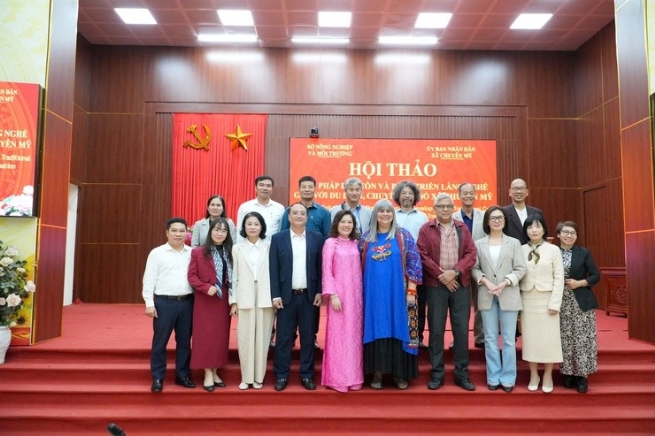
Delegates take a commemorative photo at the workshop
The application of digital technologies, from e-commerce and social media communication to product personalization according to customer needs, will help shorten the distance between craft villages and the global market. However, experts note that technology can only truly be effective when it is built upon a clear cultural and identity foundation.
Emphasizing the cultural factor, Hà Thị Vinh, Chairwoman of the Hanoi Handicraft and Craft Village Association, said that craft villages are in great need of “storytellers” namely artisans and local residents to convey cultural values in a vivid and authentic manner.
From a technological perspective, Vũ Tuấn Cương, Chief Executive Officer of A4I Company, affirmed that digital transformation is not about abandoning tradition but is a tool for preservation and sustainable development. Digitizing products, building craft village databases, and personalizing products according to each customer’s needs will help craft villages adapt to new consumption trends.
Meanwhile, Lê Bá Ngọc, Vice Chairman of the Vietnam Association for Export of Handicrafts, noted that titles granted by the World Crafts Council are reviewed every four years. Therefore, Hanoi’s craft villages need to firmly maintain criteria related to preservation, creativity, and sustainable development. Mr. Lê Bá Ngọc proposed building a ceramic pattern museum, encouraging younger generations to create new patterns, and organizing ceramic competitions from the village level to the national level, in order to affirm the position of Vietnamese craft villages on the world map.
By Minh Ngoc, Vietnam Business Forum
|
This special section is supported by Hanoi Department of Agriculture and Environment |


 Vietnamese





