


Can Tho City achieved several notable milestones in socio-economic development in 2025. While implementing administrative unit reorganization and operating a two-tier local government model, the city has maintained strong growth momentum through a range of positive indicators, creating a solid foundation for green, modern, and sustainable development. To learn more, our reporter interviewed Truong Canh Tuyen, Chairman of the Can Tho City People’s Committee.
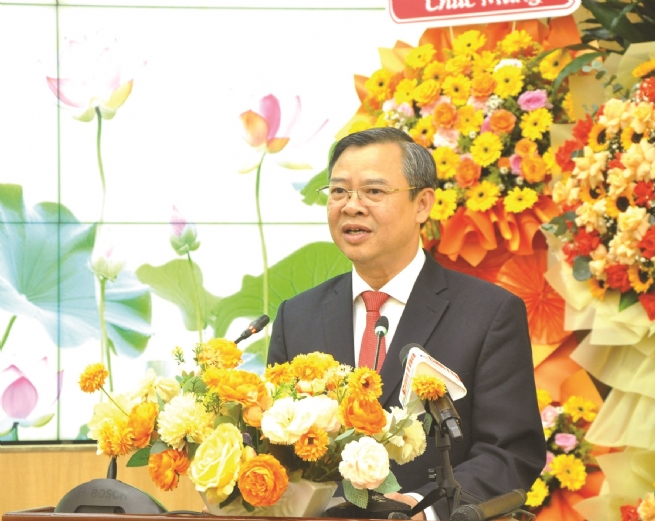 |
| Mr Truong Canh Tuyen, Chairman of the Can Tho City People’s Committee |
Could you share more details about the key socio-economic achievements in Can Tho City over the past year?
In 2025, the city’s Gross Regional Domestic Product (GRDP) increased by 7.23% year on year; GRDP per capita reached VND94.94 million (US$3,797.60) per person per year. The size of the economy reached VND306,170 billion (US$12.25 billion). In national rankings, Can Tho placed 25th among 34 provinces and cities; 6th among the six centrally governed cities; and 3rd among the five provinces in the Mekong Delta region.
The economic structure continued to move toward modernization, with the industry-construction and services sectors accounting for about 73.72% of GRDP. The Industrial Production Index (IIP) rose 10.43% as food processing, beverage production, and industrial materials manufacturing recovered strongly. State budget revenue in the locality reached VND26,685 billion (US$1.07 billion), exceeding the central government target by 7.8%. Total capital mobilization across the city reached VND230,190 billion (US$9.21 billion), up 10.00%. Outstanding credit reached VND329,110 billion (US$13.16 billion), up 14.00%. The average Consumer Price Index (CPI) in 2025 rose 3.05%.
Total disbursed investment in the city was estimated at VND92,074.44 billion (US$3.68 billion), up 18.04%. Total public investment capital assigned by the Prime Minister reached VND23,857,557 million (US$954.30 million); as of January 31, 2026, disbursement totaled VND17,892,511 million (US$715.70 million), equal to 75% of the assigned plan. The city attracted 22 new investment projects, including one FDI project with investment capital of US$100 million and 21 domestic projects with total registered capital of VND20,215.64 billion (US$808.63 million).
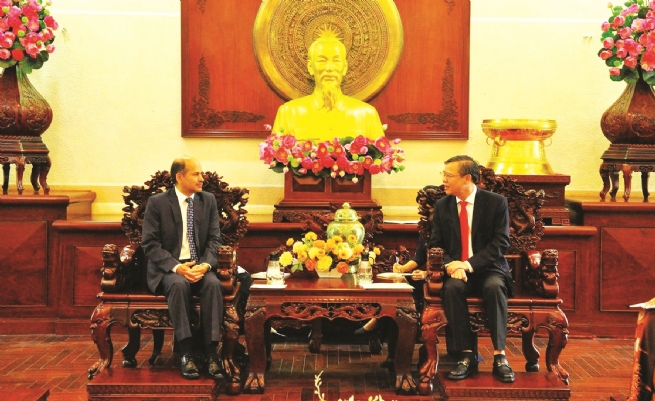
Chairman of the Can Tho City People’s Committee Truong Canh Tuyen meets with Indian Ambassador to Vietnam Sandeep Arya, June 2025
The agriculture, forestry, and fisheries sectors continued restructuring toward higher efficiency and value creation. The city now has 100,417 ha of key fruit cultivation (Ha Chau berries, star apples, durian, longan, mango, and others) with total output reaching 1,220,543 tons; rice planting area reached 710,420 ha with production of 4,597,255 tons; the pig herd reached 482,067 heads, producing 101,747 tons of live pork; and aquatic output reached 781,450 tons.
The value of construction output reached VND66,870.59 billion (US$2.67 billion). During the year, 4,655 enterprises registered for establishment with total registered capital of VND29,862.07 billion (US$1.19 billion).
The services sector remained the main pillar of the economy, contributing 45.67% to the GRDP structure. A key feature was total retail sales of goods and consumer service revenue estimated at VND350.84 trillion (US$14.03 billion), up 16.78%; of which retail sales of goods reached VND237.37 trillion (US$9.49 billion), up 16.90%. Tourism welcomed 11,185,000 visitors, up 18%, generating revenue of VND9,991 billion (US$399.64 million); accommodation and food services reached VND56.08 trillion (US$2.24 billion), up 17.17%; other services reached VND56.66 trillion (US$2.27 billion), up 16.30%; transportation, warehousing, and logistics support services reached an estimated VND14.67 trillion (US$586.80 million), up 14.87%.
Alongside economic development and investment attraction, social welfare also received close attention. Over the past year, the city created jobs for 115,084 workers; monthly allowances for revolution contributors and their families totaled VND662,483 million (US$26.50 million); support for social protection beneficiaries under Decree 20/2021/ND-CP reached VND1,322,143 million (US$52.89 million); emergency support for poor households, near-poor households, disadvantaged families, and policy households outside Decree 20/2021/ND-CP reached VND23,758 million (US$950,320); and 1,420,392 health insurance cards and free medical examination cards were issued.
Cultural and social fields continued to record positive progress. The quality and efficiency of vocational education gradually improved, responding better to labor market demand; more than 80% of graduates secured employment, with about 70-75% working in fields aligned with their training; the high school graduation rate reached 99.78%. The health sector maintained strong disease surveillance capacity and deployed many advanced medical techniques. National defense, security, and social order remained stable, providing a foundation for the city’s sustainable development in the coming period.
The first City Party Congress for the 2025-2030 term set five tasks and three strategic breakthroughs related to infrastructure, institutions, human resources, digital transformation, and development space. Could you share solutions to implement these goals, particularly in building a two-tier government and expanding new investment and business spaces?
The Can Tho City Party Committee set the theme for 2026 as: “Continue strengthening Party building and the political system to be clean and strong; mobilize and effectively use resources to build synchronized socio-economic infrastructure, creating momentum for the city’s development in the new stage.” Accordingly, all levels of government, sectors, and citizens must seize opportunities, overcome challenges, and deliver clear progress from the first year of implementing the Resolution of the first City Party Congress, while achieving results in celebration of the 14th National Party Congress. Based on this direction, Party committees are actively implementing the City Party Committee’s 2026 resolution with 28 targets and four groups of key tasks and solutions, striving to overcome difficulties and achieve growth of 10-10.5% or higher in 2026. This will create a solid foundation for a new stage of development, improving people’s material and spiritual well-being while ensuring social security.
To raise growth from 7.23% in 2025 to over 10% in 2026, the city government has determined that it must fully tap development potential from infrastructure and emerging economic sectors. Priority will be given to completing ring roads, connecting routes, and major components of the Chau Doc-Can Tho-Soc Trang expressway, helping Can Tho become a logistics center for the Mekong Delta.
At the same time, Can Tho will increase the share of the digital economy, financial services, advanced healthcare, and education and training. These sectors generate high added value and help maintain the strong contribution of the services sector. In addition, new industrial parks will contribute significantly to overall growth. The Vietnam-Singapore Industrial Park in Can Tho (VSIP Can Tho), once operating steadily, is expected to attract more secondary investors.
In 2026, Can Tho will also focus on building a two-tier urban government and adjusting planning under a multi-polar model linked with strategic economic corridors to improve governance efficiency. The city is accelerating the preparation of new planning schemes and developing industrial, urban, and service infrastructure linked with strategic investment attraction. These policies will strengthen competitiveness and provide a solid foundation for Can Tho to become a national growth pole contributing to the country’s development.
Can Tho City merging with Hau Giang and Soc Trang provinces has created new development space while also bringing new requirements for building socio-economic strategies with integrated thinking and a long-term vision. What is your view on this assessment?
After the merger, Can Tho City is a centrally governed Class I urban area covering more than 6,360 square kilometers with a population of 3,224,937 and 103 commune-level administrative units. The city holds a strategic position as the center of the Mekong Delta, a key trade gateway, and a hub for services, logistics, processing industries, and the marine economy, serving as a major growth driver for the region.
To align with the new context and expanded development space, the City People’s Council approved adjustments to the Can Tho City Master Plan for the 2021-2030 period with a vision to 2050, opening a new stage for the region’s central urban area. The plan sets the target that Can Tho will become a comprehensive development center for the region by 2030, playing a prominent role in trade, services, logistics, the marine economy, processing industries, science and technology, innovation, education and training, and advanced healthcare. These goals reflect the city’s development needs and its leadership role in the region.
Regarding economic targets, average GRDP growth in the 2026-2030 period will exceed 10% per year; average labor productivity growth will exceed 10% annually; and the contribution of total factor productivity to growth will exceed 55%. The digital economy will account for at least 30% of GRDP; GRDP per capita at current prices will reach about US$8,500. Total realized investment during 2026-2030 will reach VND1,000-1,100 trillion (US$40-44 billion), equivalent to about 40% of GRDP. Urbanization will exceed 50%. The economic structure will continue shifting toward modernization, with services accounting for more than 45%, industry and construction more than 35%, and agriculture, forestry, and fisheries below 16%.
A strategic breakthrough in the planning adjustment is the development of the marine economy. Can Tho will expand development space linked with the sea, leveraging connections through the Hau River and the corridor to the East Sea. Under the plan, the Tran De Economic Zone will be formed with an area exceeding 40,000 ha linked with the Tran De International Seaport. This will be a comprehensive multi-sector economic zone serving as the southeastern growth pole of Can Tho and the Mekong Delta region. The zone will develop processing industries, energy industries, port logistics services, multimodal logistics, and marine ecotourism.
Alongside the marine economy, the planning adjustment identifies industry, logistics, and services as three core growth pillars. Can Tho will develop industry in a deeper, more modern, green, and sustainable direction, focusing on high value-added sectors such as high-quality agricultural and aquatic processing, energy and renewable energy, mechanical engineering, electronics, supporting industries, and new materials.
During the 2021-2030 period with a vision to 2050, the city will form one economic zone and about 40 industrial parks with a total area of about 61,238 ha. The industrial park system will connect with strategic transport corridors, the Hau River, Tran De seaport, and Can Tho International Airport, forming a synchronized and efficient network of production, logistics, and services. At the same time, logistics centers will develop under a multimodal model connecting road, inland waterways, sea, and air transport, gradually making Can Tho a regional and national logistics center that reduces logistics costs and strengthens competitiveness for the entire Mekong Delta.
Regarding urban spatial organization, Can Tho will follow a multi-polar, multi-center model linked with strategic economic corridors such as the Chau Doc-Can Tho-Soc Trang corridor, the Hau River economic corridor, expressway routes, and coastal development space. This approach distributes urban functions more effectively, reduces pressure on the existing central area, and creates more balanced development momentum.
By 2030, the city aims to meet Class I urban criteria across its entire territory with nine urban areas and an urbanization rate above 50%. Urban areas will develop in a green, smart, and climate-resilient direction, prioritizing public transport, green transport, expanded green space and water surfaces, and improved living standards for residents. The plan also focuses on synchronized and modern infrastructure including transport, energy, water supply, drainage, waste treatment, and digital infrastructure, creating a strong base for sustainable urban development.
Looking ahead to 2050, Can Tho is oriented to become a modern, green, and smart river-sea city in Southeast Asia, serving as the Mekong gateway linking the region with the East Sea and international markets. The city will function as a river-sea logistics center, an energy center, a hub for high-quality services, and an innovation center for the subregion.
The economy will develop in green, digital, and circular directions; society will move toward a knowledge-based model; the environment will be sustainably protected; and national defense and security will be ensured. Residents will enjoy a high quality of life while the city becomes an attractive destination for investment, innovation, and international integration, contributing to the rapid and sustainable development of the Mekong Delta and the nation.
As Can Tho City enters a new stage of development, what message would you like to send to the business and investor community to reaffirm the government’s commitment to building a dynamic, transparent, and globally connected investment and business environment?
I would like to express sincere appreciation to all entrepreneurs, enterprises, and investors in Can Tho who work tirelessly with creativity and dedication, contributing to the city’s reputation. With the determination to build a trusted business ecosystem where enterprises can fully realize their potential and contribute to national prosperity, the leadership of Can Tho City is committed to continuing efforts to create a transparent, dynamic, and globally integrated business environment under the action motto: “When enterprises need support, the government is present; when enterprises face difficulties, the government stands beside them.” At the same time, we commit to protecting legitimate rights, balancing interests, sharing risks, and accompanying the business and investor community in sustainable development.
In the coming period, I hope the community of entrepreneurs, enterprises, and investors will continue strengthening solidarity, innovation, and determination, moving forward with confidence and contributing even more to the prosperity of the homeland and the country. I also hope they will maintain trust in the leadership of the City Party Committee, the People’s Council, and the People’s Committee, seize opportunities from new policy decisions, and work together to realize the goal of making Can Tho the comprehensive development center of the Mekong Delta and a new national growth pole.
Thank you very much!
Cong Luan (Vietnam Business Forum)


 Vietnamese
