

3:35:03 PM | 12/15/2025

Amid continued volatility in the global and domestic economy, the Government has issued multiple fiscal policies to support business recovery and growth, including Resolution 68-NQ/TW. Tax policy plays a crucial role in enhancing the business environment and promoting innovation.
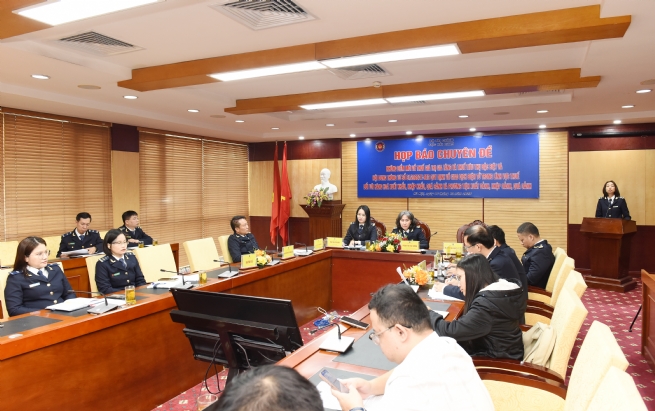
A press conference on tax-related issues hosted by Department of Vietnam Customs
In line with Resolution 66-NQ/TW on reforming the development and enforcement of laws to meet national development needs in the new era, in 2025, the Department of Customs proposed multiple solutions to remove obstacles and improve tax policies. Notably, these include regulations on value-added tax, special consumption tax, and electronic transactions in the tax sector for exported, imported, and transited goods and vehicles.
Tax law innovations creating opportunities for businesses
Mai Thi Van Anh, Deputy Head of the Customs Tax Operations Division at the Department of Vienam Customs, said that during the implementation of the Value-Added Tax Law, effective July 1, 2025, the customs sector identified four groups of new provisions that directly benefit both the customs authority and import-export enterprises.
Updates in value-added tax and special consumption tax target long-term objectives: reducing compliance costs, expanding preferential coverage, and stimulating domestic production. At the same time, standardizing electronic invoices and transaction data is a key step toward creating a transparent and modern business environment.
For manufacturing enterprises, the new policy provides clearer access to eligible preferential treatments, simpler deduction mechanisms, and streamlined documentation processes. These changes help businesses reduce goods transit times, lower capital costs, and improve cash flow.
For example, goods traded to serve production and consumption in border areas are included in the list of items eligible for duty exemption under export and import tax laws (Clause d, Point 26, Article 5). This facilitates trade for border residents and aligns with export and import tax regulations.
Similarly, relics, antiques, and national treasures imported by competent authorities under cultural heritage law (Clause e, Point 26, Article 5) are streamlined, creating convenience for enterprises and government agencies importing items from abroad.
In import-export, special consumption tax is adjusted to clearly classify each product group, ensuring consistent application, reducing dispute risks, and enabling businesses to proactively plan operations. This serves as a crucial foundation for enhancing the competitiveness of Vietnamese goods in global supply chains.
Customs: Bridging policy and implementation
Customs authorities have actively contributed to proposing, developing, and refining tax policies for import-export activities. By proactively reviewing obstacles and gathering feedback from businesses and localities, they ensure that regulations reflect practical needs without creating additional procedural burdens.
A major highlight is the customs sector’s contribution to Circular 51/2025/TT-BTC on electronic transactions in taxation for exported, imported, and transited goods. The circular establishes a complete legal framework for e-tax management, significantly reduces paper documents, shortens processing times, and limits direct contact. With end-to-end digitized data, reconciliation, inspection, and risk management become more accurate and transparent.
At many local customs departments, the “supporting businesses” model has been implemented through regular dialogue forums, policy advisory teams, and hotline support for tax procedures. This provides timely feedback, prevents cargo congestion at borders, builds trust among enterprises, and ensures the seamless implementation of new policies from day one.
New driver for the business environment
The combination of tax reform and the proactive involvement of the customs sector generates significant momentum for economic recovery. Businesses save time and costs, while the State enhances management efficiency, risk prevention, and revenue growth.
In an increasingly competitive global market, the customs sector’s active role in tax policy formulation and implementation is not only a procedural reform but also a key factor in creating a modern, transparent, and business-friendly environment.
The new tax law, built on digital foundations and a development-supportive approach, is shaping a new operational phase for enterprises. In this process, the customs sector continues to act as a “conductor,” connecting policy, resolving obstacles, and supporting the business community on its path to growth.
By Le Hien, Vietnam Business Forum
 April 24–25, 2026
 Kinh Bac Cultural Center, Bac Ninh Province


 Vietnamese





