

3:39:39 PM | 12/22/2025

As Vietnam accelerates institutional reform, digital transformation, and deep international economic integration, improving the effectiveness of customs legal policy development has become a key breakthrough in facilitating trade, supporting the business community, and enhancing the economy’s competitiveness. Amendments to the Law on Customs, the issuance of Decree 167/2025/ND-CP, and related implementing guidance documents clearly reflect Vietnam Customs’ commitment to strengthening the legal framework, removing bottlenecks, and supporting enterprises in a new stage of development.
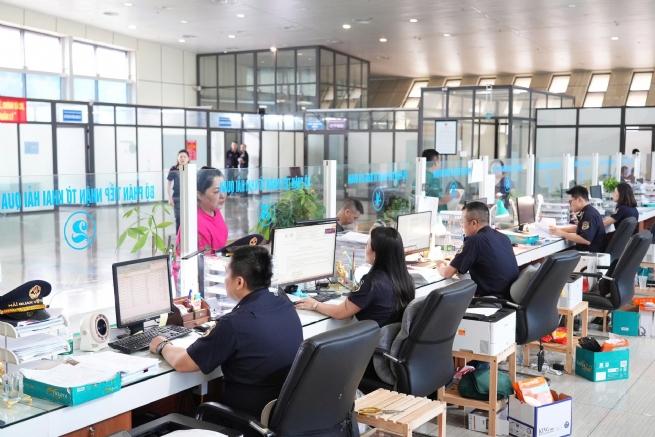
Vietnam aims to establish digital and smart customs in the country’s new development phase
Improving policies with enterprises at the center
In the reform of administrative procedures and the modernization of state management, the development and improvement of customs legal policies plays a key role. In practice, a coherent, transparent, and stable legal system aligned with international standards not only enables customs authorities to perform their state management functions effectively, but also directly influences trade facilitation, compliance costs, and the confidence of the business community.
After more than 10 years of implementing Decree 08/2015/ND-CP and Decree 59/2018/ND-CP, customs legal provisions have made an important contribution to promoting administrative reform and creating a favorable environment for investment, production, and export-import activities. However, alongside the rapid development of the economy, significant changes in production and business models, and the emergence of new industries and fields such as the semiconductor industry, high technology, and cross-border e-commerce, many provisions have revealed limitations, become outdated, or overlapped with newly issued legal documents.
In response to these requirements, the customs sector has proactively reviewed and comprehensively assessed the system of normative legal documents in the customs field, closely following the major guidelines and orientations of the Party and the State on institutional reform, science and technology development, innovation, and digital transformation. The National Assembly’s passage of Law 90/2025/QH15 amending and supplementing a number of articles of the Law on Customs, and the Government’s issuance of Decree 167/2025/ND-CP, has been regarded as an important step, clearly reflecting innovative thinking in the development of customs legal policies.
The consistent theme throughout this round of policy revision and improvement has been the mindset of “placing enterprises at the center.” The new provisions have not only aimed to strengthen the effectiveness and efficiency of state management, but have also focused on removing difficulties, reducing compliance costs, and creating the most favorable conditions for enterprises engaged in export-import activities.
Decree 167/2025/ND-CP has amended and supplemented numerous provisions in the direction of simplifying customs dossier components, cutting documents that are no longer appropriate, and promoting the implementation of administrative procedures through electronic means. Many requirements for submitting original copies and paper dossiers have been abolished or replaced with electronic copies via the Customs Electronic Data Processing System and the National Single Window Portal. This has marked an important step forward, creating a legal foundation for the goal of fully digitizing 100% of documents in customs dossiers in the coming period.
In addition, regulations on the responsibilities of customs declarants in notifying processing and export production facilities have also been revised in a way that significantly reduces documentation burdens. Enterprises no longer have to present multiple types of documents as before, thereby reducing costs, shortening dossier preparation time, and limiting risks arising during customs clearance procedures.
It can be seen that the improvement of customs legal policies in the current period has not only involved technical amendments to regulations, but has also reflected a fundamental shift in the approach to institutional development: from “management” to “service,” from pre-clearance control to post-clearance inspection, from manual processes to digitalization, and from rigidity to greater flexibility that is more closely aligned with the practical operations of enterprises.

A key highlight of the new customs policy is simplifying procedures with enterprises placed at the center of service delivery
Procedural reform, delivering effective facilitation
One of the contents that has attracted particular attention from the business community in this round of customs legal policy improvement is the new regulations related to the priority regime and on-the-spot export and import procedures.
The amended Law on Customs under Law 90/2025/QH15 and Decree 167/2025/ND-CP has supplemented and clarified provisions on the conditions for applying the priority regime to enterprises. Notably, the priority regime has been expanded to enterprises operating in the fields of the semiconductor industry, high technology, strategic technologies, and key digital technologies, in accordance with the list announced by the Ministry of Science and Technology.
Compared with ordinary enterprises, enterprises in this group are not required to meet conditions on export and import turnover or on compliance with customs and tax laws for two consecutive years. This provision has removed one of the largest barriers for high-technology enterprises, especially newly established enterprises from investment projects, enabling them to access the priority mechanism at an early stage, reduce costs, and shorten clearance time from the outset of their operations.
In addition to expanding the scope of beneficiaries, procedures for recognizing priority enterprises have also been significantly simplified. Dossiers requesting the application of the priority regime have been divided into groups, in which the group of enterprises under Resolution 57-NQ/TW has seen further reductions in required documentation compared with the past, thereby lowering compliance costs and enhancing feasibility in practical implementation. At the same time, assessment conditions for recognition have been adjusted in a more flexible manner, closer to the recommendations of the World Customs Organization, creating a foundation for Vietnam’s Authorized Economic Operator program to gradually integrate with similar programs of other countries and territories.
Another particularly important new point is the amendment and supplementation of regulations on on-the-spot export and import goods. Accordingly, on-the-spot export and import goods are clearly defined as goods delivered and received in Vietnam under the designation of foreign traders pursuant to contracts of sale, processing, leasing, or borrowing, regardless of whether the foreign trader has a presence in Vietnam. The unification of this interpretation has removed a major bottleneck that had existed for many years, created clarity and stability in policy application, and has been highly appreciated by the business community.
In practice, on-the-spot export and import procedures have brought tangible benefits to enterprises by reducing clearance time, cutting intermediary costs, and optimizing domestic supply chains. Continuing to improve the legal framework for these activities has not only supported domestic enterprises but has also contributed to enhancing the attractiveness of the investment environment, promoting the development of supporting industries, and attracting large technology groups to invest in Vietnam.
In parallel, regulations on customs valuation, specialized inspection, and procedures for means of transport entering, exiting, and transiting have also been reviewed and amended in a clearer, more transparent manner and in closer alignment with practical conditions. Principles for determining customs value for export goods have been specified in detail, covering arising situations, helping enterprises declare correctly and sufficiently, limiting the risk of tax arrears collection, and increasing predictability in law enforcement.

Vietnam’s customs authorities conduct patrols in the waters off Quang Ninh province
Notably, the amendment of regulations on specialized inspection in the direction of strengthening connectivity and information sharing on the National Single Window Portal has created an important premise for ending the requirement for enterprises to submit paper dossiers, in line with the objective of comprehensive digital transformation in the customs sector.
Overall, enhancing the effectiveness of customs legal policy development through the amendment of the Law on Customs, the issuance of Decree 167/2025/ND-CP, and implementing guidance documents has created a coherent and unified legal framework from laws to decrees and circulars. The new regulatory system has not only promptly addressed difficulties and shortcomings arising in practice but has also established an important legal foundation for the implementation of the digital customs and smart customs models in the coming period.
For the business community, these reforms have delivered tangible benefits in terms of time, costs, and the level of facilitation in carrying out customs procedures. For customs authorities, this has provided a basis to further promote administrative reform, apply information technology, enhance the effectiveness of state management, and at the same time strengthen discipline and order in law enforcement.
More importantly, the overarching message that the customs sector has conveyed to the business community is a spirit of partnership, support, and sharing. Improving the customs legal framework has not only been a professional task but also a political commitment to building a transparent and stable investment and business environment, contributing to export growth, sustainable development, and the realization of the goal of enabling Vietnam to rise strongly in the new era.
By Le Hien, Vietnam Business Forum
 April 24–25, 2026
 Kinh Bac Cultural Center, Bac Ninh Province


 Vietnamese





