

8:28:55 PM | 3/6/2026

Vietnam is entering a pivotal phase of development as the country targets approximately 10% economic growth in 2026, following nearly 8% growth in 2025. This ambitious target reflects Vietnam’s determination to accelerate reforms, strengthen infrastructure investment, and enhance competitiveness to sustain long-term growth.
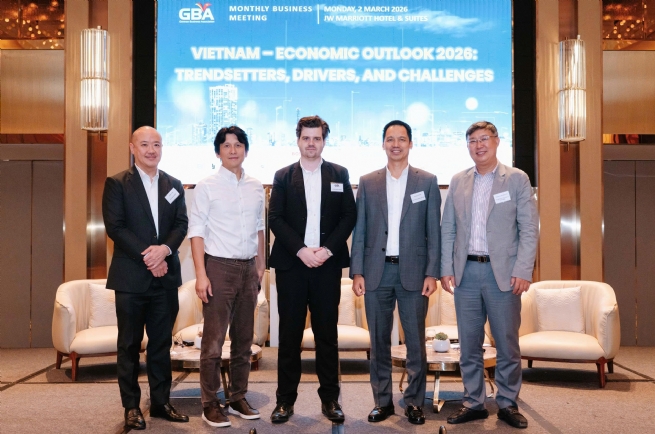
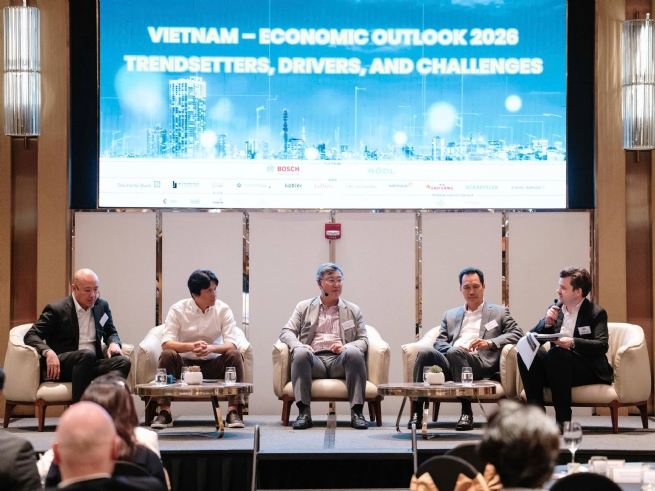
Against this backdrop, the German Business Association in Vietnam (GBA) successfully hosted a GBA Monthly Business Meeting on 2 March 2026, chaired by Mr. Alexander Ziehe, Chairman of GBA and Vice President of Hettich Group. The discussion brought together leading economic experts to share diverse perspectives on Vietnam’s macroeconomic outlook and the strategic implications for the international business community.
Vietnam in a Rapidly Changing Global Economy
Opening the discussion, Mr. John Low, Managing Partner Southeast Asia at Roland Berger, highlighted that the global economy is currently being shaped by several major trends, including geopolitical fragmentation, increasingly selective capital flows, technological disruption, and stricter sustainability standards.
While Vietnam continues to benefit from the global supply chain diversification trend, Mr. Low emphasized that the next phase of development will require deeper structural progress:
“Vietnam has been winning relocation, but the next phase requires winning in value addition and ecosystem depth within the newest wave of regionalization.”
According to Mr. Alexander Ziehe, three strategic priorities are essential for Vietnam moving forward:
High Growth Requires Structural Reforms
From a macroeconomic perspective, Mr. Nguyen Xuan Thanh, Senior Lecturer at Fulbright University Vietnam, noted that Vietnam’s high growth target reflects the government’s strong commitment to accelerating economic reforms.
However, sustaining high-quality and long-term growth will require continued improvements in institutional reform, policy implementation efficiency, labor productivity, and the development of a stronger domestic private sector.

Mr. Ziehe further emphasized: “I believe this ambitious target is not just a simple KPI, but a true commitment for the acceleration of reforms. What matters most for investors is not whether Vietnam hits an exact percentage, but whether the country delivers the reform linked to this ambition: stronger institutions, smoother implementation, productivity gains, and a more dynamic domestic private sector.”
From Assembly Hub to Value Creation
A key theme throughout the discussion was Vietnam’s evolving role in global supply chains.
Speakers agreed that while Vietnam has successfully attracted manufacturing relocation amid global supply chain restructuring, the next stage of development will require the country to increase value creation and build deeper industrial ecosystems.
According to Mr. Ziehe, this transformation will depend on three key factors: strengthening domestic supplier capabilities, moving into higher-value manufacturing activities, and investing heavily in infrastructure and technical workforce development. If these elements are successfully implemented, Vietnam can move beyond its role as a low-cost assembly base and become a high-value, reliable partner within regional supply chains.
Infrastructure as a Catalyst for the Next Growth Cycle
From an investment perspective, Mr. Pham Tuan Anh, Executive Director of Dragon Capital, highlighted the critical role of large-scale infrastructure investment in transportation and energy as a foundation for Vietnam’s next growth cycle.
Major projects such as highways, railways, seaports, and new energy systems are expected to significantly improve national connectivity, reduce logistics costs, and support industrial expansion. However, he also noted that the effectiveness of these investments will depend heavily on implementation speed, policy clarity, and efficient capital management.
Mr. Alexander Ziehe noted that international capital flows into and out of Vietnam remain an area of particular interest for many FDI investors, as the legal framework related to investment and profit repatriation continues to be refined and updated.
“Vietnam still has meaningful growth drivers: strong exports, ongoing FDI, domestic demand recovery, and importantly, large infrastructure spending that supports long-term competitiveness. The risk is real, but it’s best described as a speed limiting factor, not a derailment, provided policy remains credible and execution continues.” he noted.
Strengthening German–Vietnamese Economic Cooperation
Through initiatives such as the GBA Monthly Business Meeting, the German Business Association continues to serve as an important platform for dialogue between the German business community and leading economic experts.
“Vietnam’s next phase of development will be shaped by productivity, technology, and deeper industrial ecosystems. The German business community stands ready to remain a long-term partner in Vietnam’s journey ahead”, Mr. Alexander Ziehe shared.
He also shared that the German Business Forum is planned to take place in Vietnam this October, creating another key platform to promote economic dialogue and business connections between Germany and Vietnam.
Source: Vietnam Business Forum


 Vietnamese




