

9:24:34 AM | 4/1/2026

As Vietnam moves toward establishing an International Financial Center (IFC), developing a derivatives commodity trading market is considered an important step to improve market transparency, help businesses manage price risks, and attract international investment capital.
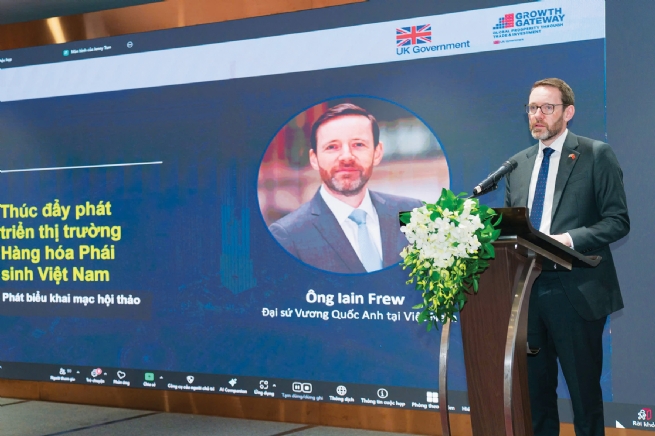
UK Ambassador to Vietnam Iain Frew addresses the event
To support the development of Vietnam’s derivatives commodity trading market, the British Embassy and the British Consulate General in Vietnam recently worked with Boston Consulting Group to organize a capacity-building session to strengthen UK–Vietnam cooperation.
Laying the groundwork for a derivatives commodity market
In his opening remarks at the event, Deputy Minister of Industry and Trade Nguyen Sinh Nhat Tan said Vietnam is moving toward building an IFC capable of connecting with regional and global markets. Within this orientation, the derivatives commodity trading market is considered an important instrument to improve market transparency, help businesses manage price risks, and attract international investment flows.
According to Deputy Minister Nguyen Sinh Nhat Tan, the Government has issued Decree 330/2025/ND-CP regulating the establishment and operation of commodity exchanges within the IFC in Vietnam. The decree creates a flexible legal framework aligned with international practices while providing for an independent clearing center model to strengthen system safety and improve risk management capacity.
In practice, Vietnam’s derivatives commodity trading market has gradually expanded. In 2025, total trading volume reached about 1.54 million contracts, an increase of more than 34% compared with the previous year, with total transaction value estimated at more than VND1,900 trillion (US$76 billion). This result shows improving market liquidity while reflecting rising demand among businesses for derivatives instruments to hedge price fluctuations.
However, the link between derivatives trading and the domestic physical commodity market remains limited. Therefore, in the coming period, Vietnam plans to gradually pilot physical commodity trading through exchanges for several key commodities. The implementation of this model is expected to help establish domestic reference prices while strengthening Vietnam’s role in price formation in international markets.
The event was designed with four thematic sessions focusing on key aspects of commodity and derivatives market development. During the discussions, experts analyzed the overall landscape of the global commodity market, shared experience from representative development models, and assessed Vietnam’s position in the process of integrating with international financial markets.
Participants also discussed market structure design, including exchange models, the operating mechanisms of clearing centers, the legal framework, and trading product portfolios suitable for Vietnam’s practical conditions. Risk management and market supervision were also discussed, with international experience shared to strengthen governance capacity when implementing the derivatives market.
Advancing international cooperation to expand the commodity trading ecosystem
Within the Growth Gateway program, the UK Government, Vietnam’s Ministry of Industry and Trade (MoIT), and Boston Consulting Group have carried out comparative research, professional training, and partnerships with leading UK exchanges, clearing centers, and technology providers.
The UK is home to internationally recognized financial institutions such as the London Metal Exchange, ICE Futures Europe, and GMEX Group. These organizations are widely regarded as leading models for exchange governance and the operation of clearing systems under global standards.
The UK side affirmed its readiness to share practical experience to support Vietnam in building a market framework suited to domestic conditions while aligning with international practices.
An important step in this process was the Vietnamese Government’s issuance of Decree 330/2025/ND-CP, which establishes a legal framework for commodity exchanges operating within the IFC. The decree expands the list of trading products to include agricultural commodities, energy, metals (excluding gold), carbon credits, and certain digital assets, while clarifying the mechanisms for spot and derivatives contracts.
Under the development orientation, from 2026 Vietnam plans to pilot physical commodity trading for several key agricultural products, combining spot, forward, and derivatives contracts in a flexible manner. This model is expected to connect production regions with exporting enterprises, processing companies, logistics services, warehousing, banks, and investors, thereby forming a comprehensive market ecosystem centered on commodity exchanges.
Speaking at the event, UK Ambassador to Vietnam Iain Frew commended the role of the MoIT in studying international standards and promoting institutional reform to develop the derivatives commodity trading market.
According to him, Vietnam has strong advantages to become one of the region’s attractive centers for commodity and derivatives trading. Ambassador Iain Frew also expressed hope that the UK will continue accompanying Vietnam in developing the IFC and building a modern, transparent commodity market closely connected with global markets.
By Hien Quyen, Vietnam Business Forum


 Vietnamese





