3:07:59 PM | 9/7/2026

Today, a truly seamless travel experience is no longer defined solely by scenic attractions, service quality or luxury accommodation. For many international travelers, particularly younger generations and frequent travelers, the experience begins the moment they book a room, hail a ride, purchase an attraction ticket or pay for a meal quickly, conveniently and seamlessly.
According to Visa’s 2026 Global Travel Intentions Study, travelers across the Asia-Pacific region are increasingly prioritizing destinations that offer familiarity, flexibility and seamless digital payment experiences throughout their journey. This is one of the factors contributing to Vietnam’s continued rise as an attractive destination in the region.
If payment was once simply the final step in a transaction, it has now become an integral part of the travel experience. A journey may begin with booking a flight or hotel, ordering a ride, purchasing an attraction ticket, enjoying local cuisine and shopping, all connected by seamless payment transactions.
As a result, the ability to make payments quickly, securely and without interruption is increasingly becoming a measure of a destination’s modernity and competitiveness. This is also why many countries have incorporated digital and cross-border payment infrastructure into their tourism development strategies.
According to data from the National Statistics Office under the Ministry of Finance, Vietnam welcomed more than 13.9 million international arrivals in the first seven months of 2026, up 13.8% year on year. China remained the largest source market, with approximately 3.1 million arrivals, followed by South Korea with 2.4 million. Notably, arrivals from Russia surged by 174%, making it Vietnam’s largest European source market.
Alongside the recovery of traditional markets, Vietnam is also seeing an increase in visitors from the United States, Australia and European markets characterized by relatively high spending, longer stays and widespread adoption of digital payments in everyday life.
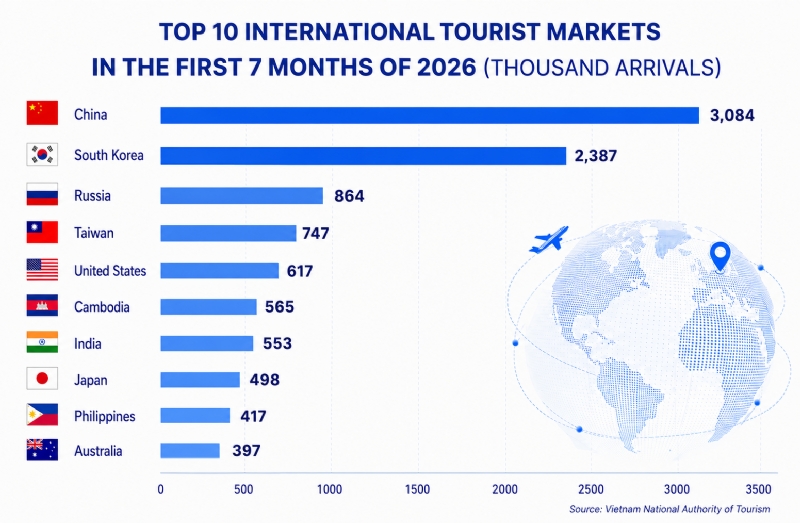
Top 10 international visitor markets in the first seven months of 2026
This shift is taking place alongside two major trends in global tourism: Bleisure, which combines business travel with leisure, and Experiential Travel. Rather than traveling solely for business or leisure, an increasing number of travelers are combining the two, using their trips to explore local culture, cuisine and everyday life.
This behavior is making travel journeys longer, more flexible and more geographically dispersed in terms of spending.
According to Visa, 37% of Asia-Pacific travelers prioritize culinary experiences and exploring destinations the way locals do, significantly higher than the global average of 29%. This means spending is taking place across a broader range of touchpoints from dining at local restaurants and shopping in neighborhood areas to using public transportation and exploring destinations beyond traditional tourist routes.
Along this journey, a seemingly simple need can make a significant difference: being able to pay using a familiar payment method, even when traveling in another country.
Across Asia, the demand to “Pay Like a Local” is driving the development of cross-border QR payment models. Instead of exchanging currency, finding an ATM, downloading another app or learning a new payment method, travelers can use the banking app or e-wallet they already use at home to pay at their destination.
Across markets, the model is evolving from “one QR system per country” toward greater interoperability, enabling a single application to scan and pay via QR codes across multiple countries while reducing friction in cross-border transactions.
From a traveler’s perspective, “Pay Like a Local” means not having to change payment habits simply because they are in another country. The experience is familiar, convenient and increasingly seamless, allowing travelers to focus on discovering the destination rather than navigating unfamiliar payment processes.
For businesses, particularly small merchants, cross-border QR payments create an opportunity to serve international customers at a broader range of touchpoints, including local restaurants, retail stores, tourist attractions and other businesses that have traditionally relied heavily on cash.
Alongside China, Thailand, Cambodia, Laos, South Korea and Singapore, Vietnam is emerging as one of the markets actively advancing this model. Banks, payment intermediaries, NAPAS and their partners have expanded cross-border payment connectivity through VietQR Global, enabling international visitors to use familiar payment applications to pay while traveling in Vietnam.
According to Vu Ngoc, COO of 9Pay, the company implementing VietQR Global, cross-border QR payments are only the starting point in building a payment ecosystem designed around the needs of international travelers: “In the future, Scan-to-Pay models and digital currencies could open up new ways of transacting as the regulatory framework evolves. What matters is not simply adding another payment method, but building an ecosystem broad enough to give international travelers a seamless experience at every touchpoint throughout their journey, encourage longer stays and increase spending in Vietnam.”

Vu Ngoc, COO of 9Pay: “9Pay aims to build an ecosystem broad enough to give international travelers a seamless experience at every touchpoint throughout their journey, encourage longer stays and increase spending in Vietnam.”
Against this backdrop, businesses with flexible payment infrastructure and diverse international connectivity will be better positioned to support the tourism industry.
A representative of 9Pay also said the company is continuing to explore and expand QR-based payment solutions for travel businesses and payment partners in markets with significant visitor potential, including the United States, Europe and India. The aim is to create increasingly diverse connections between international travelers and Vietnam’s broader tourism and service ecosystem.
LA (Vietnam Business Forum)