2:27:11 PM | 11/4/2026

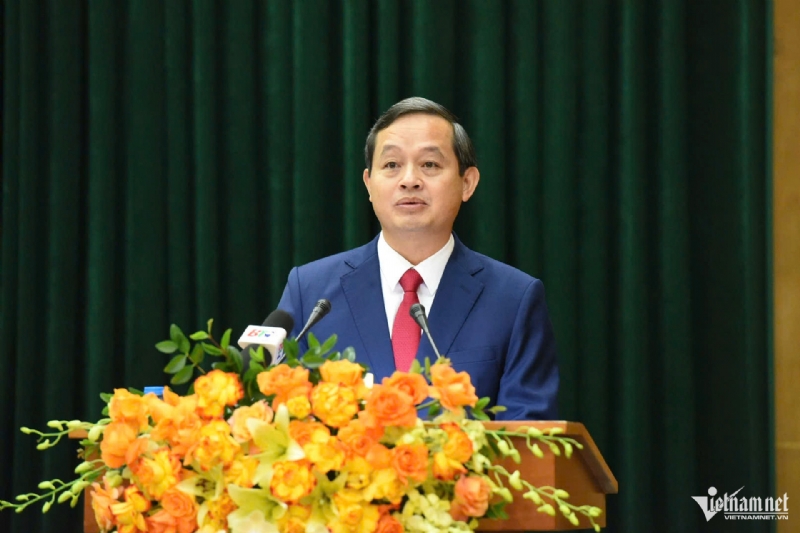
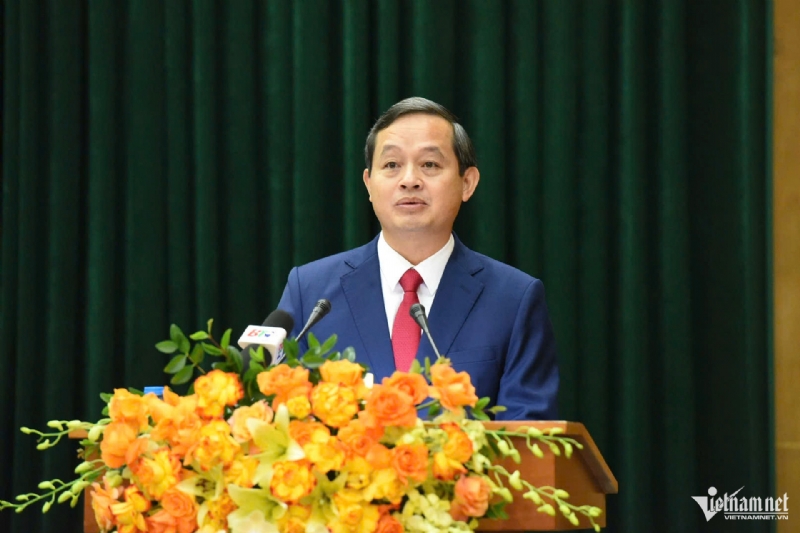
With an investment and business environment that has been highly rated by enterprises for many years, Bac Ninh is setting higher requirements for its new development phase: turning existing advantages into standards, and standards into competitive advantages. Pham Hoang Son, Chairman of the Bac Ninh City People's Committee, shared how the city plans to achieve this goal.
As a centrally run city facing high growth requirements, what new requirements does Bac Ninh face in improving quality and setting new standards for its investment and business environment?
Bac Ninh identifies the investment and business environment as the foundation of competitiveness and a driving force for growth. Entering a new phase, the city must not only maintain its existing advantages but also raise them to higher standards suited to its new development space and level of integration.
The focus is shifting from "management" to "serving and enabling development." The administration must proactively remove bottlenecks and accompany enterprises from exploring opportunities, preparing projects, and completing procedures through to production, investment expansion, technological innovation, and sustainable development. Enterprises and citizens are placed at the center, with satisfaction serving as one of the benchmarks for the quality of the administrative apparatus. This is also the consistent direction of the administrative reform program for 2026-2030.
Along with this is improving institutional quality and execution capacity. In the competition to attract investment, incentives are no longer the sole advantage. Bac Ninh must compete through transparent institutions, consistent policies, and the capacity to resolve matters quickly and efficiently. The city will continue to cut unnecessary procedures and processes; promote decentralization and delegation of authority tied to responsibility; digitize processes and expand online public services. In 2026, the city aims to place the Provincial Competitiveness Index (PCI) among the top five localities, while shortening processing times for key projects and creating favorable conditions for enterprises to access land and capital.
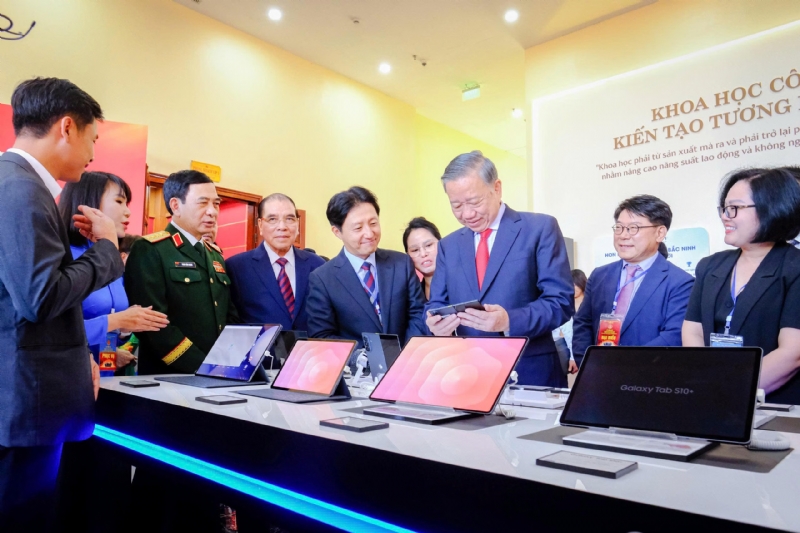
Party General Secretary and President To Lam and other delegates visit the exhibition celebrating the announcement of the National Assembly’s Resolution on the establishment of Bac Ninh City and the presentation of the First-Class Labor Order
Investment attraction is also shifting from prioritizing quantity and scale to quality, technology, greenness, and sustainability. Bac Ninh prioritizes semiconductors, microchips, AI, green energy, innovation, and R&D centers, while also developing the private sector, small and medium-sized enterprises, and innovative enterprises to build a balanced, sustainable business ecosystem.
Another requirement is to make breakthroughs in strategic infrastructure and multimodal logistics, viewing infrastructure as a new competitive advantage. Bac Ninh focuses on improving transportation, industrial zones, urban areas, logistics, and connections with national transport routes, seaports, and airports; developing multimodal logistics, modern warehousing, digital applications, and AI in supply chain management; mobilizing social resources and promoting public-private partnerships.
Based on these requirements, what standards is Bac Ninh setting for its investment and business environment, and how are they defined through specific criteria and benchmarks?
Bac Ninh determines that the new standards are not simply about faster procedures or attracting more projects, but about raising the quality of the entire ecosystem serving enterprises and investors: from "management and licensing" to constructing, serving, and supporting; and from competing through incentives to competing through institutions, transparency, and execution capacity.
Accordingly, Bac Ninh focuses on transparency, stability, and predictability; speed, convenience, and low cost; digitization independent of administrative boundaries; proactive accompaniment; equality, greenness, and innovation.
These standards are quantified through targets of 100% of enterprise-related procedures being conducted online; placing the index serving citizens and enterprises among the top three localities; and applying a "24-hour green lane" and "60% green lane" for key projects, alongside requirements to maintain the PCI among the leading group and substantively improve indicators on transparency, access to resources, compliance costs, fair competition, and business support.
The foundation for raising these standards is clear: in the 2025 PCI, Bac Ninh ranked among the top five localities; ranked first nationwide in Time Costs and Regulatory Compliance (8.93 points) and Proactive Governance Index (6.67 points); and ranked among the top four localities in both Entry Costs and Legal Institutions.
Building on this foundation, Bac Ninh aims to achieve higher standards of governance quality, consistency in execution, and long-term development value for enterprises.
To make these new standards a reality, how will the Bac Ninh government change its approach to policymaking, implementation, and resolving matters with enterprises and investors, and how will these changes be measured?
New standards are measured through three reductions: time, procedures, and compliance costs; and three increases: transparency, predictability, and the level of government support.
Regarding procedures, the goal is for 100% of enterprise-related procedures to be conducted online and 100% of procedures to be independent of administrative boundaries. Key projects will be handled through a 24-hour green lane, shortening processing time by 60%. In 2025, 90.74% of enterprises reported shorter processing times; 96.06% encountered no difficulties when using online services; 93.60% saved time and 96.03% saved costs. The score for procedure processing progress reached 19.75/20, online service quality 11.69/12, and document digitization 21.48/22.
Regarding execution, 90.74% of enterprises assessed officials as friendly, while 85.19% rated work resolution as effective. The next requirement is to ensure consistent quality across departments, sectors, and 99 communes and wards.
Regarding government support, in 2025, the Proactive Governance Index reached 6.67 points, ranking first nationwide; 81.60% of enterprises assessed the administration as dynamic and creative; 83.05% trusted leaders to fulfill their commitments to improve the business environment; and 76.23% said bottlenecks were resolved promptly through dialogue.
The ultimate benchmark is the actual experience of enterprises: less time and lower costs; simpler procedures; more transparent information; easier access to government; and faster processing of petitions.
Over the course of its development, a favorable investment and business environment has become part of Bac Ninh's "identity." As a centrally run city, how will Bac Ninh promote and strengthen this "identity" to create a distinct mark among enterprises, investors, and the international community?
Bac Ninh has gradually built an image of a dynamic and receptive locality that accompanies enterprises, viewing their success as the locality's success. The National Assembly's decision to establish Bac Ninh as a centrally run city, effective September 20, 2026, is not only an administrative milestone but also opens up new development space while setting higher requirements for governance, growth quality, and competitiveness. Therefore, Bac Ninh must not only maintain its existing "identity" but also elevate it into a new competitive advantage.
This is first reflected in innovating governance methods, building digital government, and serving and enabling development. Bac Ninh continues to shift from "management and procedural resolution" to serving, accompanying, and enabling development, with enterprises and citizens at the center. Every shortened procedure, simplified process, and resolved bottleneck must become proof of Bac Ninh's investment environment.
The city is also promoting digital government, digital data, and shared platforms, while restructuring processes toward greater transparency, speed, convenience, and measurability.
Along with governance innovation is a shift in the growth model and the development of a high-tech industrial and innovation ecosystem. Bac Ninh is not only concerned with how many more projects it can attract, but more importantly, how projects generate added value and spillover effects for the economy and domestic enterprises. The city prioritizes advanced technology and green projects capable of deep integration into global value chains, while promoting semiconductors, AI, digital industries, green industries, clean energy, and supporting industries. The goal is not only to become a location for factories of major corporations, but to form an ecosystem connecting FDI, domestic enterprises, small and medium-sized enterprises, institutes, universities, and innovation centers.
Another foundation is green, smart, and synchronized infrastructure. As a centrally run city, Bac Ninh has the conditions to reorganize its development space toward a multi-center, modern, green, and smart model, while strengthening connections among urban areas, industrial zones, logistics, services, and production regions.
Bac Ninh is focusing on inter-regional transport infrastructure and logistics, strengthening connectivity with Hanoi, Hai Phong, Quang Ninh, Lang Son, and major economic centers, while implementing the orientation for Gia Binh International Airport.
Investors coming to Bac Ninh must see a complete ecosystem: modern infrastructure, convenient logistics, quality services, livable urban areas, skilled human resources, and an accompanying government.
In this regard, Bac Ninh continues to build a contingent of capable, responsible, and professional officials who stay close to citizens and enterprises, uphold the responsibility of heads, and embrace the spirit of daring to think, daring to act, and daring to take responsibility for the common interest. In particular, Bac Ninh considers high-quality human resources a component of its investment attraction policy, increasing training in digital skills, modern management, new technologies, and skills based on enterprise demand, ready to support new industrial sectors.
From this, Bac Ninh's new "identity" is reflected in dynamism in investment attraction, professionalism in governance, transparency in action, modernity in infrastructure, greenness in development, innovation in technology, and substance in accompanying enterprises.
If there is one distinct message Bac Ninh wants to convey to the business community and international investors, it is clear: "Bac Ninh is not only a place where enterprises come to invest, but a place where enterprises can invest with confidence, develop for the long term, and shape the future together with Bac Ninh."
Thank you very much!
Ngo Khuyen, Vietnam Business Forum