

10:11:34 AM | 4/2/2026

As Lao Cai works toward becoming a growth pole and a trade connectivity hub for the Northern midlands and mountainous region, the province’s industry and trade sector has continued to strengthen its role as a pillar of the economy. With a development approach focused on green growth, modernization, and integration, the sector has maintained steady industrial expansion while also opening greater opportunities for border-gate economic activities, logistics services, and the attraction of high-quality investment.
Industrial foundation
Entering 2026, Lao Cai’s industry and trade sector faces the dual task of accelerating development while restructuring more deeply to adapt to the new development landscape following administrative consolidation.
Looking back at 2025, despite a challenging economic environment, the sector achieved encouraging results, particularly in industry. Industrial production value reached an estimated VND75,000 billion (US$3 billion), nearly 20% higher than the previous year and meeting 100% of the planned target. The sector remained a central pillar, providing the foundation for the province’s GRDP growth.
According to Hoang Chi Hien, Director of the Lao Cai Department of Industry and Trade, these results came from the recovery of major manufacturing enterprises, along with sustained high prices for key industrial products such as gold, copper, and yellow phosphorus. The sector also worked with provincial authorities to address bottlenecks related to raw materials, land access, energy supply, and investment procedures, enabling several major projects to begin operations earlier than expected.
Beyond expanding in scale, Lao Cai has gradually shifted its industrial model from raw resource extraction toward deep processing, circular economy practices, and green industry, viewing this transition as the path toward long-term sustainable development.
Border-gate economy - A strategic growth driver
Alongside industry, trade and import-export activities have been identified as areas that can drive stronger growth for Lao Cai in the coming years. In 2025, the sector implemented practical measures to facilitate trade flows.
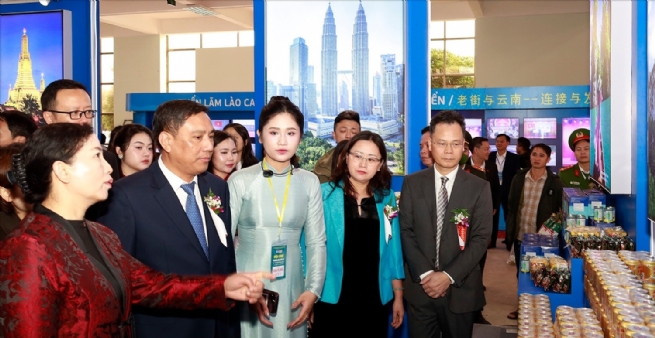
One key step was stronger coordination with authorities in Yunnan province (China), effectively applying a “priority lane” mechanism for agricultural products at Kim Thanh-Bac Son border gate. The Vietnam-China International Trade Fair was also successfully organized with 500 booths, where 16 deals worth US$330 million were signed directly at the event.
The province has set a target of US$6.1 billion in import-export turnover for 2026, nearly double the level recorded in 2025, reflecting a clear determination to make the border-gate economy a main growth driver.
An important part of the sector’s development strategy has been linking trade expansion with infrastructure investment and institutional reform. Strategic transport projects such as the Lao Cai-Hanoi-Hai Phong standard-gauge railway, the Bat Xat-Ba Sai border bridge, and the rollout of the digital border gate system, moving toward a smart border gate model, are creating opportunities to reduce logistics costs, shorten customs clearance time, and improve business competitiveness.
At the same time, Lao Cai has accelerated preparations for the Cross-Border Economic Cooperation Zone project, which aims to apply advanced management mechanisms and create conditions to attract processing and manufacturing investment directly in the border area, thereby increasing the value of traded goods.
Facilitating new industrial investment
To meet the target of GRDP growth above 10%, the provincial industry and trade sector has identified the creation of at least 500 ha of cleared industrial land as a key task for 2026. A series of new industrial parks and clusters, including Coc My-Trinh Tuong, Ban Qua, Vo Lao, Bao Minh, Bao Hung 2, and An Thinh, are moving ahead with faster procedures, along with the development of technical infrastructure and environmental preparations.
These new industrial zones are being planned under the ecological industrial park model, prioritizing high technology and environmentally friendly production in line with the province’s green growth strategy. The industry and trade sector has committed to supporting investors from the initial survey stage until cleared land is ready, viewing investor success as a measure of administrative effectiveness.
From the first days of 2026, production and business activities across the province have gained strong momentum. Factories, industrial zones, and border gates have begun the year with urgency and determination. Commodity markets remain stable, supply is abundant, and coordinated market management and price stabilization measures have helped strengthen confidence within the business community.
Ngo San - Tran Cong (Vietnam Business Forum)


 Vietnamese





