

11:03:21 AM | 4/28/2026

As a major industrial hub, Bac Ninh is entering a new phase of development focused on high technology and innovation. According to Pham Van Thinh, Vice Chairman of the Provincial People’s Committee, completing infrastructure, advancing administrative reform, and improving workforce quality provide the foundation to reinforce Bac Ninh’s position as a strategic and trusted destination for investors.
Amid intensifying competition for investment, how will Bac Ninh choose its growth model and FDI strategy to sustain high growth while increasing technological content, value added, and spillover effects?
Bac Ninh holds a strategic location in the northeast of the Hanoi Capital Region, within the Red River Delta and at the heart of Northern Vietnam, along key economic corridors such as: North-South (Bac Ninh-Hanoi-Ninh Binh), Lao Cai-Hanoi-Quang Ninh, Hanoi-Lang Son-China, Hanoi-Hai Phong-Quang Ninh, Hanoi-Thai Nguyen-Cao Bang, and Lao Cai-Hanoi-Hai Phong. The province serves as a regional connectivity hub with a green, clean industry, urban, services, and logistics base, and as an “industrial capital” with a large-scale ecosystem in electronics, precision components, and semiconductors, generating spillover effects and value chains with hundreds of satellite enterprises.
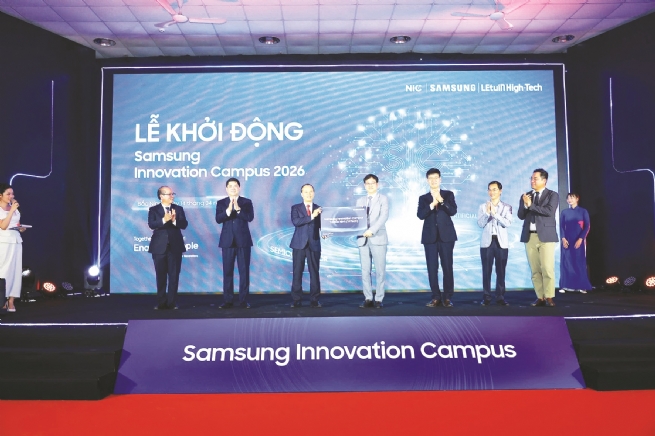
Samsung presents the Samsung Innovation Campus High-Tech Talent Development Center to Bac Ninh province, April 14, 2026
Its strategic infrastructure system has been developed in a coordinated, modern, multimodal way, connecting both domestically and internationally. A centerpiece is the large-scale Gia Binh International Airport, designed to 4F standards and aiming for five-star quality, while the province is also close to Noi Bai, Van Don, and Cat Bi airports and about 110 km from Hai Phong and Cai Lan seaports. The transport network includes three expressways, eight national highways totaling over 432 km, 37 provincial roads spanning more than 813 km, Ring Roads 4 and 5, international intermodal railways and high-speed rail lines under development, as well as inland waterways linked to the sea.
The province prioritizes planning and developing industrial land, expanding production space, and attracting secondary investment. It has planned 52 industrial parks (IPs) covering 16,138 ha and expects to add around 20 more with over 5,000 ha. Of these, 39 IPs have been approved with a planned area of 11,751 ha, of which about 4,363 ha have been leased, reaching an occupancy rate of 53.76%. Infrastructure within the IPs continues to be upgraded, ensuring convenient connections to seaports, border gates, railway stations, and key transport routes.
In addition, the province has an abundant, high-quality workforce, with a population exceeding 3.6 million and a labor force of around 1.8 million. The trained labor rate has reached 80%, of which approximately 40% hold degrees or certificates, concentrated in digital transformation, automation, electrical and electronics engineering, high technology, and semiconductors.

Bac Ninh’s economic development remains closely linked to its cultural identity
On that basis, the province has chosen a new growth model driven by science, technology, innovation, and digital transformation, focusing on attracting high-tech, green, digital, and data-driven industries, while developing foundational, strategic, and emerging sectors aimed at mastering core technologies and increasing value added.
Priority sectors include AI, robotics, 5G, blockchain, and unmanned aerial vehicles, closely linked to the development of industrial parks, clusters, and innovation centers, positioning Bac Ninh as a northern hub for semiconductor manufacturing, supporting industries, and artificial intelligence.
The province seeks stronger cooperation with Korean enterprises in areas such as smart manufacturing, high technology (semiconductors, AI), digital transformation, green energy, supply chain development, and sustainable growth; shifting from manufacturing and assembly toward workforce training, research, development, and innovation, while expanding into cultural industries, healthcare, and smart urban development.
With the goal of becoming a regional center for manufacturing and innovation, which core elements of the investment environment and development ecosystem will Bac Ninh build and operate to create a clear competitive advantage, not only to attract but also to retain and support investors?
The province focuses on the following key tasks and elements:
(1) Reviewing and adjusting the Provincial Master Plan for 2021-2030, with a vision to 2050; preparing the Bac Ninh Urban Master Plan to 2050, with a vision to 2075, ensuring alignment with regional and national planning and creating new development space and capacity.
(2) Concentrating resources on economic restructuring toward high-tech industry, green industry, supporting industries, and the digital economy; building a modern industrial ecosystem linked with innovation and deeper participation in global value chains. The province has issued Plan 109/KH-UBND on the technology innovation roadmap to 2035 and Plan 144/KH-UBND on digital economy and digital society development for 2026-2030, with the goal of becoming a high-tech industrial center, a smart urban area, and a leading locality in digital transformation.
(3) Continuing to invest in coordinated, modern, multi-dimensional infrastructure, focusing on interregional, interprovincial, and international transport routes such as Gia Binh International Airport, the Hanoi connection route, Ring Roads 4 and 5, and the Lao Cai-Hanoi-Hai Phong and Hanoi-Lang Son-Quang Ninh-Mong Cai railway lines, among others. At the same time, developing industrial parks, large urban areas, modern logistics systems, and ICD ports.
(4) Treating private sector development, strengthening the capacity of domestic enterprises, increasing localization rates, and reinforcing linkages between FDI and local firms as a key driver.
(5) Accelerating comprehensive digital transformation across government, businesses, and society, seen as the “soft infrastructure” of the new growth model, helping to raise labor productivity, reduce costs, and improve competitiveness. At the same time, building a facilitating, service-oriented government centered on citizens and enterprises, with stable, transparent, and predictable policies to build investor confidence.
(6) Developing a high-quality workforce as a foundation for improving technology absorption capacity and participation in global value chains.
(7) Ensuring coordinated development of living conditions, including healthcare, education, housing, urban services, and socio-cultural institutions, to attract and retain experts and workers.
These solutions are being implemented in a coordinated, consistent, and focused manner, thereby strengthening not only investment attraction capacity but also creating a foundation for investors to confidently expand operations, commit for the long term, and contribute to sustainable development.
Within FDI Connect Forum 2026, what specific commitments will Bac Ninh make on administrative reform, coordination, and government accountability to shorten processing times and ensure transparent, consistent policy implementation?
Bac Ninh is accelerating institutional reform, streamlining its organizational structure, and improving the quality of its cadre, civil servant, and public employee workforce. The province is also strictly enforcing codes of conduct based on civility, courtesy, responsibility, and dedication to promote professionalism, accountability, and integrity in public service.
The province is committed to reducing and simplifying administrative procedures so they are concise, clear, accessible, and fast, while ensuring public disclosure and transparency of administrative processes. At the same time, it is strengthening connectivity and data sharing between provincial information systems and national databases on population, land, enterprises, and more. The province is also developing mobile public service applications to enable citizens and businesses to easily access information, complete procedures, and make online payments.
With the view that enterprise development goes hand in hand with the province’s development, Bac Ninh is committed to continuing to invest in and complete coordinated, modern strategic infrastructure; accelerate administrative reform; stand alongside, provide strong support for, and safeguard the legitimate interests of enterprises and investors, thereby continuing to affirm that “Bac Ninh is an attractive and trusted destination, where the spirit of cooperation, innovation, and long-term, sustainable development comes together.”
Thank you very much!
By Vietnam Business Forum


 Vietnamese





