

8:01:29 AM | 5/3/2026

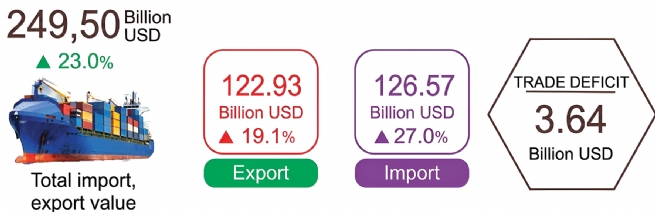
Vietnam’s trade surged, with total turnover reaching US$249.5 billion in the first quarter (Q1) of 2026. However, behind the 23% increase is a reversal in the trade balance, shifting from a surplus to a deficit of US$3.64 billion, reflecting changes in the production cycle and rising global geopolitical pressures.
Trade balance shifts as imports surge
According to the National Statistics Office (NSO) under the Ministry of Finance, in Q1 of 2026, Vietnam’s exports reached US$122.93 billion, up 19.1%, while imports rose to US$126.57 billion, up 27%. March saw a strong increase, with total trade reaching US$93.55 billion, up 39.2% compared with February.
The leading role of the foreign-invested (FDI) sector is becoming clearer. FDI exports reached US$98.46 billion, including crude oil, accounting for 80.1% of total export turnover and rising 33.3% year-on-year. In contrast, the domestic sector slowed, with exports falling 16.6% to US$24.47 billion. This raises concerns about the resilience and competitiveness of local enterprises amid market volatility.
By product group, processed industrial goods continued to lead with US$110.52 billion, accounting for nearly 90% of total exports. Notably, 20 products recorded export values above US$1 billion, with five key categories such as electronics, computers, phones, and machinery accounting for more than 62% of total export value.
The most notable development in Q1 2026 is the shift to a trade deficit of US$3.64 billion, compared with a surplus of US$3.57 billion in the same period last year. This change comes from faster import growth at 27%, compared with export growth of 19.1%. However, this is not necessarily a negative signal when considering the composition of imports.
Data shows that production inputs accounted for 93.9% of total imports, reaching US$118.84 billion. Of this, machinery, equipment, and spare parts made up 55.3%, while raw materials and fuels accounted for 38.6%. The sharp rise in imports of electronic components, up 50.5%, and machinery, up 22.6%, shows that businesses are actively preparing for large orders in the coming period.
Nguyen Thu Oanh, Director of the Service and Price Statistics Department at the NSO, said that the shift to a trade deficit mainly reflects rising demand for machinery, equipment, and raw materials to support production. Businesses are increasing input inventories to guard against supply chain disruptions and energy price volatility. The current trade deficit is short-term in nature and tied to the production cycle.
Responding to geopolitical pressures
Vietnam is facing dual risks, as geopolitical tensions in the Middle East disrupt supply chains and push up logistics costs. Rerouting shipments via the Cape of Good Hope has extended delivery times to the EU and the United States by 14 to 20 days, while container freight rates have risen to around US$4,000.
Amid these challenges, key export sectors such as seafood and textiles are adapting through diversification strategies. The seafood industry recorded growth of 13.3%, reaching US$2.62 billion, despite transport risks in the Middle East market. Meanwhile, the textile and garment sector reached US$8.8 billion in Q1, laying the groundwork for its US$50 billion target in 2026.
Experts say that leveraging free trade agreements such as the EU Vietnam Free Trade Agreement (EVFTA) and the Comprehensive and Progressive Agreement for Trans-Pacific Partnership (CPTPP) remains a key driver. At the same time, the shift toward green standards and investment in ESG (Environmental, Social, and Governance) practices is moving from a choice to a requirement for accessing high-end markets.
On the policy side, support measures such as simplifying origin certification procedures and a proposal by the Ministry of Finance to cut import tariffs on gasoline to 0% are helping ease cost pressures for businesses.
Truong Van Cam, Vice Chairman of the Vietnam Textile and Apparel Association, said the industry needs to focus on improving growth quality by developing domestic raw materials, upgrading products, and increasing value addition.
According to experts, the US$3.64 billion trade deficit is not a setback but a necessary step to build internal capacity for the next growth cycle. However, the heavy reliance on the FDI sector, which accounts for 80% of exports, along with the 16.6% decline in the domestic sector, serves as a reminder of the need to strengthen control over raw material supply and accelerate localization. Despite challenges, the 2026 export target remains achievable if geopolitical pressures are turned into momentum for greener development and greater production self-reliance.
By Huong Ly, Vietnam Business Forum


 Vietnamese





