

11:18:46 AM | 12/4/2025

Multi-Stakeholder Convening in Hanoi Advances Technical Frameworks, Industrial Pilots, and Blended Finance Models for 10,000–16,300 MW Storage Target.
Vietnam sharpened its national energy-storage roadmap this week as government leaders, technical agencies, utilities, and industrial operators aligned on the next phase of Battery Energy Storage Systems (BESS) deployment.
The three-day convening held December 1-3 brought together stakeholders to review policy progress, technical findings, and financing pathways shaping Vietnam's storage pipeline through 2030. With the revised Power Development Plan VIII targeting 10,000–16,300 MW of storage by 2030, sessions focused on translating policy frameworks into investable projects and replicable business models. Toward the 2050 vision, Vietnam aims to reach approximately 96 GW of battery storage (BESS) capacity.
To advance this goal, EVN is considering assigning its five Power Corporations to deploy around 1,200 MW of BESS. Recent policy instruments have established pricing methodologies and requirements for renewable-paired storage, signaling regulatory momentum. A forthcoming Circular on electricity-service pricing for BESS, anticipated in late 2025 or early 2026, is expected to provide additional clarity for investors evaluating Vietnam's emerging storage pipeline.
"The Ministry of Industry and Trade is working systematically to create the regulatory conditions needed for energy storage to become a practical, investable sector in Vietnam," said Mr. Tran Cao Thang, Officer of the Electricity Market & Power System Department, Electricity Authority of Vietnam. "These circulars establish pricing frameworks and integration requirements that give the market clear direction."

Participants engaged in a technical session on December 2, discussing Vietnam’s development orientation for grid integration, grid infrastructure, and BESS deployment under PDP8. The session highlighted new regulatory guidance and pathways for scaling storage solutions nationwide
Technical studies and pilots define market parameters
The Technical Working Group 3 meeting on Grid Integration and the BESS Task Force reviewed technical studies from the Institute of Energy on pricing mechanisms for grid-scale and distributed storage. Early pilots demonstrated practical applications: EVN Ha Noi's 50 MW/50 MWh project highlighted load-shifting and frequency-regulation capabilities, while case studies from Ho Chi Minh City and private developers like VinEnergo illustrated integration pathways for renewable-paired systems.
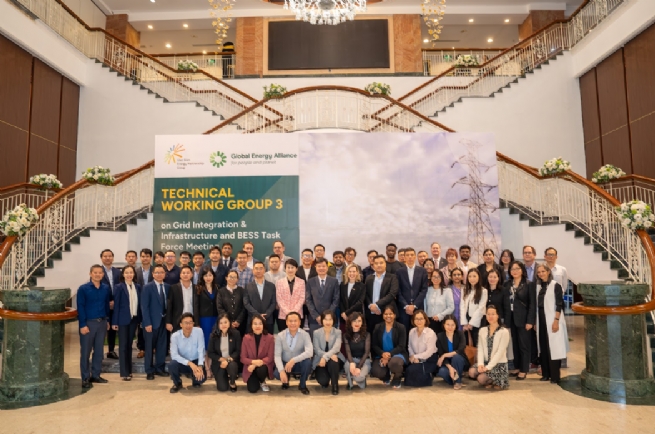
The third Technical Working Group, held on December 2, brought participants together to deepen alignment on grid integration, grid infrastructure, and BESS as Vietnam moves toward scalable energy-storage solutions
Industrial parks emerged as critical proving grounds. With manufacturers confronting peak-hour pricing pressures and supply-chain sustainability mandates, behind-the-meter BESS paired with mini-grid and rooftop solar is gaining commercial traction across Vietnam's nearly 400 industrial zones. This is expected to be one of GEAPP’s key priority models for accelerated support in 2026.
With the global trend toward reducing emissions across supply chains, adopting green energy solutions will become increasingly essential for manufacturers in Vietnam to maintain their competitive advantage in international markets.
"Industrial parks are becoming the proving ground for Southeast Asia's clean energy future," said Ms. Minh Nguyen, Vietnam Country Manager at the Global Energy Alliance for People and Planet. "Recently, we conducted a feasibility study and operating-cost assessment at a garment factory in the VSIP Hai Phong Industrial Park. The study demonstrates that behind-the-meter battery storage paired with solar is not only environmentally necessary but economically compelling for manufacturers seeking reliable, cost-stable power."
Catalytic capital to accelerate regional deployment
Blended and philanthropic capital emerged as essential levers for moving from analysis to deployment. Energy-storage projects continue to face long payback horizons and elevated early-stage development risks, making concessional finance critical to crowding in private participation.
"Vietnam has reached an inflection point where policy frameworks, technical capacity, and industry interest are converging," said Kitty Bu, Vice President for Southeast Asia at the Global Energy Alliance for People and Planet. "What's needed now is catalytic capital that can de-risk the first wave of projects and demonstrate viable business models."
The Global Energy Alliance for People and Planet is providing grant support for EVN Ha Noi's 50 MW/50 MWh utility-scale pilot and technical assistance for distributed storage projects, including the first 5 MW/10 MWh BESS project in Ho Chi Minh City, located in Tan Phu Trung Industrial Park. Platforms such as the Enhancing Access to BESS for Low-carbon Economies (ENABLE) initiative are being structured to support early pilots in Vietnam, Philippines, and Indonesia through risk-reduction instruments and technical assistance. At the same time, GEAPP is partnering with the Monetary Authority of Singapore to establish a fund that supports the retirement of coal-fired power plants, contributing to regional carbon-neutrality goals for 2030–2035.
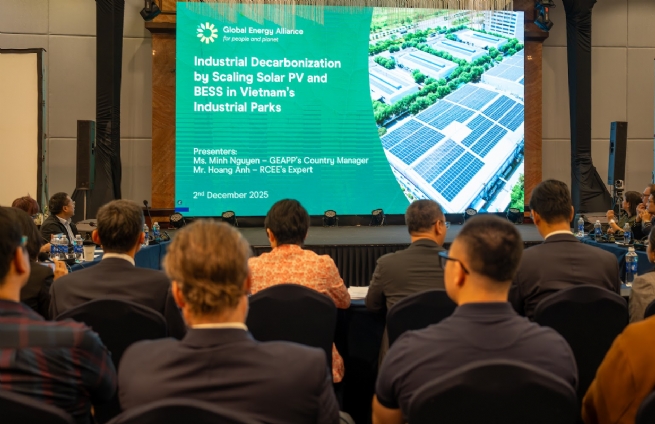
Experts from The Global Energy Alliance for People and Planet and RCEE shared how expanding solar PV and BESS across industrial parks can accelerate Vietnam’s decarbonization goals and support more reliable, future-ready manufacturing
Pilot projects like EVN Hanoi’s will serve as critical reference points for domestic banks to assess and finance future investments, laying the groundwork for scaling battery-storage deployment nationwide. Looking ahead, GEAPP plans to expand its support to additional projects such as the 40 MW Hai Anh Wind Power Plant, while working closely with development partners to incorporate international best practices.
Supporting green mobility
Alongside its work in industrial zones, GEAPP also highlighted its collaboration with major enterprises in the green-transport sector during the media roundtable on “Advancing Industrial Decarbonization through Energy Storage and Clean Power,” held as part of this week’s program. The Alliance have been partnering with Petrolimex, Vietnam’s largest fuel retailer, to pilot rooftop solar combined with battery storage at fuel stations along national highways, while also studying a battery-swap model for electric motorbikes in Hanoi, Ho Chi Minh City, and Da Nang. To date, two pilot projects in Hanoi have been launched in 2025 to support green mobility in alignment with the Government’s broader energy-transition strategy.
The partnership framework between GEAPP and Petrolimex also includes proposals to develop electric-motorbike battery-swap stations, primarily aimed at supporting delivery drivers and other high-mileage users, thereby strengthening the infrastructure ecosystem for electric motorbikes. The system, developed in collaboration with Selex Motors, uses battery packs compatible with approximately 70% of electric motorbike models currently on the market.
Regarding end-of-life battery management, GEAPP is working with the Ministry of Industry and Trade and EVN to study extended producer responsibility policies for battery collection and recycling. GEAPP will continue to propose technical solutions and lifecycle-management models in upcoming projects.
Path forward: Regulatory clarity and scaled pilots
The week's discussions pointed to a maturing ecosystem defined by stronger policy alignment, expanding technical evidence, and increasing government-industry collaboration. The forthcoming MOIT Circular is expected to provide pricing and service-mechanism guidance needed for both grid-connected and BTM systems. Ongoing initiatives with EVN, industrial operators, and technical partners are generating insights that will shape technical standards and investment approaches for larger-scale rollout.
As Vietnam moves into 2026, stakeholders believe the country is well-positioned to advance its next cycle of pilot projects, strengthen regulatory frameworks, and set a regional example for storage-enabled decarbonization.
By Vietnam Business Forum
 April 24–25, 2026
 Kinh Bac Cultural Center, Bac Ninh Province


 Vietnamese





