

10:47:18 AM | 4/29/2026

In 2025, profit rose 73%, the trade surplus reached US$300 million, and accumulated losses were fully cleared six months ahead of schedule. Vietnam National Chemical Group (Vinachem) is finalizing the cleanup of its balance sheet as it enters a new growth cycle. The next phase focuses on a green transition with clearly defined targets, creating room to attract sustainable investment capital.
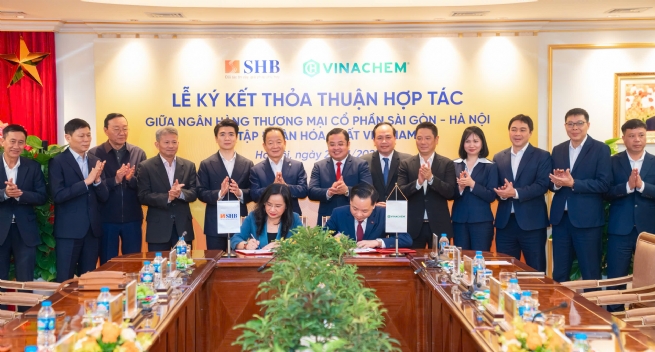
Vinachem and SHB sign a cooperation agreement marking a new milestone in the partnership between a key national chemical group and a leading joint-stock commercial bank
Post-restructuring acceleration, stronger financial foundation
The year 2025 marked a major shift for Vinachem as production and business indicators showed broad-based growth. Industrial production value increased 10.3%, revenue rose 8%, and profit surged 73%, reflecting the impact of a restructuring process carried out over several years.
A key milestone was the parent company’s full elimination of accumulated losses, achieved six months ahead of plan. Beyond a financial result, this cleaned up the balance sheet, creating room for Vinachem to strengthen capital mobilization and carry out long-term investment plans.
From a market perspective, import-export activity grew by more than 14%, with a trade surplus of about US$300 million, showing that the competitiveness of Vietnam’s chemical products is improving in international markets.
Amid deep restructuring, Vinachem maintained stable employment for nearly 20,000 workers, with average income exceeding VND16 million per person per month. This has supported its workforce foundation for the next phase of development.
These results came from decisive streamlining, including reducing 70 units, accelerating automation, and cutting nearly 2,900 indirect positions. Lower operating costs, combined with higher labor productivity, have significantly improved profit margins.
Member companies have largely stabilized after restructuring, with many moving from losses to profitability, gradually addressing debt and strengthening cash flow. At the same time, digital transformation in management and production has progressed, improving cost control and enabling more agile responses to market changes.

Green strategy drives long-term growth
With restructuring completed, Vinachem has shifted its focus to a green development strategy, seen as a driver of medium- and long-term growth.
Vinachem’s representatives said the green transition has become a strategic pillar, linked to a new growth model and stronger international competitiveness. It has set out a transition roadmap with specific targets: by 2030, reduce CO₂ emissions by at least 5% and raise the share of renewable energy to 5–10%; by 2050, cut emissions by at least 20% and move toward carbon neutrality.
To achieve these goals, Vinachem is advancing three main investment pillars. The first is transforming energy inputs, including rooftop solar development, biomass use, and research into new fuels such as LNG, green ammonia, and green hydrogen to reduce reliance on fossil fuels.
In parallel, production technologies are being upgraded, with a focus on overhauling energy-intensive lines, increasing automation, and optimizing operations. Energy-saving measures and waste heat recovery are also being implemented to reduce costs and emissions.
The third pillar is developing a circular economy, aimed at reusing waste and by-products across plants, thereby reducing environmental pressure and increasing economic value.
Vinachem is also exploring carbon-related technologies such as carbon capture, utilization, and storage (CCUS). At high-emission facilities such as urea plants, CO₂ can be used to produce methanol, soda, or alternative fuels, thereby opening new value chains from emissions themselves.
In addition, Vinachem is preparing to participate in carbon credit markets through renewable energy and fuel transition projects. As global carbon markets take shape, this represents a new avenue for long-term growth.
The green transition also presents challenges, particularly high investment costs and demanding technological requirements. However, as environmental standards tighten, this brings both pressure and an opportunity for Vinachem to strengthen its position and deepen its participation in global value chains.
With a strengthened financial foundation and a clear development strategy, Vinachem stands at the threshold of a new growth cycle, where value is driven not only by production scale but also by growth quality, technology, and the ability to adapt to green economic trends.
By Huong Hau, Vietnam Business Forum


 Vietnamese





