

8:24:18 AM | 5/1/2026

After more than three decades of reforms, Vietnam stands at a turning point as it shifts from a labor-intensive economy toward becoming a high-tech hub. With strong macroeconomic indicators in 2025 and a national vision extending to 2045, the country’s next phase is defined not only by GDP growth figures, but also by a shift in thinking toward integrated and sustainable urban planning.
Strengthening domestic capacity
A review of Vietnam’s economy in recent years shows strong growth in both scale and quality. In 2025, GDP grew by 8.02%, bringing the average annual growth rate over the past decade to 6.2%, the highest among regional economies. Total trade turnover reached a record US$930.05 billion, placing Vietnam among the world’s 25 largest trading economies.
This shift is clearly reflected in the structure of FDI inflows. For decades, Vietnam was widely known as a “factory” for garments and phone assembly. However, the latest data shows a strategic transition: export value has increased by 166%, driven by higher value-added products such as electronics, computers, and precision engineering. Vietnam is no longer simply a destination for low-cost labor; it is becoming an important link in the global supply chain.
Hoang Nguyet Minh, Country Head of Cushman & Wakefield Vietnam, said Vietnam’s growth story reflects a transition from a phase of rapid expansion to one of more sustainable development. The country has entered a more mature stage in which growth is measured not only by scale, but also by productivity, technological innovation, and the quality of investment flows.
With a population of 102.3 million and a rapidly expanding middle class, domestic demand has become a second growth driver alongside exports. GDP per capita has surpassed US$5,000, creating a consumer market large enough to attract long-term investors while also generating positive pressure for urban infrastructure upgrades.
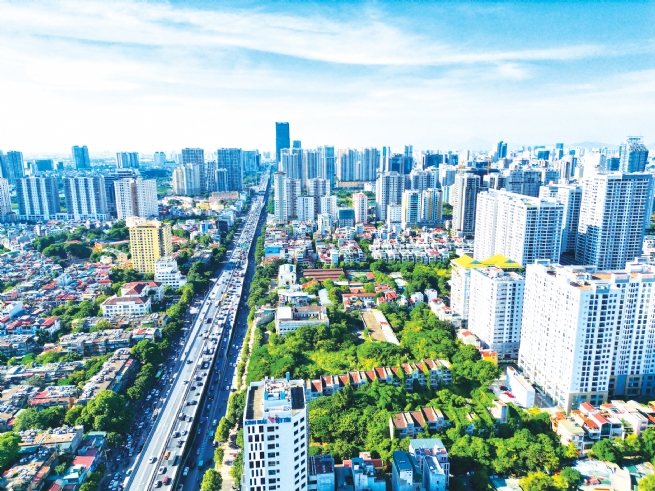
Despite encouraging economic indicators, Vietnam still faces several challenges. In the past, urbanization in many localities often followed a fragmented or “oil-spill” pattern, where isolated real estate projects emerged without coordinated links to transport infrastructure and public services. This has led to traffic congestion, pollution, and a shortage of high-quality living spaces.
As the country enters a new cycle toward 2030, stronger legal transparency and more complete institutional frameworks have become increasingly urgent. The goal of becoming Southeast Asia’s third-largest economy before 2030 requires a shift in FDI attraction strategies. Instead of welcoming every project, current priorities focus on future industries such as semiconductors, AI, robotics, biotechnology, and nuclear energy.
The qualitative shift in the economy requires a corresponding urban foundation. Experts warn that if planning does not move ahead of growth, economic expansion could be constrained by high logistics costs and living environments that are less attractive to highly skilled professionals. According to Le Hoang Lan Nhu Ngoc, Senior Director of Strategic Consulting at Cushman & Wakefield Vietnam, the key lesson is that successful urbanization has never been simply about increasing housing supply. The focus should be on creating a complete urban logic in which infrastructure, employment, education, healthcare, public amenities, and quality of life develop together. Long-term thinking and disciplined implementation are needed to build integrated districts and urban areas rather than isolated projects.
Building integrated urban ecosystems
To realize the ambition of becoming a developed country by 2045, Vietnam needs a new development model: integrated urbanism. Future mega-cities must function as self-contained ecosystems where residents can live, work, study, and enjoy leisure activities within a convenient, well-connected radius.
According to experts, a well-planned infrastructure development strategy combined with economic corridors will create stronger investment appeal. Experience shows that areas with early infrastructure connectivity tend to maintain long-term real estate value while improving overall living standards. Vietnam still has significant room to pursue this approach through ongoing market restructuring and the continued improvement of legal frameworks related to land and real estate business.
Anshul Jain, Chief Executive for India, Southeast Asia, the Middle East and Africa at Cushman & Wakefield, said Vietnam remains one of the region’s most attractive long-term growth markets. Urban planning, infrastructure investment, and economic strategy need to be more closely aligned. If this alignment continues, Vietnam will be in a strong position to develop more competitive cities and urban corridors with greater investment appeal.
For 2026, while several regional economies have begun to slow, Vietnam has maintained a high growth target based on government adjustments and assessments from Moody’s Analytics. This reflects continued confidence among international investors in a new phase of the economy driven by high technology, coordinated infrastructure, and more livable cities, supporting the ambition of becoming Southeast Asia’s third-largest economy and a developed, high-income country by 2045.
By Huong Ly, Vietnam Business Forum


 Vietnamese





