

11:38:07 AM | 4/29/2026

The Vietnamese government has responded quickly to energy supply disruptions with time-bound fiscal measures, along with price management and supply assurance. These steps have helped stabilize the macroeconomy in the short term. Over the longer term, improving energy efficiency, diversifying supply sources, and shifting to clean energy will play an important role in reducing the impact of external shocks. On this topic, Shantanu Chakraborty, Country Director of the Asian Development Bank (ADB) in Vietnam, shared his views with the press.
 |
How do you assess Vietnam’s economic outlook amid global volatility and energy supply disruptions?
Under an early stabilization scenario, we project Vietnam’s growth to be among the highest in Southeast Asia, reflecting the economy’s resilience amid current challenges. These projections are supported by strong economic fundamentals, solid public investment momentum, and export-oriented measures implemented over the past year.
To sustain this strong and steady growth, Vietnam needs to focus on improving productivity and production efficiency. It also needs to strengthen financial and capital markets to ensure investors can access long-term funding. Most importantly, as the recent crisis has shown, the country needs to focus on energy security and the transition to green, clean, and domestic energy sources to reduce exposure to external shocks. Reform in these three areas is therefore essential.
Vietnam has integrated very well into global value chains. Over several decades, it has built a strong manufacturing base, driven exports, and attracted foreign direct investment (FDI). However, core value added needs to improve further. The advantage of low labor costs is not sustainable in the long run, as reflected in relatively low domestic value added. Vietnam therefore needs to increase its value added within supply chains and move up the global value chain.
What should Vietnam do in the short and long term to strengthen its position in global supply chains?
Four key factors are required. First, a stronger business environment with greater transparency in implementation to attract high-quality investors. Second, access to capital, especially long-term funding, by further developing capital markets, including equities and bonds, through more supportive regulations. Third, improving infrastructure quality. Significant progress has been made through public investment and private sector participation, but further acceleration is needed, as this will be a key factor in continuing to attract supply chain investment in Vietnam. Finally, the availability of skilled labor is critical as Vietnam seeks to move up the value chain, particularly as the government focuses on AI, fintech, and green growth.
Amid Middle East conflicts driving risks to infrastructure, tourism, and real estate, some capital is shifting toward Asia. Is Vietnam well positioned to capture these flows? What support does ADB have to help Vietnam achieve double-digit growth in the short and long term?
Regarding capital shifts, investors seek stability, predictability, and attractive risk-adjusted returns. Vietnam has strong potential to become an alternative destination thanks to its core advantages, including political stability and solid foundations in human capital and infrastructure. These factors position the country well to receive capital seeking alternatives to more unstable regions. However, to fully capture this opportunity, Vietnam needs to ensure a transparent and predictable business environment. This includes improving regulations, developing domestic capital markets to provide long-term financing, and ensuring strong investor protection mechanisms.
As for ADB’s support for the new government and its ambitious growth targets, I would like to point out that ADB has been a partner of Vietnam for more than 30 years. We have disbursed around US$20 billion for more than 500 projects. ADB stands ready to support Vietnam not only through concessional financing (ODA) and regular lending, but also through technical assistance, policy advisory, and private sector development via public-private partnership (PPP) projects. ADB will continue to work alongside Vietnam to achieve short-term goals such as double-digit GDP growth, as well as long-term targets such as reaching net zero by 2050 and becoming a high-income country by 2045. We are also focusing on regional initiatives such as the ASEAN Power Grid, where Vietnam plays a key role.
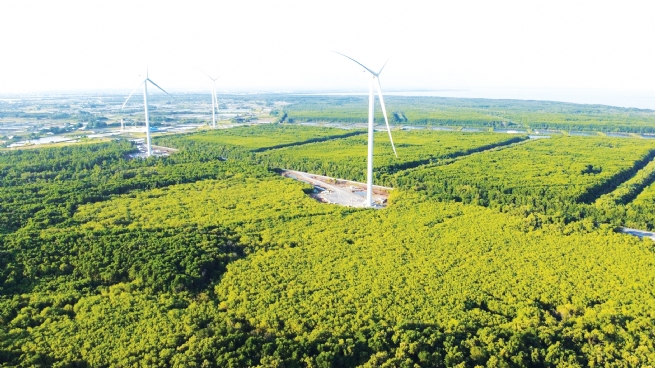
Vietnam needs to expand wind power and battery storage to strengthen grid flexibility and resilience
Vietnam is moving toward a green and sustainable growth model. What should it do to accelerate this process?
Vietnam plays an important role in Southeast Asia’s energy transition. ADB has identified green growth as a key pillar in its country partnership strategy with Vietnam since 2023.
Ambitious targets have been set to reach net zero by 2050, and Vietnam has joined the Just Energy Transition Partnership (JETP), which is progressing well and showing early signs of success in several financially viable projects. In practice, many private investors and state-owned enterprises are highly interested in green energy, but for lenders such as ADB and private financiers, the primary concern remains financial viability. To advance green growth, Vietnam needs to focus more on this aspect.
From ADB’s perspective, we are firmly committed to supporting Vietnam in achieving these goals. ADB has announced a US$10 billion support package for the ASEAN Power Grid, a regional initiative to develop renewable energy as well as transmission and distribution projects. This can be deployed in various ways under the ASEAN Power Grid framework, and Vietnam, as an important ASEAN member, will benefit from it.
However, one of the main challenges Vietnam faces is uncertainty in policies and regulations, along with gaps in infrastructure and financing. For example, renewable energy in the southern region requires a strong transmission and distribution network to deliver power to demand centers in the north. High-quality transmission infrastructure is therefore needed.
The adoption of clean technologies has also been relatively slow. There was a surge of investment during the Power Development Plan VII period, when renewable energy projects, including solar, wind, and floating solar, expanded rapidly, with ADB financing many of them. However, this momentum has slowed, and Vietnam needs to reinvigorate investment in clean energy.
To accelerate the transition toward green growth while keeping it affordable, Vietnam needs a stronger plan and a more predictable regulatory environment. Greater mobilization of private investment is also essential, as the government faces many competing demands.
Vietnam also needs to diversify its energy sources and improve efficiency. Energy generation should expand beyond traditional options, with greater focus on offshore wind and battery energy storage systems, which can complement existing renewable sources and make the power grid more flexible and resilient.
Thank you very much!
By Lan Anh, Vietnam Business Forum


 Vietnamese





