

2:22:34 PM | 4/30/2026

In a context where environmental, social, and governance (ESG) has become a global standard, Vietnamese enterprises can no longer remain low-cost manufacturers. They must become responsible partners in global value chains. Green transition, innovation, and transparent governance will define the competitiveness of Vietnamese businesses in the next decade. On this issue, our reporter interviewed Nguyen Quang Vinh, Vice President of the Vietnam Chamber of Commerce and Industry (VCCI) and Chairman of the Vietnam Business Council for Sustainable Development (VBCSD).
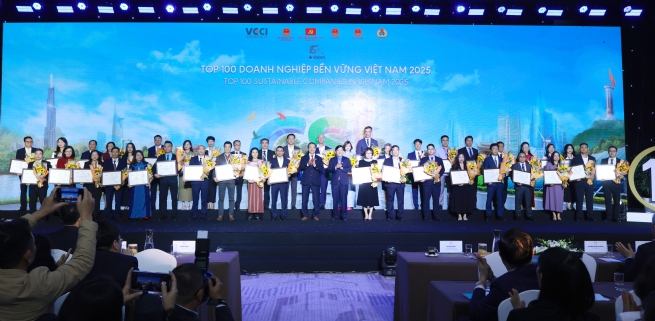
The CSI program has become a hallmark of sustainable business transformation, helping enterprises apply ESG through practical indicators aligned with Vietnam’s development context
Amid climate change, supply chain disruptions, and increasingly stringent ESG standards, how is the role of Vietnamese enterprises changing?
It can be said that the global economy is operating in a “new phase.” According to the World Economic Forum, global sustainable investment assets have exceeded US$35 trillion, reflecting a structural shift in capital flows. ESG is also reshaping corporate behavior. According to the OECD, in 2024, 91% of listed companies (by market capitalization) disclosed sustainability-related information, up from 86% in 2022. This shows that ESG has become a universal standard rather than a voluntary trend.
In this context, the role of Vietnamese enterprises is being repositioned. Vietnam is deeply integrated into the regional and global economy, with a development model shifting from low value-added outsourcing toward higher value-added production and a stronger position in global value chains. Enterprises must become responsible partners in the global ecosystem, not only low-cost producers. They need to invest in clean technologies, transparent governance, and a skilled workforce that meets new requirements, while advancing science, technology, and innovation to integrate more deeply into global value chains.
At the same time, enterprises are becoming key actors in implementing national commitments on green growth. Targets such as net-zero emissions and energy transition can only be achieved through production, where businesses play a central role. In other words, enterprises are no longer just policy beneficiaries but partners in policy implementation.
In addition, the development mindset is shifting from compliance to value creation. ESG is no longer a cost but a tool that helps enterprises manage risks, improve competitiveness, and strengthen resilience against shocks, including economic and supply chain disruptions. Enterprises are also expanding their role across entire value chains. International requirements are pushing large firms to lead ecosystems and work with suppliers to raise standards, forming more interconnected and sustainable supply chains.
From practice, how do you assess ESG transition in Vietnam, and what is holding back the process?
Vietnam has made notable progress in awareness. According to PwC’s ESG Progress Tracker Report 2025, 89% of surveyed enterprises in Vietnam have ESG commitments or implementation plans for the next two to four years. This is a very positive signal. However, there remains a significant gap between commitment and implementation.
One of the biggest barriers is finance and implementation capacity. According to international statistics by Reuters, 36% of managers cite a lack of financial resources to achieve sustainability goals, while 39% point to insufficient internal skills. This is especially true for small and medium-sized enterprises in Vietnam.
In addition, the complexity of the ESG ecosystem is another major challenge. There are currently hundreds of different standards, and the ESG data market is growing rapidly at about 23% per year, exceeding US$1.5 billion. However, the lack of standardized data and frameworks makes effective implementation difficult.
At the global level, macro factors such as inflation and financial instability can also slow ESG capital flows, particularly in emerging economies. This explains why, despite strong pressure, the pace of transition has not fully matched expectations.
In Vietnam, the gap between policy and implementation remains a challenge. PwC also indicates that Vietnam may achieve only 38% of its emissions reduction target by 2030, below the committed 43.5%. Awareness has advanced quickly, but action remains slower.
What solutions is VCCI prioritizing to help enterprises implement ESG more effectively?
We approach this from an ecosystem perspective.
First are governance tools. The Corporate Sustainability Index (CSI), developed by VCCI, helps enterprises translate ESG into concrete indicators aligned with Vietnam’s development level and socio-economic context. From 2025, the CSI for small and micro enterprises has also been introduced, helping these firms gradually approach ESG. Building a CSI framework that reflects Vietnam’s ESG content, with a simple structure and easy application, is essential.
Second is capacity building for implementation. ESG cannot succeed if it remains at the strategic level. We focus on practical training to help enterprises build concrete roadmaps.
Third is promoting green finance. OECD data shows that institutional investors currently hold about 47% of global equity capital and play a decisive role in allocating capital for sustainable activities. Therefore, connecting enterprises to this capital flow is a key priority.
Fourth is improving the policy framework. Vietnam has made progress with the 2020 Law on Environmental Protection, a pilot carbon market, and green growth strategies. However, further improvements are needed in consistency and feasibility.
In the next 5-10 years, what are the key pillars for improving the competitiveness of Vietnamese enterprises?
I believe that in the next 5-10 years, the competitiveness of Vietnamese enterprises will no longer be determined by labor costs or resource advantages, but by their ability to adapt to structural shifts in the global economy.
Recent international research shows that the world is entering a period of deep restructuring. McKinsey’s The State of Organizations 2026 report identifies three major forces reshaping organizations: technological breakthroughs (especially AI), economic and geopolitical uncertainty, and changing workforce expectations. These are not short-term trends but fundamental shifts that require enterprises to redefine value creation.
In this context, I see four strategic pillars for Vietnamese enterprises.
First is innovation linked to green and digital transformation. According to McKinsey, the integration of AI and data is reshaping how organizations operate. For Vietnamese enterprises, this means optimizing energy use and designing sustainable products.
Second is developing flexible, people-centered organizational models. One of the most profound changes is the shift in workforce expectations. New working models, along with demographic and occupational value changes, are pushing enterprises beyond traditional organizational structures. This is especially important in the green transition, where high-quality human resources in renewable energy, ESG, and clean technology remain in short supply.
Third is building sustainable and resilient value chains. New regulations from the European Union, the United States, and other developed markets are shifting focus from individual firms to entire supply chains. Vietnamese enterprises seeking deeper participation in global value chains must comply with emissions, traceability, and social responsibility standards across the entire chain.
Fourth is accessing and mobilizing green finance. International institutions consistently emphasize that capital costs will increasingly favor enterprises with clear and transparent ESG strategies.
However, these pillars are interconnected within a broader shift: from optimizing short-term efficiency to a long-term value creation model based on technology, people, and social responsibility.
In the history of economic development, each transition creates new leaders. Vietnam is standing before such a window of opportunity. If Vietnamese enterprises proactively capture global trends, leverage free trade agreements, and invest seriously in green transformation, they can not only keep pace but also redefine their position in global value chains.
Thank you very much!
Source: Vietnam Business Forum


 Vietnamese





