

10:30:39 AM | 5/6/2026

As the national organization representing the business community and entrepreneurs, the Vietnam Chamber of Commerce and Industry (VCCI) has consistently worked to build a strong community of entrepreneurs and enterprises that meet the requirements of a developed and modern nation, contributing to double-digit economic growth in the new development phase. These are the remarks of Hoang Quang Phong, Vice President of VCCI, on the occasion of the 63rd anniversary of VCCI (April 27, 1963 - April 27, 2026).
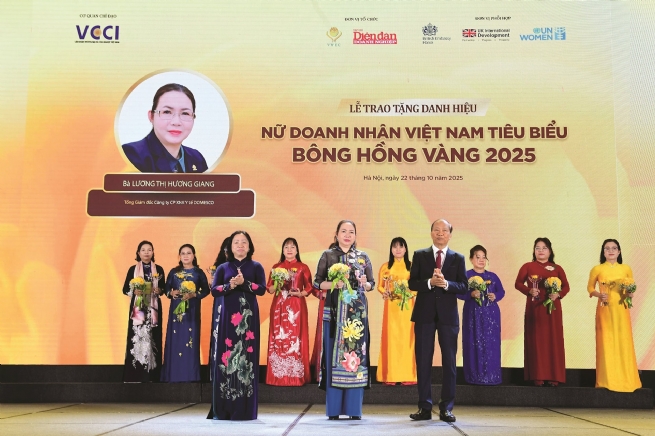
VCCI also organizes various awards and recognition programs for entrepreneurs and enterprises
In the photo: VCCI Vice President Hoang Quang Phong presents the “Golden Rose Award 2025” to outstanding businesswomen
Looking back on 40 years of Doi Moi (Renovation), how do you assess the development of Vietnam’s business community in terms of both scale and quality?
After four decades, Vietnamese enterprises have grown not only in number but also in quality. From an economy with limited resources, high inflation, and inefficient resource allocation, Vietnam has rebuilt its “market lifelines,” opened up to global integration, developed a dynamic private sector, and laid a new foundation for development.
In 2025, GDP growth reached 8.02%, with the economy expanding from US$346 billion in 2020 to US$514 billion; GDP per capita exceeded US$5,000, figures that show Vietnam has moved beyond a subsistence level and entered a phase of accumulation for breakthrough growth.
The new stage of Vietnam’s economic development brings different demands. It is no longer only about rapid growth, but about quality growth based on productivity, innovation, fiscal discipline, and effective execution. In this context, the business sector plays a central role as the force that directly creates wealth, jobs, and drives structural transformation. A strong, dynamic, and adaptable business community provides a solid foundation for achieving long-term development goals. To reach double-digit growth, Vietnam needs more resources, but more importantly, it needs resilient entrepreneurs and enterprises capable of navigating today’s unpredictable changes.
In particular, Resolution 41-NQ/TW dated October 10, 2023, issued by the Politburo on building and promoting the role of Vietnamese entrepreneurs in the new era plays an important role in shaping the development of the business community in the coming period. The resolution affirms the central role of entrepreneurs in the economy while encouraging entrepreneurship, innovation, and competitiveness. Improvements in institutions, the business environment, and business ethics and culture will help build a strong and capable entrepreneurial force suited to integration and sustainable development.
In practice, the scale of Vietnam’s business sector has expanded significantly. Alongside growth in numbers, many enterprises have expanded in size, improved governance, and gradually built a presence in international markets. Notable examples include Viettel’s investments in many countries, FPT Corporation’s global technology services, and Vingroup’s development of industrial and technology sectors with an international outlook. In addition, THACO, TH Group, TBS Group, and many others are expanding their operations, participating more deeply in global value chains, and steadily building Vietnamese brands in international markets. Enterprises in manufacturing, agriculture, logistics, and other sectors are also integrating further into global value chains and improving their competitiveness. However, the sector is still largely made up of small and medium-sized enterprises, which need continued support for sustainable growth and further development.
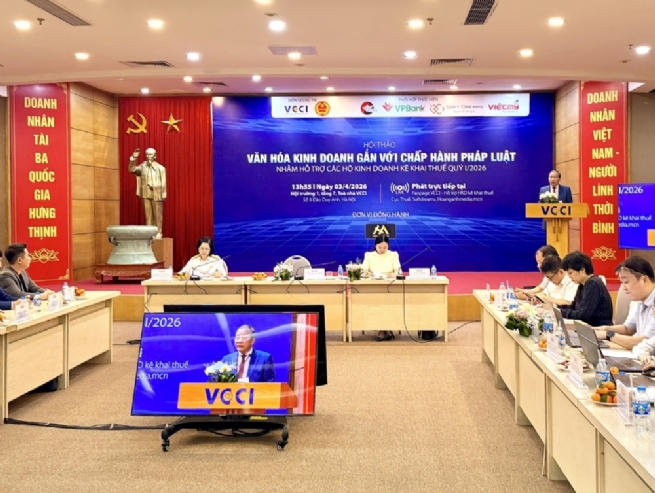
VCCI serves as an important bridge between enterprises and state agencies in taxation and customs
According to statistics, in the first quarter of 2026, the business landscape showed encouraging signs, with more than 57,400 newly established enterprises and over 38,600 returning to operation, up more than 31% year on year. These figures reflect a positive trend and show clear improvements in the business environment. In particular, the number of household businesses converting into enterprises is rising strongly, indicating greater awareness of transparent and structured business practices. The country currently has more than 5.5 million household businesses and over 30,000 cooperatives. This is a large pool for future enterprise formation. Meanwhile, Vietnam has nearly 1 million enterprises, with a target of around 2 million by 2030.
Moreover, compared with developed economies, Vietnam’s enterprise density remains low. In many countries, there is one enterprise for every 7 to 10 people, whereas VCCI estimates that in Vietnam, there is roughly one enterprise per 100 people. This gap shows there is still significant room for further development of the business sector.
Enterprise development is closely linked to employment and living standards. As the public sector undergoes restructuring and streamlining under reform policies and administrative boundary adjustments, job creation will depend largely on the business sector. This requires pioneering enterprises and effective, responsible business models that meet market demand, create spillover effects, and inspire other economic actors.
Amid rising logistics costs and continued global economic volatility, what should enterprises do to maintain competitiveness?
Complex global developments, particularly in the Middle East, are creating challenges for the business community, including logistics bottlenecks and possible disruptions to transport flows. Enterprises therefore need to proactively prepare contingency plans, explore alternative routes and options, and optimize costs to avoid increasing product prices, thereby maintaining existing markets and gradually expanding into new ones.
Vietnamese goods are now present in more than 200 trading partners; however, exports remain concentrated in several key markets such as China, Japan, the United States, and parts of Europe. Many other markets remain underused. VCCI is working with relevant ministries and agencies to expand trade promotion channels, bring Vietnamese products to global markets, and make use of overseas Vietnamese communities to promote products.
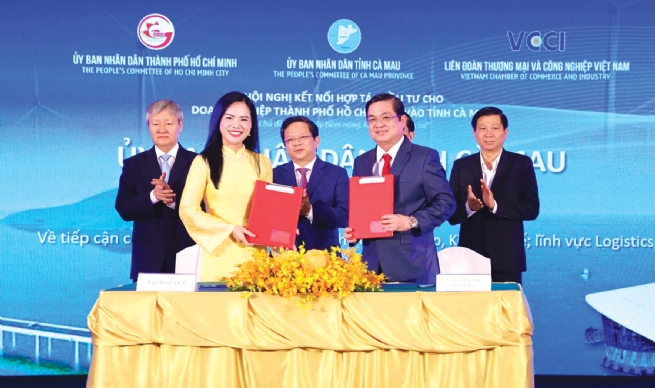
VCCI consistently works alongside cities and provinces in promoting investment, trade, and tourism
Could you share VCCI’s notable achievements in recent years and its orientations for further strengthening the competitiveness of Vietnamese enterprises?
Over 63 years of development, VCCI has consistently supported the Vietnamese business community, serving as a bridge between enterprises and the Party and government, helping improve the business environment, strengthening competitiveness, and contributing to the international position of Vietnamese enterprises.
VCCI now has a broad membership network with more than 11,000 direct members, over 200,000 enterprises through affiliated associations, and more than 200 business associations, forming a nationwide business ecosystem. This provides a solid foundation for VCCI to act as a central connector and representative voice for Vietnamese enterprises in international cooperation activities.
Over the past 20 years, VCCI has implemented the Provincial Competitiveness Index (PCI) program. The PCI has become an important tool for reflecting the quality of economic governance, transparency, market entry costs, and the overall business environment at the provincial level. In the coming period, VCCI plans to study and add a business development index to this system to provide a more comprehensive view of local business environments and growth drivers.
In addition to activities that strengthen competitiveness and enhance corporate image and brand value, VCCI also organizes various awards and recognition programs for entrepreneurs and enterprises through honors such as “Outstanding Vietnamese Entrepreneur,” “Golden Rose Award,” “Enterprise for Workers,” and the Benchmarking and Announcement of Sustainable Companies in Vietnam (CSI Program).
On the international front, VCCI plays a central role in connecting the domestic business community with global partner networks, contributing to Vietnam’s deeper economic integration. To date, VCCI has built relationships with nearly 200 trade organizations, chambers of commerce, and international partners, and is an active member of key regional and global mechanisms such as the APEC Business Advisory Council (ABAC), ASEAN Business Advisory Council (ASEAN BAC), and the International Chamber of Commerce (ICC). Through these channels, VCCI helps Vietnamese enterprises access market information and international standards, and participate directly in global value chains.
VCCI also regularly organizes business forums, trade fairs, investment and trade promotion programs, market surveys, and B2B matchmaking activities, creating opportunities for direct engagement between Vietnamese enterprises and foreign partners. These efforts not only support partner search but also help improve competitiveness and integration capacity for domestic enterprises.
With its wide network and strategic bridging role, VCCI is becoming an important “soft infrastructure” of the economy, helping Vietnamese enterprises expand their development space, increase their presence in international markets, and gradually strengthen their position in global value chains.
Amid intense competition for FDI among provinces and cities, Bac Ninh has emerged as a leading destination in Vietnam for major projects. In your view, what core advantages should Bac Ninh maintain to sustain its top-tier position nationwide?
Bac Ninh has implemented coordinated solutions from governance to infrastructure, creating new momentum for its image as an “eagle taking flight” in the national economy. In recent years, Bac Ninh has consistently focused on improving its PCI, and with a strong commitment to private sector development and investment attraction, it has introduced reforms and support measures that make doing business increasingly convenient.
To attract high-quality FDI and maintain its leading position, steady and focused efforts to improve the investment and business environment are needed. This includes reviewing land use efficiency in industrial parks, preparing energy infrastructure, and developing a highly skilled workforce to capture next-generation foreign investment flows. A key priority is completing provincial master plans and accelerating public investment projects, particularly site clearance, to bring Gia Binh International Airport and APEC-related infrastructure into operation as soon as possible.
Alongside industrial development, Bac Ninh also needs to improve the quality of advanced education to build a sustainable talent pipeline. The province is the first in the country to introduce policies supporting high-quality workforce training and the semiconductor industry for the digital economy, showing its determination to become a reliable partner and an important link in the global semiconductor supply chain.
With an open investment environment, modern infrastructure, and a large local and migrant workforce, Bac Ninh continues to confirm its position as an attractive destination for investors. Investment flows from major Asian economies such as Japan, South Korea, and China in software and semiconductor industries further reflect clear changes in the quality of FDI attraction. This provides a solid foundation for Bac Ninh to build a transparent and appealing business environment, attract large-scale, high-tech FDI projects, and achieve its goal of advancing its economy to a higher level.
Thank you very much!
By Lan Anh, Vietnam Business Forum




 Vietnamese





