On the occasion of Vietnam Manufacturing Expo 2016 (VME 2016) held in Hanoi from April 6 - 8, Vietnam Business Forum had an interview with Mr Nguyen Duc Cuong, Sales Director of Nagoya Industrial Equipment Co., Ltd, on the company’s strategy of supplying high-grade tools and machines for construction of Japan-standard factories in Vietnam as well as its preparation for upcoming integration impacts. Nam Pham reports.
Could you please briefly introduce Nagoya’s operations?
Nagoya Industrial Equipment Co., Ltd is a professional supplier of Japan-branded industrial tools, equipment and parts for factories and industrial zones in Vietnam. Its major products include lifting equipment, hand pallet truck, hydraulic bottle jack, wheel caster, hand truck, hi cupla, industrial hand tool, pocket tape and engineer pocket measures.
After 15 years of representative operation and distribution of high-quality products in Vietnam from more than 10 Japanese manufacturers like Kito, Futaba, Masada Seisakusho, Kakuta, Sisiku, Nitto, Bishamon, Tajima, Fuji, Togawa and Shinwa, Nagoya has secured a strong trust of major customers across the country, mainly Japanese-invested FDI factories.
We are very proud to supply components and equipment, directly or indirectly, to manufacturing factories of many world’s leading corporations in Vietnam such as Toyota, Ford, Toto, Yazaki, Brothers, Nissan, Sumi-Hanel, Piaggio and Vietnam - Japan Float Glass. This is a strong motivation for Nagoya to make further efforts to cater high-quality industrial tools, machinery and equipment for Japan-standard factories in Vietnam.
Would you tell us about your development strategy for the upcoming time, particularly in the current context of Vietnam’s extensive integration?
The ASEAN Economic Community (AEC), Trans-Pacific Partnership (TPP) and other free trade agreements (FTAs) are expected to draw more FDI into Vietnam in the coming time. Many sectors such as automobile, electronics and mechanical manufacturing will have more opportunities to develop and have more choices with competing products imported into Vietnam. Hence, our field of supplying industrial products will not be affected but we have more opportunities to supply a wider range of products in more designs with more competitive prices.
Japanese-invested factories are our main customers. We have seen a steady increase in Japanese investment projects in Vietnam over the past years, focusing in northern Vietnam. According to surveys into Japanese companies in Vietnam by the Japan External Trade Organisation (JETRO), Japanese companies pinned high hopes on Vietnam’s economic development. Surveys showed that more than 60 per cent of respondents planned to their operations in Vietnam and continue to see Vietnam as an important investment destination. 85 per cent of companies said they expand investment because they seek to increase revenue.
What do you think about your competing products in Vietnam market?
As our high-quality products are made by leading Japanese manufacturers, prices of our products are also higher than similar products from South Korea, Taiwan (China) and China. However, Japanese factories still use components and equipment made by other Japanese companies. Hence, we still have a stable traditional customer base. Due to cultural factors and nationalistic spirits, people of each country normally give priority to products their country makes. For this reason, similar products with lower prices from other countries also primarily serve their own customers.
How do you feel about the quality of recent VMEs?
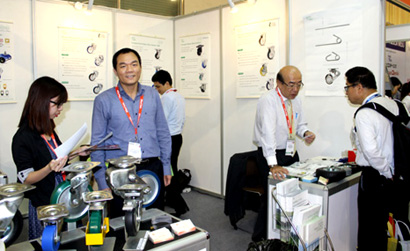
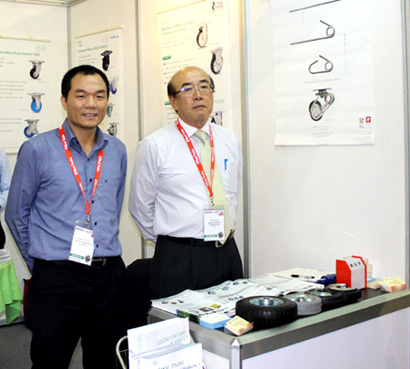
We joined VMEs for several times and found that this was a useful, effective playground and bridge for domestic manufacturers to access new advanced technologies and products to meet business expansion needs. The event ensures the quality and number of visitors and draws right target customers that exhibitors seek for. I appreciated the effect of VMEs and we thus decided to open two separate booths to display Togawa-branded heat-resistant hoses and Sisiku-branded wheel casters with the cooperation from Japanese partners. This was a good opportunity to exchange information, seek and expand relationships with partners and potential customers.




 Vietnamese





