3:34:49 PM | 8/3/2026

The 2026 Dak Lak Provincial Planning Announcement and Investment Promotion Conference introduced 259 investment projects worth more than VND1.03 quadrillion (US$41.2 billion). A total of 122 documents were presented, including investment approvals, survey approvals, and memorandums of understanding (MOUs). While the planning framework serves as the blueprint for the province's development, investors are expected to turn that vision into reality. More important than the number of projects or commitments is the need to move them into implementation as quickly as possible.
Capital for new development space
Viewed solely through the figure of more than VND1.03 quadrillion (US$41.2 billion) for 259 investment projects, the conference could be seen as a major investment promotion success. More importantly, however, the 2026 Dak Lak Provincial Planning Announcement and Investment Promotion Conference marked the emergence of a new development space following planning adjustments, where growth drivers in energy, industry, infrastructure, urban development, high-tech agriculture, and services are gradually taking shape.
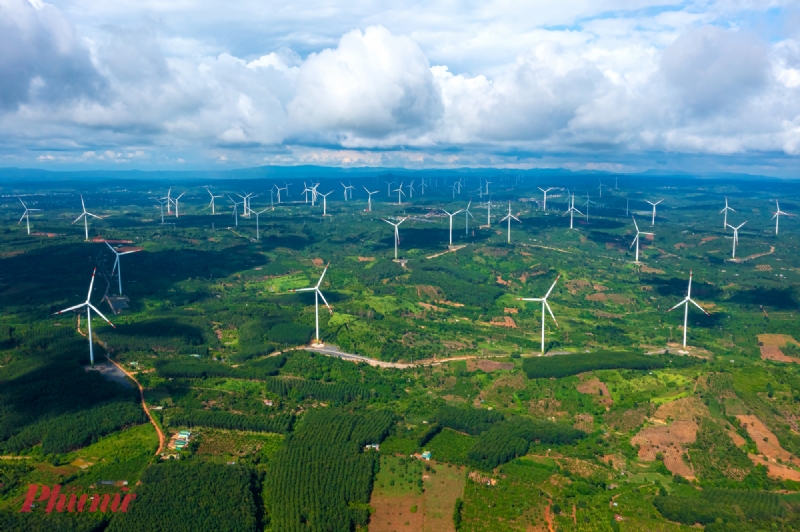
Ea Nam wind farm - the largest onshore wind power project in Vietnam
The project portfolio covers sectors with long-term growth potential, including renewable energy, transport infrastructure, industrial parks and clusters, urban development, social housing, water supply, agricultural processing, high-tech agriculture, trade, services, and tourism. These sectors require substantial capital, long investment horizons, and strong execution capacity. Capital commitments are also clearly divided, reflecting different levels of project readiness.
The first group consists of 25 projects that received investment policy approvals and investment registration certificates, with total registered capital exceeding VND40.294 trillion (US$1.61 billion). These projects have largely completed legal procedures and can move into implementation once site clearance and technical preparations are completed. They cover renewable energy, industrial parks, urban development, social housing, transportation, water supply, agricultural processing, and high-tech agriculture, creating new development corridors. Major projects include the Serepok 3 floating solar power plant (VND7.661 trillion), Hoa Xuan Tay Industrial Park (VND4.7 trillion), Hoa Xuan Dong Industrial Park (VND3.807 trillion), the Thuan Phong, NT1, NT2, and Krong Nang wind power projects, as well as the Krong Buk 500kV substation.
The second group includes 78 projects with total registered capital of more than VND1,020.864 trillion (US$40.83 billion), focused on energy, infrastructure, urban development, industry, agriculture, and tourism. This group reflects the province's strategic direction and expectations for medium- and long-term capital inflows. The participation of major corporations such as Vingroup, T&T Group, and FLC Group, together with energy, real estate, and industrial companies, reflects a shift toward integrated development. VinEnergo, a Vingroup subsidiary, signed an MOU to study large-scale wind power projects in Dak Lak.
The third group comprises the 259 projects on the province's investment promotion list, serving as an open blueprint that reflects the long-term potential and vision of Dak Lak's new development space.
From planning announcement to implementation
At the 2026 Dak Lak Provincial Planning Announcement and Investment Promotion Conference, the most important feature was not the scale of commitments but the clearly defined stages of capital flows. Projects are at different points in the investment process, from research and initial commitments to legal approval and implementation, reflecting an investment pipeline moving at different speeds.
In the first group, projects with investment policy approval have moved beyond commitments and into the implementation phase. Even so, the gap between approval and operation remains significant, depending on site clearance, technical infrastructure, and implementation capacity. In the second group, MOUs and cooperation agreements reflect strong expectations for the province's new development space, but they are also the stage most vulnerable to delays without effective mechanisms and clear implementation schedules.
Capital is also shifting from individual projects toward an ecosystem approach built around the integrated development space defined in the provincial plan. This creates a new requirement: local authorities must do more than attract investment. They must build an implementation environment where planning, land, infrastructure, and administrative procedures work together as a unified system. After the conference, the key question is no longer how many projects were signed, but how many become operational. This is the difference between an investment promotion event and a genuine process of creating growth.
For businesses, the period after commitments tests financial capacity, risk management, and long-term strategy. For government, it tests policy implementation, administrative reform, land preparation, and coordination among agencies. The core message is a shift from an investment promotion mindset to an implementation mindset. The value of the planning framework will ultimately be measured by the number of projects that move from investment approval to commercial operation.
From commitments to results
Along with the provincial plan and the published project portfolio, the 2026 Dak Lak Provincial Planning Announcement and Investment Promotion Conference also conveyed commitments to improve the investment climate, reform administrative procedures, and support businesses. Even so, these remain a framework of expectations. The decisive factor is the ability to turn commitments into measurable results in the real economy.
The issue is no longer the number of projects or the scale of registered capital, but how effectively capital is turned into real investment at each stage: how many projects break ground on schedule, how many complete legal procedures and move into implementation, and how many actually disburse capital and begin stable operations. Likewise, commitments to improve the investment climate must be measured through concrete indicators, including administrative processing times and whether the green lane mechanism works in practice rather than remaining a policy on paper. Investor satisfaction throughout project implementation is the clearest measure of governance quality.
This is a two-way test. For businesses, capability is measured not by signing agreements or proposing projects, but by the ability to mobilize capital, manage risks, and complete projects. For government, capability is measured not only by attracting investment, but also by the speed of administrative processing, the quality of governance, and consistent support throughout the project lifecycle. From this perspective, more than VND1 quadrillion (US$40 billion) is not the destination but the starting point of the transition from planning to implementation. The conference will achieve its purpose only when these commitments become operating factories, industrial parks, urban areas, and service projects.
Ngo Khuyen (Vietnam Business Forum)