11:34:16 AM | 8/12/2026

The merger has opened up broader development space for Tuyen Quang, but also a bigger challenge: turning new potential into real growth. The 2026 double-digit growth target leaves little room for relying on existing momentum. With growth in the first six months below expectations, the province needs to strengthen growth drivers, remove infrastructure bottlenecks and unlock capital flows.
From momentum to growth
In 2025, Tuyen Quang recorded GRDP growth of 6.4% at constant 2010 prices. Although this fell short of the Government-assigned target, the result reflected the efforts of the entire political system, business community and people of the province amid continued difficulties and challenges. A notable contributor was the digital economy, whose value added accounted for 7.39% of GRDP. In 2026, the 10.17% target is testing the province’s ability to operate within its new development space. After six months, GRDP was estimated to have grown 7.72%, below the projected scenario. The economy has maintained its pace, but lacks enough momentum to reach double-digit growth.
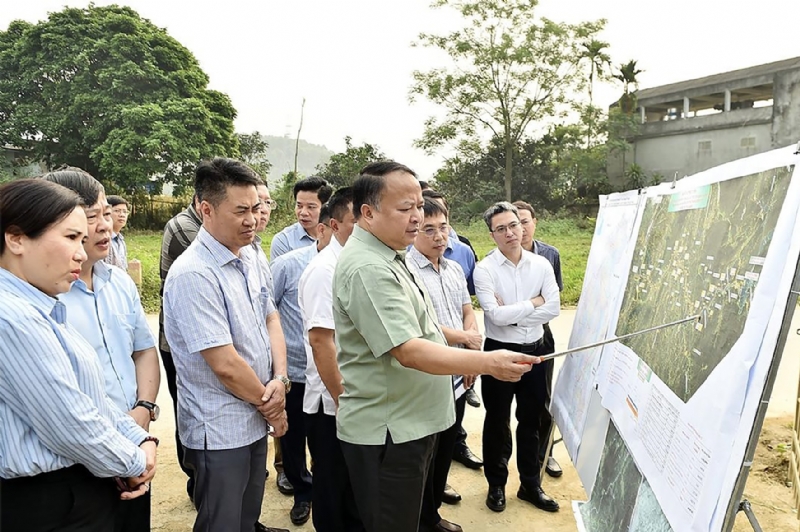
Tuyen Quang provincial leaders survey the proposed road linking the Tuyen Quang-Ha Giang Expressway with the Na Hang-Lam Binh Tourism Area (Photo: Tuyen Quang Online)
The core issue is not a few weak indicators, but the need to activate stronger growth drivers. Agriculture remains a foundation, but has limited room to accelerate. Industry and services have the potential to break through, but have yet to meet expectations. Tuyen Quang therefore needs new growth momentum.
The merger has expanded the province’s geographical scale, but scale alone does not create growth. To grow faster, the province must reorganize its development space, choose the right growth poles, prioritize key projects and focus resources. Otherwise, its new advantages could become fragmented.
"A new development space only has meaning when it is organized into new growth drivers. Tuyen Quang is not pursuing double-digit growth through inertia, but by selecting the right growth poles, prioritizing the right projects and concentrating resources sufficiently to create tangible momentum for the economy," said Phan Huy Ngoc, Chairman of the Tuyen Quang Provincial People's Committee.
Therefore, the double-digit growth target is not simply a one-year task, but a requirement to restructure the development approach. Growth must be driven by infrastructure, investment, administrative reform and implementation capacity. The second half of 2026 will test the province’s ability to turn its new development space into new growth drivers.
Reshaping development space for growth
Of particular significance in the adjustment of the Tuyen Quang Provincial Plan for 2021-2030, with a vision to 2050, is the reorganization of development space within the new administrative boundaries. Following the merger, the challenge is to manage a larger area without spreading resources too thinly.
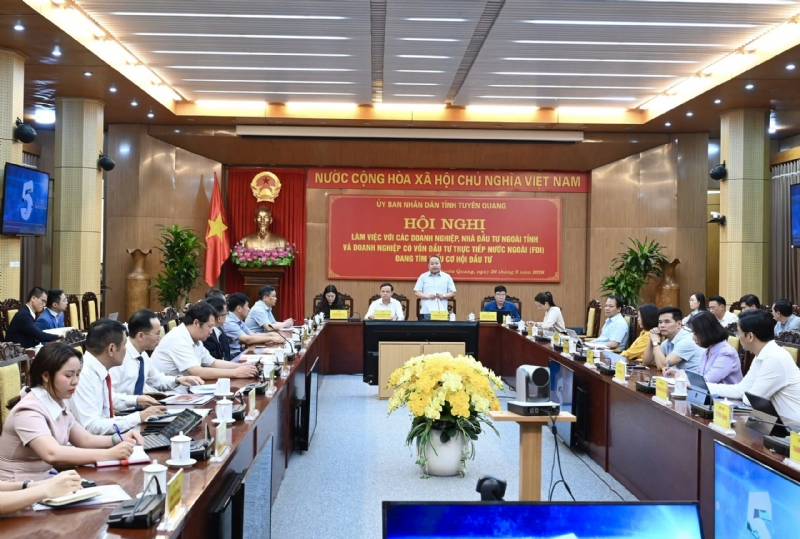
Tuyen Quang is committed to supporting businesses and fostering a conducive investment environment
The adjusted plan establishes one growth corridor, two growth poles and three economic zones. The growth corridor runs from the Thanh Thuy Border Gate Economic Zone to the Noi Bai-Lao Cai Expressway. It is not simply a transport route, but an economic corridor connecting goods, tourism, logistics, industry and services.
When this corridor operates effectively, Tuyen Quang will have an opportunity to strengthen its position within the regional connectivity network of the Northern Midlands and Mountainous Region. To accelerate growth, a mountainous locality cannot rely solely on natural resources; it must shorten its distance to markets, reduce logistics costs and build strong enough connectivity to attract investors.
The two growth poles have clearly defined roles. The northern area focuses on border trade and tourism, leveraging its border location, landscapes and cultural assets. The southern area focuses on urban development, industry and services, linked to industrial parks, industrial clusters and new production spaces.
This division of roles goes beyond a planning diagram. Tuyen Quang is shifting from development based on administrative boundaries to development based on economic functions. Scale becomes an advantage only when each area has the right role, industries and capital flows.
In investment competition, each area needs a clear role. Industry needs land, utilities, logistics and fast procedures; tourism needs landscapes, cultural identity and access infrastructure; border trade needs customs clearance, warehousing and transport links; urban development needs clear land-use planning. Scattered resources make it harder to build distinct advantages.
With clear growth poles, each area can become a specialized “magnet.” The northern area can attract tourism, border trade services, specialty agriculture and border logistics, while the southern area focuses on industry, urban development and commerce. A seamless corridor can create a balanced growth structure linking the highlands with industrial and urban development.
To turn the growth poles into results, Tuyen Quang is focusing resources on key sectors and public investment. In the first six months of 2026, public investment disbursement reached 30.4%, above the national average. This funding is supporting major infrastructure projects while also aligning with national target programs and linking economic development with sustainable social welfare.
Potential and distinctive investment landscape
Planning shapes the development space, while Tuyen Quang’s local assets provide the foundation for becoming a new investment hub in the Northern Midlands and Mountainous Region. Following the merger, the province covers more than 13,700 sq. km and has a population of over 1.86 million, with a diverse resource base spanning border trade, industry, urban development, tourism, agriculture and the forest economy. The key is that authorities are turning this potential into strategic project portfolios, moving beyond “searching for gold in the sand” and preparing to attract large capital flows.
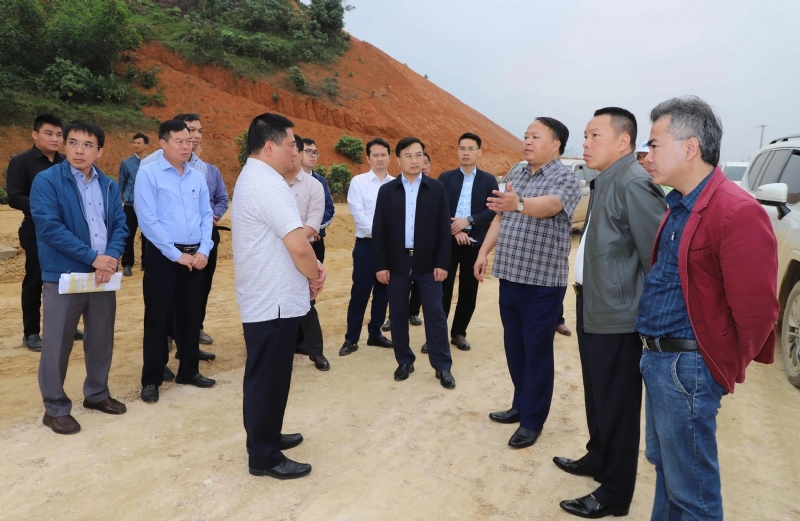
Chairman of Tuyen Quang Provincial People’s Committee Phan Huy Ngoc reviews progress on the Tuyen Quang-Ha Giang Expressway (Phase 1) project in Tuyen Quang Province. (Photo: Tuyen Quang Online)
In manufacturing, Tuyen Quang has a large land bank with room to develop industrial parks, industrial clusters and large-scale projects. The province has planned and is investing in 12 industrial parks covering about 3,096.2 ha and 48 industrial clusters covering about 2,450.1 ha. This provides a strong foundation for attracting high-tech industry, automobile manufacturing, electronic components, mechanical engineering, supporting industries and deep processing of agricultural and forestry products.
Tuyen Quang’s industrial advantage also lies in its workforce. With more than 500,000 working-age people, the province benefits from a “golden population structure” and a workforce that can adapt to technological shifts. As vocational training improves, this advantage is no longer just about workforce size, but increasingly about the ability to meet the demands of projects requiring advanced technical skills, technology and modern management capabilities.
On the resort tourism map, Tuyen Quang has distinctive advantages in landscapes, culture and heritage. Its diverse cultural heritage across 46 ethnic groups, 697 historical and cultural sites, particularly the Tan Trao Special National Historical Site and the Na Hang-Lam Binh Special National Scenic Landscape, along with prestigious international awards, have created a distinctive brand. This offers strong potential for attracting high-end resort real estate, entertainment complexes, ecotourism, wellness and internationally standardized tourism services.
Na Hang-Lam Binh alone, covering more than 15,000 ha, is likened to a “green gem in the great forest,” with the potential to become a premier resort destination in northern Vietnam. Community-based and highland cultural tourism models are also creating sustainable opportunities for investors who understand local identity and can leverage its landscapes while preserving them and improving visitor experiences.
In high-tech agriculture, Tuyen Quang has strong products rooted in its soil and climate, including Shan Tuyet tea, Sanh oranges and Soi Ha pomelos, along with more than 1,000 species of valuable medicinal plants, more than 1 million ha of forestry land and about 18,000 ha of aquaculture water surface. These resources provide a foundation for attracting investment in large-scale agriculture, deep processing, the forest-based economy and the emerging carbon credit market. The province is also supporting businesses in applying digital technology across production, processing and distribution, helping integrate Tuyen Quang’s agricultural products more deeply into global supply chains.
In sum, across the three pillars of industry, tourism and agriculture, Tuyen Quang’s message to investors is clear: the province has not only resources, but also a clear development vision; not only land, but also the capacity to create investment opportunities. This provides a strong foundation for Tuyen Quang to position itself as an open, distinctive and rapidly developing investment destination, guided by professional, selective and sustainable standards.
Upgrading infrastructure, improving institutions to attract investment
Tuyen Quang aims to attract around 150 new projects in 2026-2030, with total additional investment of VND70-75 trillion (US$2.69-2.88 billion). The target also includes at least three companies ranked among Vietnam’s Top 500 largest enterprises investing in new projects in the province. This scale can create new momentum, but also requires the province to improve project preparation, land allocation, site clearance and investor services.
To attract and retain investment, transport infrastructure remains an important factor. The Tuyen Quang-Ha Giang Expressway is receiving concentrated resources for construction not only to shorten travel times, but also to reshape perceptions of the province’s economic position. For a mountainous locality, a strategic route can reduce logistics costs, support weekend tourism, improve the feasibility of industrial parks and help investors reassess location risks.
But hard infrastructure is only part of the equation. Tuyen Quang also needs strong “soft infrastructure”: fast procedures, clear responsibilities, transparent data and consistent services. The province aims to put all eligible investment- and business-related administrative procedures online and maintain a Public Administration Reform Index (PAR Index) score above 88%. For investors, delays are a cost and administrative consistency is a measure of competitiveness.
Digital transformation is also helping accelerate growth. Tuyen Quang’s administrative procedure system is connected to 24 national and specialized databases, while the reuse rate of digitized data has reached 96.71%, making procedures more transparent and saving businesses time. In 2026, the province aims to raise the digital economy’s share of GRDP to 7.71%.
“Attracting investment goes beyond presenting potential. Investors need infrastructure with clear timelines, clean land, transparent procedures and an administration committed to supporting them through to completion. When institutions clear the way, the growth corridors in the plan can become concrete projects, revenue and jobs,” Phan Huy Ngoc said.
Infrastructure discipline covers site clearance, public investment disbursement, priority project selection, land-bank management and adherence to project timelines. A delayed road can cause a project to be missed; uncleared land can slow capital flows; prolonged procedures can erode an advantage before a project even begins.
More than an invitation, Tuyen Quang is opening the way for a new investment wave through strong commitments from the highest levels of the political system. Provincial leaders understand that no matter how open the planning space, it can only develop through close partnership with the business community. The province is therefore not waiting for capital to arrive, but is proactively building a safe, transparent and sustainable investment destination.
The coordinated effort, from clearing land and focusing resources on major transport infrastructure to fully digitizing administrative procedures, reflects the province’s approach: businesses’ difficulties are the administration’s concerns, while investors’ success is a measure of local governance capacity. Barriers are being removed, and responsibility for resolving issues is clearly assigned at every level and across every sector, with a strong commitment to serving businesses.
Tuyen Quang is ready. Infrastructure has opened the way, and institutions have cleared the path. The province is welcoming strategic investors and businesses with financial strength, technology and a vision for sustainable development to unlock its potential “gold mines.” The combination of new development space and the administration’s commitment to partnership can create new momentum, positioning Tuyen Quang as a promising investment destination in the Northern Midlands and Mountainous Region.
Ha Thanh - Trinh Long (Vietnam Business Forum)