With familiar local products, Dai Thanh Commune is gradually bringing them into the digital space. The livestream sessions not only open up an additional sales channel but also demonstrate a shift in the way producers think about production, promotion and brand building.
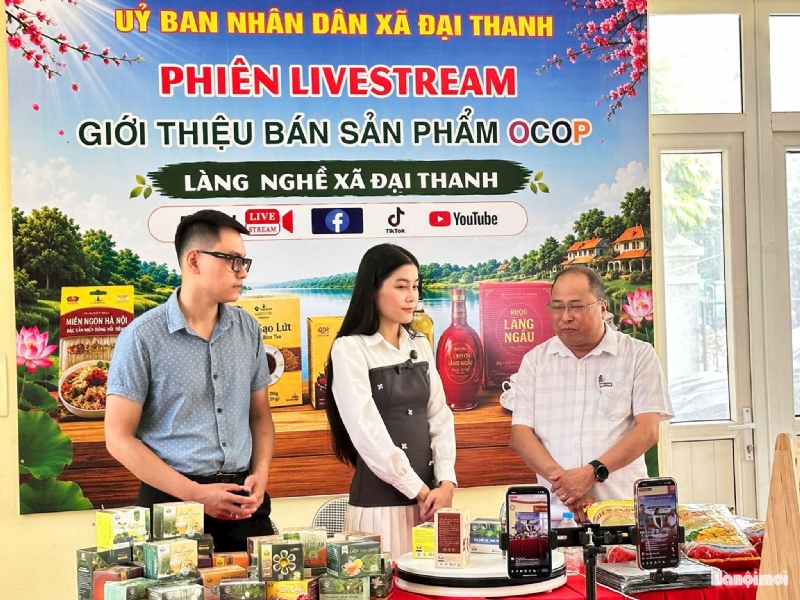
Vice Chairman of the Dai Thanh Commune People’s Committee Pham Van Ngat (far right) participates in a livestream to introduce local OCOP products. Photo: Ngoc Minh
Bringing local products “on air”
At 9 a.m., at the Quoc Bao Residential Area Cultural House in Dai Thanh Commune, OCOP products were neatly arranged in front of cameras, lighting and equipment serving the livestream session.
No longer confined to traditional stalls or local markets, local products are being brought into the digital space, reaching consumers through a new approach.
Nguyen Duc Dung, owner of the Huu Hoa arrowroot vermicelli production facility, an OCOP product of Dai Thanh Commune, said his family has been engaged in vermicelli making for generations. If in the past, arrowroot vermicelli was often purchased by consumers toward the end of the year, especially as Tet approached, the product has gradually become a familiar item in daily meals.
However, traditional sales methods such as wholesale distribution and selling at markets have prevented his family’s products from reaching a large number of consumers.
This situation is not unique to arrowroot vermicelli. Many craft village, agricultural, handicraft and OCOP products are of good quality, but their markets remain largely confined to local areas. Meanwhile, shopping habits are changing rapidly, with an increasing number of consumers searching for information, choosing and ordering products on digital platforms.
The story of the Le Dinh Tuan business in Team 12 also clearly reflects the pressure for change. According to Le Dinh Tuan, the facility previously offered more than 30 types of flower and herbal tea. However, due to difficulties in sales, the facility has narrowed its product portfolio and focused on key products. Of the products previously certified, eight OCOP products remain valid, including Gymnema tea bags, brown rice tea and chrysanthemum tea.
The products are manufactured in accordance with ISO 22000:2018 standards, with clearly sourced ingredients. Alongside maintaining quality, the facility has proactively expanded its distribution channels on Google, Facebook, Zalo, TikTok and e-commerce platforms.
According to Tuan, changes in consumer habits are forcing sellers to change as well. As customers increasingly move to e-commerce platforms, producers must also find ways to establish a presence where their customers are.
Although costs on e-commerce platforms remain an issue for sellers, Tuan believes this is still a difficult-to-reverse trend.
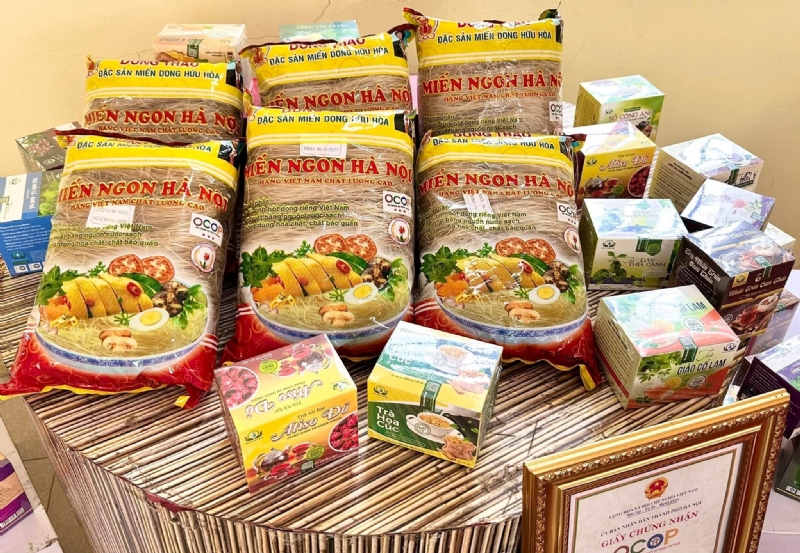
OCOP products of Dai Thanh Commune. Photo: Ngoc Minh
Opportunity to expand the market
Taking part directly in the livestream to introduce and promote local OCOP products, Vice Chairman of the Dai Thanh Commune People’s Committee Pham Van Ngat said the commune has determined that product promotion needs to be carried out through multiple channels. First and foremost is leveraging the role of producers themselves; followed by trade fairs, product introduction activities and, in particular, the voices of those who have directly used and experienced the products.
“Promoting products and introducing them on e-commerce platforms and online markets, the locality identifies this as a fast and accessible way to bring products to local residents in particular and consumers nationwide in general,” Pham Van Ngat said.
Following the first livestream session, the locality plans to maintain one to two livestream sessions per week, gradually turning product promotion and introduction into a regular activity rather than one implemented only during peak campaigns.
In 2026, Dai Thanh Commune aims to have at least three additional products achieve an OCOP rating of three stars or higher. Priority products include processed and deeply processed products, traditional craft village products, gift products, products with export potential, and products associated with community and ecotourism. Notably, Dai Thanh’s OCOP development orientation does not stop at improving the quality of existing products but also aims to create new products based on the locality’s own advantages.
According to the Dai Thanh Commune Economic Division, the locality will support organizations and individuals in developing new products, encouraging the creation of products based on new ideas, community tourism services and tourist destinations. This approach aims to diversify products while promoting the values of natural conditions, culture, history, traditional craft villages and local production experience.
Watching the livestream introducing local OCOP products, Nguyen Thi Thuy, a resident of Dai Thanh Commune, expressed her excitement that products long familiar in local life were being introduced through a modern approach.
“From the traditional market space to the digital space, the locality is increasingly demonstrating dynamism, youthfulness and positivity. If more people become aware of products from our homeland, producers will also have more opportunities to expand their markets,” Thuy said.
For Le Dinh Tuan, the initial signal is even clearer: following the first livestream session, the number of customers coming to the facility increased by about 50%. This figure is not enough to confirm the long-term effectiveness of a model, but it demonstrates one thing: when local products are placed in the right channel for reaching consumers, market opportunities can expand significantly.
| This page is produced in coordination with the Hanoi Coordination Office for New-Style Rural Development |
Source: Vietnam Business Forum