As the year-end season approaches, carved wood production facilities in Thuong Quan Village, Thuong Tin Commune in southern Hanoi, are adjusting production to meet purchasing demand. Maintaining jobs and expanding product sales are issues directly linked to local rural development.
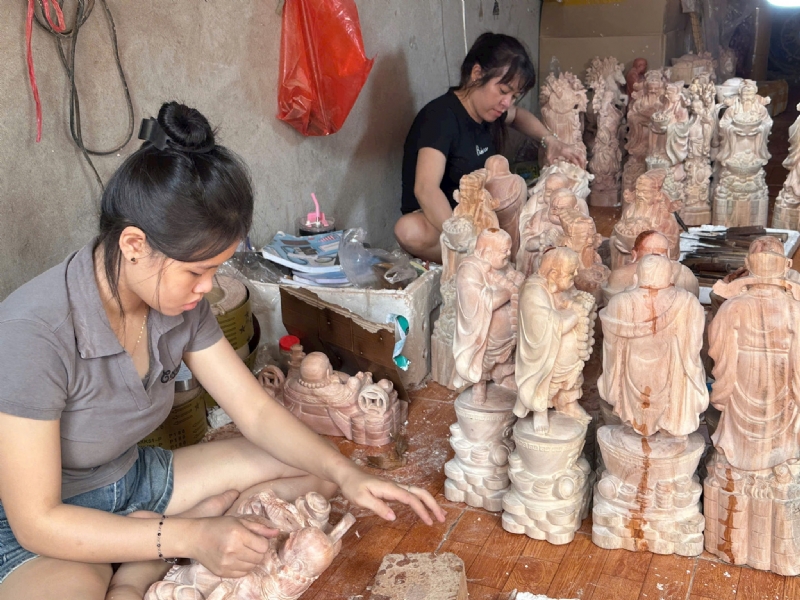
Workers refine intricate woodcarvings at a local workshop in Thuong Tin Commune
Preserving the Craft While Meeting Market Demand
Thuong Quan was formed from Thuong Cung and Dinh Quan in July 2026. At the workshop of Tran Diem My, preparation of materials and research into goat mascot designs for the 2027 Tet holiday began in August. The family plans to start carving products in October, combining wholesale and online sales.
According to Nguyen Van Su, Chairman of the Thuong Quan Village Wood Carving Craft Association, difficult sales have prompted some workers to change occupations. Currently, about 60% of families in the village still work in woodworking. Nguyen Van Tan, Vice Chairman of Thuong Tin Commune People’s Committee, said the traditional craft contributes to job creation and higher incomes, and helps the locality meet advanced new rural development criteria.
For a production household, an order affects several decisions at the same time: how much raw material to purchase, how many workers to arrange, and when to complete the products. Unsold goods mean capital remains tied up in the workshop. Therefore, calculating seasonal demand and product designs is also a way of managing resources within a household economy.
Preserving the craft is closely linked to the ability to generate regular income. Workers with stable jobs have better conditions to gain experience and pass their skills on to the next generation. Conversely, when employment is interrupted, production facilities may face labor shortages just when demand increases. The relationship between markets and labor therefore affects the production capacity of the craft village as a whole.
From the perspective of new rural development, the value of handicrafts lies in providing livelihoods where people live. Households participate in production and business; workers handle individual stages; and supply and transport activities also generate additional demand. Income from the craft is reinvested in family living expenses, education, and investment.
Sharing his views on the role of craft villages in the rural economy, Nguyen Dinh Hoa, Deputy Director of the Hanoi Department of Agriculture and Environment, said the city values the sector’s contribution to job creation, higher incomes, and social welfare. Craft village development also creates conditions for experiential tourism, while providing opportunities for local young people to receive training and return to participate in production.
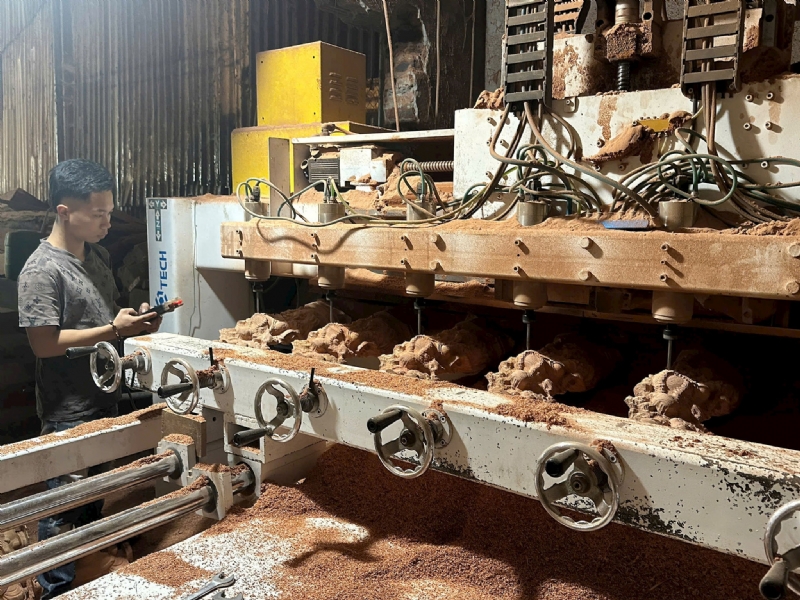
Craft preservation is closely linked to the ability to generate stable income
Connecting Craft Products with Buyers
Thuong Tin Commune is supporting market access through both knowledge provision and promotional activities. On April 3, 2026, the Commune People’s Committee coordinated with the Hanoi Department of Justice to provide training on e-commerce for craft village production facilities. Participants included households engaged in woodworking in Thuong Cung and wood carving in Dinh Quan, the two areas that were later merged to form Thuong Quan Village.
At the conference, producers were introduced to relevant policies, guided on applying them to business activities, and given an opportunity to discuss practical difficulties. Nguyen Van Tan said the activity aimed to help organizations and individuals adapt to digital transformation and expand markets. He emphasized the need for craft villages and companies to “actively participate in and take advantage of opportunities from e-commerce.”
By August 2026, the commune had organized four livestream sessions to introduce craft village products, with participation from local leaders and companies. According to results released by the locality, the sessions generated about 150 orders, with revenue of nearly VND200 million (US$7,692) from various product groups. This was the combined result of the commune-level program.
Le Anh Tuan, Head of the Economic Division of Thuong Tin Commune, said the locality plans to maintain weekly product introduction sessions while supporting companies in accessing e-commerce platforms. The goal is to establish stable sales channels after promotional events. The presentations also cover production processes, product functions, and usage methods, giving buyers more information to make their choices.
For carved wooden products, online transactions require sellers to clearly describe the materials, dimensions, and product details. Customers cannot directly handle or examine an item before placing an order. Images, consultation information, and delivery of the product as presented are directly related to the facility’s reputation.
During a meeting between the Hanoi and Da Nang agriculture and environment sectors on September 11, 2026, on craft village development, Nguyen Dinh Hoa emphasized the links among artisans, production households, cooperatives, and companies. Along with trade promotion and promotion on digital platforms, he mentioned connecting craft villages with tourism and developing spaces for displaying and experiencing products.
These approaches create greater opportunities for division of labor between skilled craftspeople and organizations with market expertise. A small production facility may find it difficult to handle design, production, product presentation, and distribution on its own. Linkages allow workers’ skills to be connected with buyer demand, rather than requiring each household to manage the entire business operation independently.
Market requirements were also reflected in the 2026 Hanoi Craft Village Product Competition. At the award ceremony on September 28, Nguyen Dinh Hoa said the competition focused on applicability and commercial potential, encouraging products to retain their identity while meeting consumer demand. The evaluation also considered environmental friendliness alongside technical quality and aesthetics.
From this perspective, the development of woodworking in Thuong Quan is linked to product quality, sales capacity, and working conditions. Expanding production goes hand in hand with organizing workshops, controlling dust and noise, and ensuring fire safety, all of which are directly related to life in residential areas.
The year-end sales season is an important period for craftspeople. In the long term, the ability to retain customers, create jobs, and maintain a skilled workforce will determine the sustainability of production facilities. This is also a concrete contribution of the craft village economy to residents’ incomes and quality of life in the process of new rural development.
|
This special section is presented in collaboration with the Hanoi Coordination Office for National Target Programs |
By Do Ngoc, Vietnam Business Forum