Hanoi's One Commune One Product (OCOP) program is entering a new development phase, where product value is measured not only by quality, standards, or star ratings, but increasingly through links to culture, craft villages, tourism, and the market. This is a suitable approach to multi-value rural economic development, while creating more opportunities for enterprises to participate more deeply in the city's trade and tourism service chains. This shift is important if Hanoi is to turn the advantages of its craft villages into competitive strengths for the rural economy and tourism.
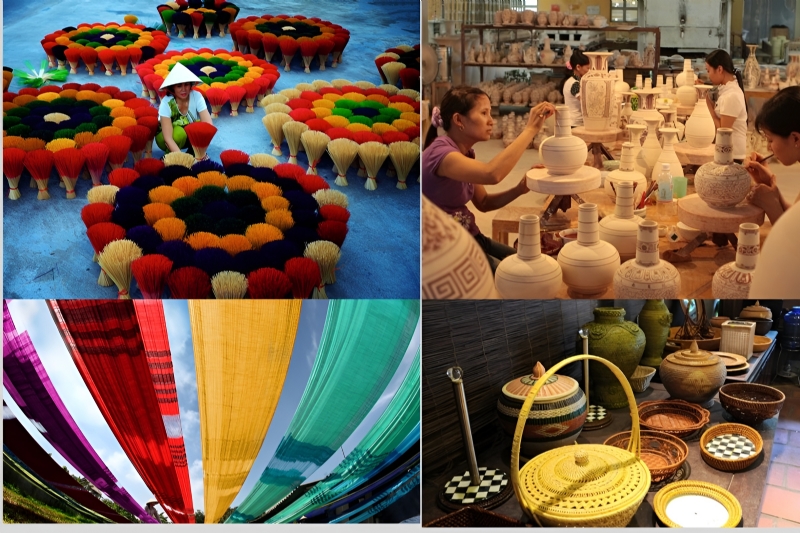
Hanoi’s OCOP program is shifting from quantity to value, turning craft village products into cultural ambassadors that enrich the city’s tourism experience
From Star Ratings to Economic Value
Hanoi currently has over 1,350 craft villages and villages with crafts, including more than 300 traditional craft villages; over 3,400 OCOP products have been evaluated and recognized.
With the number of products now reaching a large scale, requirements in the new phase no longer center on rapidly increasing the number of recognized products, but shift toward improving quality, reinforcing brands, increasing value, and expanding markets. A ceramic, silk, lacquerware, tea, or local specialty product can only compete sustainably if it offers stable quality, suitable design, transparent origin, and a compelling narrative that helps it stand out.
OCOP is thus moving beyond the framework of an evaluation and rating program to become a tool for reorganizing production and market development.
The lotus silk story of Meritorious Artisan Phan Thi Thuan in Hong Son Commune serves as an example. Drawing on traditional sericulture, she developed a technique for weaving silk from lotus thread, creating a product that combines practical value, craftsmanship, and cultural depth. When a product tells a story about people, craft, and land, it can move into a higher-value segment, including gifts, souvenirs, and cultural products for tourism.
The city also promotes links between OCOP and digital transformation, the circular economy, the preservation of traditional cultural values, rural landscapes, and the environment, while selecting products with potential to become Hanoi gift items.
Turning OCOP Products into Tourism Experiences
The cultural value of OCOP increases when products are experienced in their authentic setting. Visitors to Bat Trang do not merely purchase ceramics; they observe the creation process, meet artisans, experience product making firsthand, and learn about the craft village's history. This process turns a commodity into an experience and a craft village into a destination.
Hanoi's 2026 OCOP Program Implementation Plan sets goals to develop 8 to 10 additional product introduction and sales points, establish five creative design, introduction, promotion, and sales centers for OCOP and craft village products linked with tourism, while supporting community and eco-tourism and strengthening communication about "OCOP product stories" tied to the culture, heritage, and people of the city.
However, OCOP products should not simply sit on shelves at tourist spots. More importantly, OCOP should be integrated into the Hanoi visitor experience: gift items at hotels, airports, and convention centers; products offered during craft village tours; experiential spaces at production facilities; and gift sets for conferences, events, diplomatic affairs, and international guests.
A small gift with clean design, clear information, and a story about Hanoi can create a stronger impression than a product competing on price alone. Products serving tourists must therefore be not only "good" or "standard-compliant," but also convenient, aesthetic, easy to carry, and evocative of the destination.
Enterprises Driving Market Expansion
To make the OCOP-culture-tourism link a true value chain, enterprises play an important role. Many OCOP entities possess strengths in products and local identity but face limitations in design, packaging, communications, supply capacity, and access to distribution systems. This presents a gap for retail, e-commerce, tourism, logistics, design, and media enterprises to fill.
In 2026, Hanoi continues to expand trade promotion channels. The Agricultural and OCOP Trade Promotion Fair in the AEON system brought nearly 1,000 agricultural product lines and regional specialties closer to consumers and modern retail networks.
Even so, trade promotion and technology are only tools. The foundation remains quality, brand storytelling, and the ability to organize value chains. For a product to become a tourism gift, it requires appropriate design, aesthetic packaging, origin traceability, and a concise cultural story. For a craft village to become a destination, it needs experiential spaces, storytelling, clean environments, reception services, and links with tour operators.
Hanoi's 2026 OCOP plan targets adding 300 products rated 3 stars or higher, with at least 20 potential 5-star products proposed for national evaluation. However, these targets have meaning only when each product is supported by a clear market, an established brand, and a durable linkage chain.
This also presents an opportunity to form new partnership models among OCOP entities, artisans, designers, distributors, and tourism businesses. When enterprises join from the product development stage, OCOP can reduce the risk of "producing first, seeking outlets later" and align more closely with market demand.
When well organized, OCOP generates revenue for production facilities while creating jobs, services, and trade, contributing to traditional craft preservation and enhancing the value of destination images. With a large consumer market, a rich craft village network, and a diverse tourism ecosystem, Hanoi has favorable conditions to make OCOP an important component of the city's cultural and tourism economies.
At that point, each OCOP product becomes more than a commodity; it can serve as an "ambassador" for Hanoi's culture, people, and vitality.
|
This special section is presented in collaboration with the Hanoi Coordination Office for National Target Programs |
By Bao Ngoc, Vietnam Business Forum