Hoai Duc Commune in Hanoi is accelerating digital adoption, introducing digital passports for One Commune One Product (OCOP) items, and expanding partnerships with e-commerce platforms and social channels to bring local products to a broader online market.
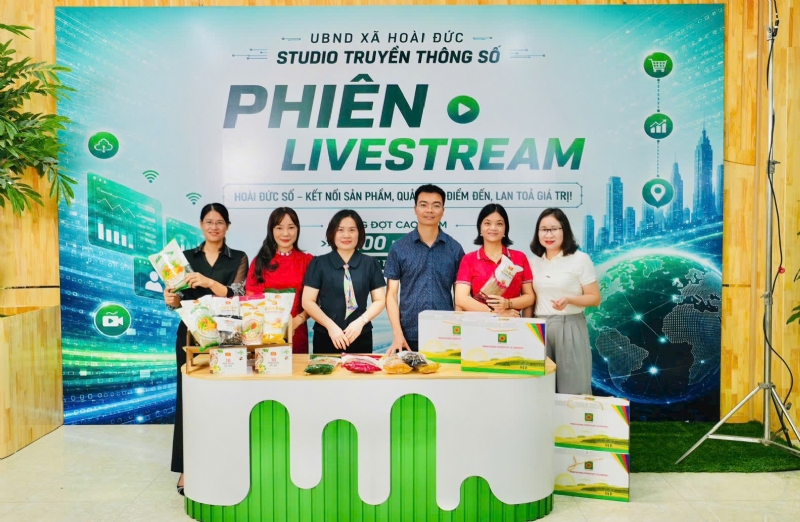
Hoai Duc Commune’s officials and business representatives host an e-commerce livestream for OCOP products
Craft Village Stories Go Online
In front of the camera, packages of arrowroot noodles, sweet potato noodles, potato noodles, pulled arrowroot noodles and rice vermicelli are neatly arranged on a table. The host takes viewers through the ingredients, preparation methods, quality standards and stories behind the products. On the other side of the screen, viewers can ask questions and receive answers almost immediately. The distance between the production site and consumers’ kitchens is therefore reduced to a smartphone.
This was part of the first livestream organized by Hoai Duc Commune to promote OCOP products on digital platforms. The noodles and vermicelli featured in the livestream are made by Minh Duong Foodstuff Joint Stock Company, which grew from the traditional noodle and vermicelli trade in Minh Khai in Duong Hoa Commune following administrative reorganization. Many of the company’s products have received four-star OCOP ratings and are gradually entering modern distribution systems.
Compared with a trade fair booth, a livestream lacks the advantage of letting customers “hold, taste and try” products, but it greatly expands their reach. Good content can also be edited into short videos and continue circulating after the program. This gives producers more opportunities to reach customers and understand what they actually care about.
According to Nguyen Dinh Linh, Head of the Economic Department of Hoai Duc Commune, quality remains the key factor determining competitiveness. Consumers today not only ask where a product is made but also want to know what ingredients are used, how it is produced, whether food safety is assured and whether its origin can be traced. “When product information is publicly and transparently provided and quality is assured, consumers will have greater confidence in, choose and embrace the products,” Linh said.
Expanding the Market Reach
For many OCOP producers, the challenge is not simply making products that meet standards. A greater challenge is reaching the right customers, building brand recognition and turning interest into steady demand. Trade fairs, display areas and agents remain necessary, but are limited by location, time and cost. Livestreaming offers small businesses a new “storefront” for telling their stories.
A significant advantage of this format is that it gives familiar products more context. A package of noodles on a store shelf cannot easily explain why the noodles have a particular texture, how the ingredients are selected or how they should be prepared. During a livestream, these details can be explained through images, demonstrations and dialogue. This soft value can easily be overlooked when producers focus only on packaging or star ratings.
However, livestreaming is not a “magic wand” for agricultural sales. High viewership does not necessarily translate into orders, and a lively broadcast does not by itself build a brand. For long-term development, producers must prepare everything from product quality, content and pricing policies to inventory, packaging, delivery and after-sales service. For food products, information presented during broadcasts must be consistent with product labels, quality records and the actual products.
What businesses need after each broadcast is not just engagement but market data: what customers ask, where they are located, what the conversion rate is and which products attract interest but are not purchased. When this information is analyzed and used in subsequent broadcasts, livestreaming can become a genuine business tool. If it is pursued merely as a campaign, digital channels can easily produce only short-term results.
Strong Support from Local Authorities
What is noteworthy about Hoai Duc Commune’s approach is that local authorities are directly involved in the market process. Commune leaders participate in livestreams, joining producers in introducing products and addressing consumers’ concerns. This involvement adds credibility and shows that digital transformation at the grassroots level is not limited to digitizing administrative procedures but must also support livelihoods, production and business activities.
Previously, the Hoai Duc Commune People’s Committee launched a “Digital Media Studio” at the Community Learning Center to produce videos, podcasts and livestreams for grassroots communications and promote OCOP products, agricultural products and craft villages. The shared space helps producers and small businesses overcome barriers related to equipment, technical skills and personnel, which can otherwise discourage them from moving onto digital platforms.
Dong Thi Nga, Vice Chairwoman of the Hoai Duc Commune People’s Committee, said livestreaming provides a practical way to connect products with consumers. Customers can learn about products, including their ingredients, production processes, quality standards and brand stories, without visiting the production site. According to Nga, local authorities will continue working with businesses, household businesses and OCOP producers to adopt technology, promote products and expand markets.
Such support needs to follow a specific roadmap: selecting eligible products, providing training in sales skills and legal compliance, establishing regular broadcast schedules, connecting with e-commerce platforms and logistics providers, and making post-program performance indicators public. Local authorities can provide infrastructure, connect experts and facilitate media exposure; businesses must remain responsible for quality, reputation and customer service.
The first livestream in Hoai Duc should be viewed as a market experiment rather than a standalone event. Its value lies not in putting a few products “on air,” but in creating a process that enables local specialties to maintain a regular, transparent and professional presence in the digital environment. When views lead to dialogue, dialogue builds trust and trust leads to repeat orders, digital transformation can genuinely increase the value of OCOP products and create sustainable livelihoods for rural communities
|
This special section is presented in collaboration with the Hanoi Coordination Office for National Target Programs |
By Minh Ngoc, Vietnam Business Forum