From the traditional craft of manually fluffing cotton, Trat Cau village has grown into a large-scale production hub for blankets, bed sheets, pillows, and mattresses, creating stable employment and incomes for local residents. This evolution from individual craft households to a connected network of enterprises and production facilities underscores the role of the craft village economy in local economic development in Thuong Tin Commune, Hanoi, while creating new requirements for technological innovation, brand development, and environmental management.

A historic setting in Trat Cau traditional bedding craft village, Thuong Tin Commune, Hanoi
Improving Residents' Livelihoods
In the final months of the year, production activity in Trat Cau grows increasingly intense. Behind the retail storefronts, cutting, sewing, quilting, and embroidery workshops operate at full capacity.
This atmosphere reflects the resilience of a craft village that has weathered many changes over time. According to local resident Nguyen Thi Yen, the trade in Trat Cau originated with manual cotton fluffing using a simple wooden bow and cord. Artisans from the village once traveled to different localities to make custom blankets directly at customers' homes.
Trat Cau residents have not preserved their craft in isolation. After 1945, improved weaving machinery was introduced to support blanket and pillow production. Over time, households continued investing in automated quilting and embroidery machines, as well as production lines for foam and mattress cores. Expanding beyond basic cotton blankets, the product line grew to include bed sheets, pillows, and four-season mattresses, catering to market segments from affordable to premium. Mechanization has steadily increased productivity, improved consistency, and shortened production cycles.
Local records indicate that Trat Cau currently supports roughly 80 enterprises alongside hundreds of household-run manufacturing and trading establishments. Most residents participate in one or more stages of the value chain, ranging from material supply and pattern design to core production, cover sewing, packaging, logistics, and retail. This collaborative ecosystem allows local businesses to share orders, assist one another across production stages, and flexibly adjust production during peak market seasons.
Within local economic development, the craft village's most significant contribution lies in restructuring the local labor force and raising community incomes. Residents can work and run enterprises directly in their hometowns, while workers from neighboring areas find additional employment opportunities. Active manufacturing also drives demand for commerce, logistics, equipment repair, and support services. Revenue generated by these household businesses and enterprises continues to fund home improvements, production infrastructure upgrades, and community activities.
The Trat Cau experience demonstrates that in traditional artisan areas, local economic progress must be built on livelihoods capable of delivering lasting value. When a craft is organized into a cohesive value chain, the rural workforce steadily transitions from fragmented, small-scale output toward greater specialization and higher-value production.
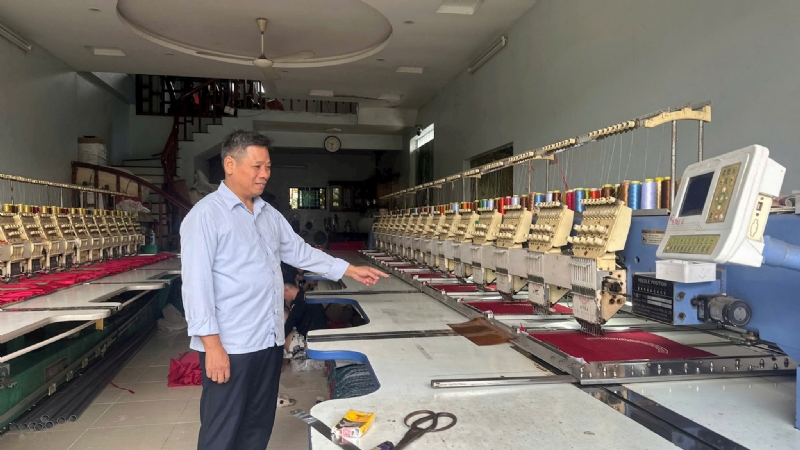
Trat Cau Village is applying technology to the production of traditional cotton bedding products
Innovating Production for Sustainable Development
Rapid growth also presents Trat Cau with new requirements. The next stage of development must therefore focus on standardized products with clear identification and full traceability.
Enterprises and craft households need to treat design, branding, and quality as core assets of the craft village economy. Packaging that clearly details material composition, usage instructions, and warranty policies will build stronger consumer confidence. Local authorities can assist with trademark protection, help establish a distinct craft village identity, connect qualified businesses and production facilities with trade promotion initiatives, and support the inclusion of local products in official evaluations for outstanding rural products.
Digital transformation must also be integrated more deeply into daily business operations. Although many businesses already utilize social media and e-commerce platforms, overall effectiveness will improve through professional product photography, consistent catalog data, traceability codes, and structured feedback management. Managing orders, inventory, and cash flow through dedicated software will allow producers to control operating costs, forecast seasonal demand more accurately, and reduce reliance on experience-based planning.
For production, machinery upgrades must be tied directly to energy efficiency and workplace safety. This is not merely a management requirement, but an important condition for enterprises to secure large orders and establish long-term market credibility.
Environmental management must be addressed across every stage of production. Fabric scraps, excess cotton, foam, and packaging should be sorted at the source for recycling or transferred to specialized treatment providers rather than disposed of in residential neighborhoods. Production facilities should invest in dust-collection systems, reduce noise, and set up designated, orderly storage zones for raw materials and finished goods. Commune authorities need to combine compliance inspections with technical guidance, promote cleaner production methods, and systematically transition higher-risk manufacturing stages into specialized craft village industrial clusters equipped with proper infrastructure.
This strategic orientation aligns closely with Hanoi's broader craft village development agenda. The city currently encompasses 1,350 craft villages and traditional artisan settlements, including 334 officially recognized craft villages. Policies taking effect from 2026 promote technological innovation, product design, brand building, workforce training, and tighter integration between manufacturing and retail markets. Trat Cau can leverage this framework to secure targeted support for quality standardization, equipment modernization, and trade promotion.
To turn these policies into practical results, Thuong Tin Commune needs to review enterprises, production households, workers, and production-space needs, thereby identifying the groups that need support.
From a traditional handicraft occupation, Trat Cau has developed into a production area with a large network of enterprises and craft households. The value of the craft village in the new phase should be measured by job quality, brand strength, safety, and the ability to protect the environment. These are the foundations for the blanket, bed sheet, pillow, and mattress industry to continue making a sustainable contribution to new rural development in Thuong Tin Commune.
|
This special section is presented in collaboration with the Hanoi Coordination Office for National Target Programs |
By Ngoc Minh, Vietnam Business Forum