Phuc Son Commune in Hanoi is prioritizing production restructuring, infrastructure upgrades, and livelihood improvements to make its advanced new-style rural development program more effective and directly impact residents' incomes, environment, and quality of life.
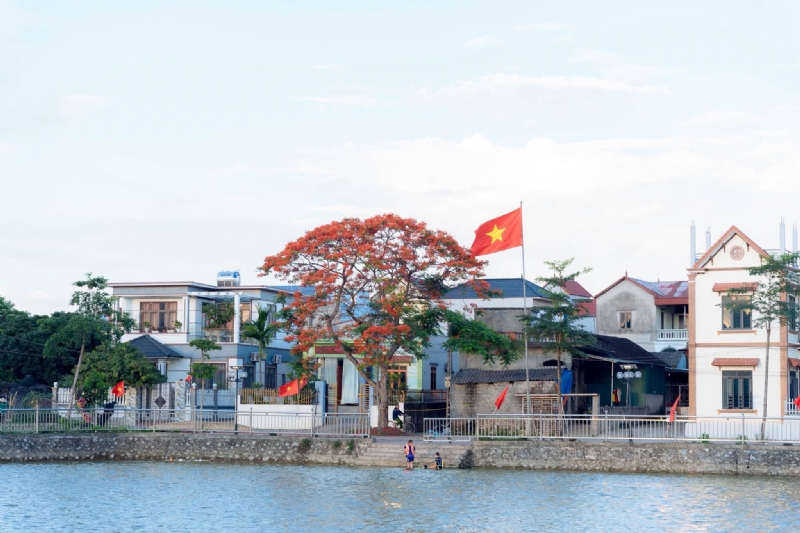
Phuc Son Commune’s infrastructure and facilities are undergoing major improvements, providing a foundation for rural development
Adding Value to Farmland
In Thuong Lam Village (Phuc Son Commune), local resident Ngo Duc Manh has farmed for more than 25 years and invested in a water treatment and water-saving irrigation system. He grows chili, Malabar spinach, cucumbers, melons, bananas, and other crops under VietGAP standards. Farming activities are recorded, while organic fertilizers and biological products are prioritized to reduce impacts on soil, water, and agricultural products.
The farm creates jobs for about 20-30 local workers, with daily income of VND150,000-250,000 per person, and annual revenue of VND2-3 billion. The model also helps control inputs, save water, and organize production according to market demand. Manh also shares his experience with people seeking to develop clean agriculture.
During the 2026 crop season, tray-grown seedlings and machine transplanting were used across 121 ha at My Thanh, Bot Xuyen, Thuong Lam, and Dong Tam cooperatives. Bot Xuyen Cooperative linked the production and sale of 25 ha of J02 rice and Co Tien glutinous rice. Mechanization reduces labor needs and helps ensure crop schedules, while market linkages encourage producers to follow production processes and maintain quality.
In the first six months of 2026, the commune’s spring crop cultivation area reached 1,961.86 ha, with spring rice covering 1,614.9 ha and estimated yields of 60.2 quintals/ha, supported by sufficient irrigation water. The locality continues to seek higher value per unit of land and lower production costs.
Bringing machinery and new varieties to farmland is not enough to create green agriculture. Phuc Son also needs to reduce chemical inputs, collect pesticide packaging, manage livestock waste, and make use of byproducts. In commodity-producing areas, traceability, preliminary processing, storage, and market linkages must be part of the production process.
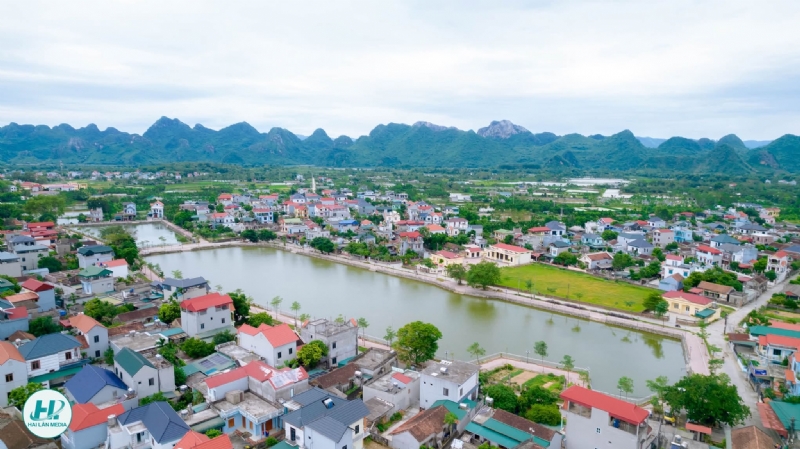
Phuc Son strives to raise rural living standards through better infrastructure, livelihoods and essential services
Improving Infrastructure and the Living Environment
In advanced new rural development, infrastructure must directly serve production and residents’ needs. Roads through Vinh Xuong, Vinh Lac, Bot Xuyen, and My Tien have been concreted and widened, with drainage systems added. Field roads support mechanization, agricultural transport, and connections among villages.
In 2026, the commune is implementing 33 carryover projects and 50 new projects, with public investment disbursement through June estimated at VND175 billion (US$6.73 million). Projects need to be prioritized based on actual needs, with close management of construction quality and post-investment maintenance, prioritizing schools, cultural centers, field roads, canals, and flood prevention.
Phuc Son aims to ensure that 100% of households have access to clean water from centralized facilities by the end of 2026. By early June, 87.7 km of transmission pipelines had been built in 12 of 40 villages. Alongside expanding the network, the commune must ensure household connections, water quality, and stable operations.
The rural environment requires continuous attention. Phuc Son is focusing on five livelihood bottlenecks: traffic safety; urban and construction order; environmental sanitation; flooding; and food safety. The commune is dredging canals and upgrading residential areas, while maintaining village roads, caring for greenery, and cleaning rivers and canals in various villages.
By 2030, the commune aims to collect and treat all household solid waste and ensure that at least 80% of urban wastewater is treated to required standards. This is necessary to develop high-value agriculture, rural industries, and ecotourism without adding pressure on the environment.
Alongside public resources, residents participate by donating land for road construction, supervising projects, maintaining the landscape, and reporting issues at the grassroots level. The commune needs to make planning, progress, funding, and post-investment management responsibilities public to build consensus. When residents are informed, consulted, and directly benefit, new rural development projects can deliver lasting results.
Raising Quality of Life
In the first six months of 2026, average income in the locality was estimated at VND76.8 million (US$2,954) per person per year. The commune has achieved its goal of eliminating poor households, with 174 near-poor households remaining, accounting for 1.24%. This result needs to be reinforced through stable livelihoods, support for near-poor households, and more local employment opportunities.
According to Phuc Son Commune People’s Committee Chairman Tran Xuan Hai, the commune is reviewing each advanced new rural development criterion, preparing plans, and assigning responsibilities to each department and village. The goal for 2025-2030 is to fully meet the criteria while maintaining broad-based rural development.
The review process must identify criteria that have been met but whose quality remains unstable, as well as areas lacking resources. Phuc Son needs to prioritize safe production areas, value-chain linkages, clean water supply, waste and wastewater treatment, and flood prevention, while improving healthcare, education, and cultural services at the grassroots level.
The program for building advanced new-style rural areas does not end with completing recognition documents. Its results must be measured by stable incomes, lower production costs, well-functioning infrastructure, an improved environment, and convenient access to essential services. These provide the foundation for Phuc Son to sustain its new rural development achievements.
|
This special section is presented in collaboration with the Hanoi Coordination Office for National Target Programs |
By Dinh Bao, Vietnam Business Forum