One Commune One Product (OCOP) recognition is just the start. To help local specialties reach broader markets, Hanoi is focusing on modern distribution, e-commerce, logistics, craft village tourism, and creative design. This reflects a shift from "having products" to "having markets," where cultural stories must go hand in hand with quality and reliable supply capacity.
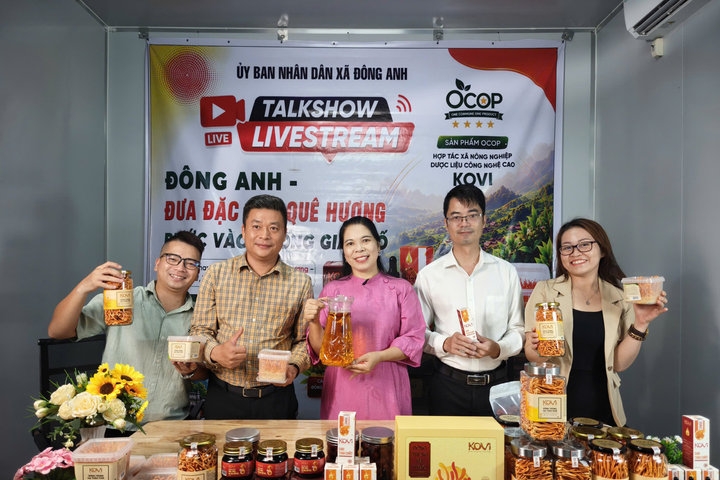
A product promotion livestream in Dong Anh Commune
Turning Star Ratings into Market Reality
Hanoi currently has 3,531 OCOP products, a diverse base large enough to build collections of specialties, gifts, and goods that reflect the capital's identity. However, variety alone does not drive sales. When entering supermarkets, e-commerce platforms, or export channels, products must compete directly on quality, price, design, convenience, and supply capacity. A star rating opens the door, but the market decides whether a product stays on the shelf.
The city's 2026 OCOP plan aims to develop 8-10 additional sales and product showcase points, while establishing five creative design, promotion, showcase, and sales centers linked to tourism. If managed effectively, these locations will serve not only as retail outlets but also as sources of market feedback where producers can refine their products.
Product promotion weeks and fairs at venues like AEON Mall Ha Dong and AEON Mall Long Bien let OCOP producers connect directly with urban shoppers and retail buyers. These events help promote local specialties while giving producers a chance to study competitors and understand what is required for packaging, product display, and branding.
Nguyen Manh Phuong, Deputy Director of the Hanoi Department of Agriculture and Rural Development, views engagement with modern retail systems as a bridge for businesses and cooperatives to build their brands and enter distribution channels. The value of this bridge increases when events lead to concrete steps: connecting with buyers, completing vendor paperwork, placing test orders, tracking sales, and adapting to buyer requirements. This turns a trade fair into the start of a contract rather than the end of a promotional event.
Bringing Craft Village Culture into Gift Products
Hanoi’s main advantage lies in its rich culture and network of traditional craft villages. The city features 1,006 OCOP products from craft village areas, making up about 28.5% of the total, with four villages recognized by the World Crafts Council. This provides a unique foundation for creating gifts, decorative items, and tourism experiences. To build on this, the city plans to develop hundreds of signature gift items for placement at tourist sites, shopping centers, and airports, while connecting OCOP producers and craft villages with artists, architects, and packaging designers. This partnership helps products retain their traditional stories while offering shapes, sizes, and functions that suit modern consumers.
E-commerce broadens market reach, but it is no magic fix. Clear product images, accurate details, concise stories, and traceability codes are merely baseline requirements. Behind them lie inventory management, customer support, order fulfillment, shipping, and returns. Small producers need practical support to master operational workflows and interpret sales data. Without this, setting up an online store that sits idle turns digitalization into just another box-ticking exercise.
Tan Thinh’s Ngoc Suoi glazed pottery from Bat Trang, currently under review for a five-star rating and already exported to India, shows how local products can reach distant markets when craftsmanship, cultural identity, and real market demand align.
Connecting the Ecosystem for Greater Impact
To help products reach broader markets, Hanoi needs a continuous support ecosystem: regulatory bodies set standards and facilitate connections; retail networks signal market demand; design firms enhance the customer experience; logistics providers guarantee reliable delivery; and training institutions build digital and management capacity. OCOP producers remain at the core of this effort, as external support is only effective when they actively innovate, protect their brand reputation, and continuously reinvest in product quality.
Products should be tailored to specific channels rather than pushing an entire product lineup across every market. Tourism gifts demand a compelling narrative, compact design, and authentic Hanoi identity; supermarkets prioritize regulatory compliance, competitive pricing, and steady supply; e-commerce relies on strong visuals, customer reviews, and dependable delivery; export channels require technical documentation, trademark protection, and cultural adaptation. Strategic market segmentation ensures promotion budgets are used effectively and yields predictable, long-term orders.
The Hanoi OCOP program has built a strong enough foundation to enter a phase of deeper growth. Progress no longer depends on running endless promotional events, but on turning business connections into lasting commercial partnerships, craft village stories into practical design value, and sales data into smarter production decisions. When quality, culture, and market capability operate within a single ecosystem, local specialties can expand into larger markets without losing their identity.
This special section is presented in collaboration with the Hanoi Coordination Office for National Target Programs
By Bao Dan, Vietnam Business Forum