From training young workers to improving product design, building brands, and developing tourism, Thu Lam, a northeastern commune of Hanoi, is gradually turning its craft village economy into a driver of rural development.
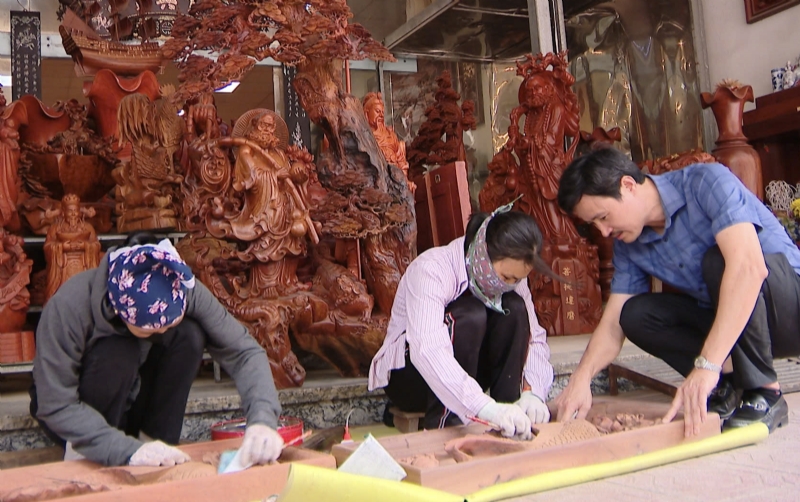
Thu Lam Commune’s woodworking craft is traditionally passed down through generations
Training the Next Generation
In a woodworking workshop in Thu Lam Commune, 35 trainees are learning to identify materials, use tools, and apply techniques for shaping, carving, and creating decorative patterns. For a craft that requires years of practice, a three-month course cannot turn trainees into artisans overnight, but it provides a starting point for young people to understand the craft, develop basic skills, and explore employment opportunities in their hometown.
Thu Lam is home to two long-established woodworking villages, Thiet Ung and Thu Lo. Thiet Ung is known for carving, statue making, ancestral worship items, and fine wooden handicrafts. The craft was traditionally passed down within families, with children becoming familiar with wood, chisels, and planes in their parents' workshops. This approach produced generations of skilled craftspeople with distinctive techniques, but it is facing pressure as young workers have more employment options and are less willing to pursue the long training process.
The vocational training class for 35 young workers opened on August 24, 2026, and will run through November. It is organized by the Hanoi Center for Industrial Promotion and Trade Promotion in coordination with the Thu Lam Commune Economic Division and Phuong Dong Wood Furniture Development Co., Ltd. The model brings together management agencies, businesses, and skilled craftspeople, helping the program align more closely with production needs. Trainees receive hands-on instruction, while businesses have an opportunity to identify suitable workers for further training and employment. The class is helping replenish the workforce for the Thiet Ung and Thu Lo fine woodworking villages.
According to Nguyen Ba Trinh, Deputy Head of the Thu Lam Commune Economic Division, woodworking has supported many families and helped them prosper, but some young people are not genuinely interested in pursuing the craft. The city and local authorities are strengthening training and apprenticeship programs to help young people understand the value of their traditional craft. From a new rural development perspective, this is a way to create local livelihoods, restructure the labor force, and retain workers capable of producing high-value products.

Thu Lam Commune is turning its craft village economy into a driver of rural development
Integrating Craft Villages into Rural Development
Training new workers addresses only part of the challenge. For young people to stay with the craft, the village needs markets, a safe working environment, and income that is commensurate with their efforts. Thiet Ung currently has 28 artisans, including five distinguished artisans, along with hundreds of woodworkers. Many products have received three- and four-star OCOP ratings, while the craft village has also been recognized by Hanoi as a tourist destination. These foundations create opportunities to move beyond simply selling products to offering cultural experiences and services.
Nguyen Thanh Luan, Vice Chairman of the Thu Lam Commune People's Committee, said Thiet Ung wood products have reached many parts of Vietnam and some overseas markets. Their appeal lies in the delicate, refined, and lively details of each piece, helping build the reputation of the collective brand "Van Ha - Dong Anh - Hanoi Fine Wood Handicrafts." Protecting this reputation requires greater consistency among producers in product traceability, finishing quality, warranty procedures, and ownership of design patterns.
At the "Thu Lam Woodcraft Excellence Exhibition 2026," the first of its kind, Lai Manh Cuong, Vice Chairman of the Thu Lam Commune People's Committee, called on artisans and producers to make quality and reputation the foundation while pursuing innovation, developing the craft village in a clean and civilized manner, and combining production with services and experiential tourism. This direction fits Thiet Ung's strengths, as the locality already has an ancestral craft temple, a system of historical sites, exhibition spaces, and a creative design center.
A craft village tour can only thrive when visitors can observe the production process, hear artisans tell their own stories, try a suitable stage of production, and purchase products with clear origins. Alongside statues, ancestral worship items, and high-value furniture, producers can develop small gift products that are easy to transport and reflect the Thiet Ung identity. Dao Cong Trung, Head of Thiet Ung Village, said products such as pens, keychains, desk calendars, and especially personalized engraved items, are attracting visitor interest.
Digital transformation is an important tool for expanding markets. Nguyen Dinh Hoa, Deputy Director of the Hanoi Department of Agriculture and Environment, said the 2026 Craft Village Product Competition encourages the use of digital technology in design, innovation, branding, promotion, and sales. For Thu Lam, this could begin with a standardized collection of product images and stories, online storefronts for individual producers, traceability codes, digital payments, and the skills needed to process orders through online platforms.
Production development must also go hand in hand with environmental management. This is a condition for improving the quality of life in the craft village, meeting new rural development requirements, and reaching customers who value responsible production.
According to Ngo Van Ngon, Standing Deputy Chief of the Hanoi Coordination Office for National Target Programs, through 2030, the city plans to develop the rural economy toward ecological and circular models with integrated value creation, while supporting technological innovation, product design, branding, and training for artisans and skilled workers. For Thu Lam, these areas need to be translated into support plans for different groups of households, linking training with orders, product standards, and market access.
|
This special section is presented in collaboration with the Hanoi Coordination Office for National Target Programs |
By Minh Ngoc, Vietnam Business Forum