Preserving wood carving, expanding markets and improving the production environment are helping Nhan Hien Village, Thuong Tin, a southern commune of Hanoi, leverage its craft heritage, create livelihoods and improve the quality of new rural development.
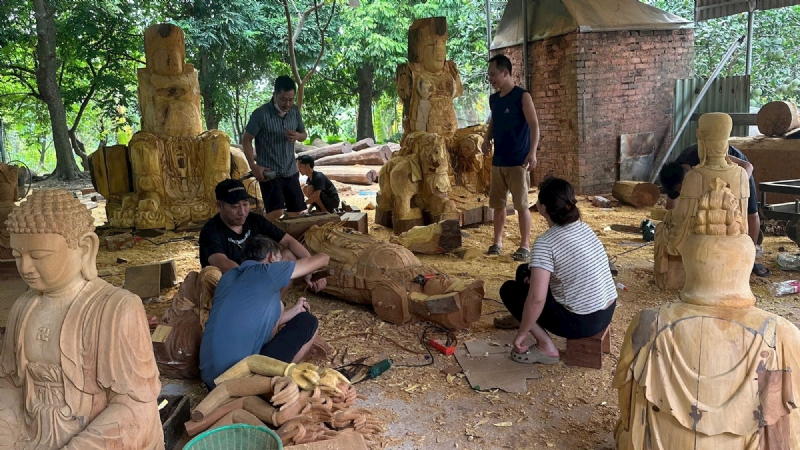
Artisans in Nhan Hien, a village in southern Hanoi, work to preserve and develop the village’s traditional carving craft
Preserving Craft, Creating Livelihoods
In the craft village area south of Hanoi, Nhan Hien is known for wood and stone carving, a craft with a history dating back to around the 17th century. About 200 families in Nhan Hien are currently engaged in wood and stone carving. Products range from decorative reliefs to statues up to 5m tall. Many village artisans create Buddha statues, Arhat statues, Dharma Protector statues and artistic works for the construction and restoration of temples and pagodas in many localities.
What makes Nhan Hien distinctive is not only its carving and sculpting techniques. Artisan Nguyen Van Truc, Chairman of the Nhan Hien Carving Craft Village Association, said the craft is passed down from father to son, but craftsmen cannot simply reproduce existing models. Each work requires the ability to shape forms and judge proportions, lines and expressions, thereby conveying cultural, religious and aesthetic values.
Mastering the craft requires years of dedicated learning. Artisan Hoang Van Ke said he spent nearly 10 years learning from older generations before becoming proficient in the craft.
In new rural development, traditional crafts first create local jobs, maintain incomes and keep workers connected to their hometowns. More importantly, crafts preserve knowledge, skills, community memories and links between generations. A rural area may have well-developed roads and infrastructure, but if its traditional crafts disappear, it loses an important part of its identity and distinctive vitality.
The preservation and transmission of the craft across generations in Nhan Hien therefore show that new rural development does not mean eliminating traditional production spaces. The challenge is to reorganize the craft to suit new conditions, so production does not conflict with residential life while cultural values are transformed into economic advantages. When craftsmen can earn a living from their craft, preservation has a sustainable foundation.
Modernizing Production, Advancing Rural Development
Residents of Nhan Hien Village have proactively adapted by expanding from wood carving to stone carving and diversifying product sizes and designs. Changes in materials have not altered core techniques but have expanded their ability to meet demand from cultural, religious, architectural and decorative projects. This is a necessary direction for traditional crafts to reach broader markets.
Nguyen Van Tan, Vice Chairman of the Thuong Tin Commune People’s Committee, said the locality is working with artisans and production households to strengthen product promotion and gradually bring the craft village brand closer to consumers. This support should go beyond short-term promotional campaigns to include product databases, standardized images, creator stories, order channels and digital transaction skills.
Hanoi’s criteria for new rural development communes for 2026-2030 set comprehensive requirements for the rural economy, human resources, digital transformation, the environment and public service quality. For a craft-rich area such as Thuong Tin, results should be measured not only by the number of production establishments remaining in operation, but also by added value, sustainable employment, safety and the ability to develop a common brand.
Along with markets, the environment is an issue that must be addressed in a coordinated manner. Immediate solutions include reviewing production spaces, supporting dust extraction equipment, collecting and reusing waste materials, ensuring electricity for production, fire prevention and firefighting, and providing protective equipment. Households need guidance on safety procedures appropriate to their workshop size. Inspections should be linked with consultation, corrective action roadmaps and support mechanisms, enabling small establishments to comply rather than simply being penalized for violations.
In the long term, Nhan Hien needs to develop a collective trademark linked to quality and product-origin criteria while strengthening the role of the Craft Village Association in connecting orders, protecting designs and training young workers. Representative products can be selected to complete One Commune One Product (OCOP) applications, participate in specialized exhibitions and connect with architects, heritage restoration units and furniture businesses.
Training the next generation also needs to shift from informal skills transmission toward cooperation among artisans, vocational education institutions and local authorities. Learners need to acquire not only production techniques but also knowledge of fine arts, occupational safety, pricing, copyright and business skills. When young people see a clear career path, the craft village will be better able to sustain the craft over the long term.
The experience of Nhan Hien Village shows that craft villages are an important resource for Hanoi’s new-style rural development. Preserving a craft does not mean maintaining old production methods unchanged; it means preserving techniques and cultural identity within an efficient, safe and environmentally friendly economic model. When tradition is supported by management, technology and markets, the carving craft can continue to create livelihoods, enrich cultural life and contribute to building a modern, green and sustainable rural area in Thuong Tin.
|
This special section is presented in collaboration with the Hanoi Coordination Office for National Target Programs |
Source: Vietnam Business Forum