From connecting rural communities to supporting household companies, Trung Gia - the northernmost commune of Hanoi - is bringing technology into everyday activities. This process creates additional conditions for improving the quality of new rural development while also creating requirements for data, human resources, and service efficiency.
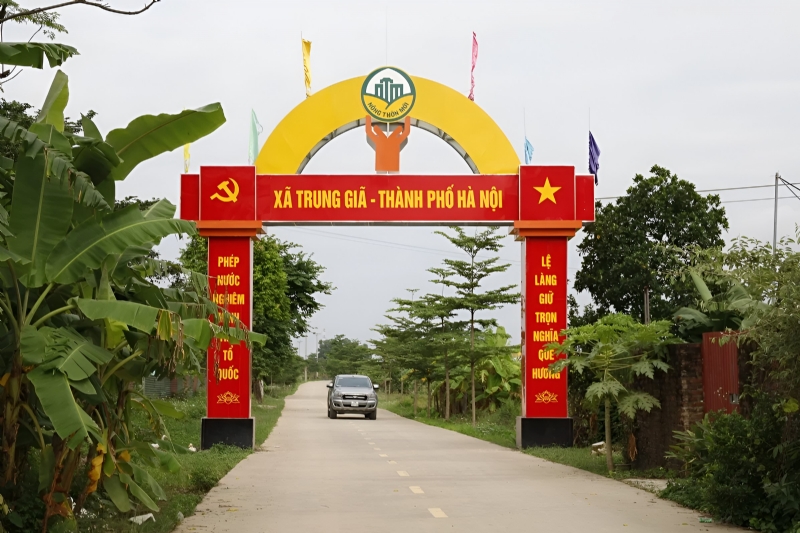
Trung Gia Commune is working to improve the quality of new rural development
Bringing Digital Services Closer to Residents
By the end of September 2026, Trung Gia had established 16 “Digital Village” community groups on the iHanoi app. According to Le Anh Truong, Head of Hong Ky Village, the model helps deliver notices, meeting schedules, and community activities to residents more quickly while creating an additional channel for receiving feedback on the environment, infrastructure, and village affairs.
Alongside this, the commune aims to provide free Wi-Fi and computer equipment at 100% of community cultural centers; build electronic libraries with at least 200 books at each location; and organize at least four digital citizen support sessions each month. Guidance covers online public services, VNeID, iHanoi, digital payments, and personal information protection. These are implementation targets, not results already achieved across the entire commune.
Using community cultural centers as support locations is meaningful for access to services in rural areas. For people who are not familiar with using smartphones, a location close to home with someone available to provide guidance makes learning and practice more convenient. The ability to use services independently after each support session more fully reflects the value of digital skills outreach.
In its June 2026 tasks, the Commune Party Committee identified a phased rollout of “Digital Community Cultural Centers,” prioritizing technology infrastructure, essential equipment, and digital content for community activities. This approach links investment with the functions of existing community facilities while incorporating content serving residents into the same equipment plan.
Supporting Businesses and Expanding Linkages
At the third-quarter review conference on September 25, Trung Gia reported that it had provided guidance on e-invoices, digital payments, and online sales to 581 of 668 business households, or 86.97%. This figure reflects the scope of support; it does not indicate the rate of regular use or any increase in revenue through online channels.
For business households, these skills are directly related to recording transactions, receiving payments, and reaching customers. From the perspective of rural economic development, simultaneous support across several areas can help small companies gradually become familiar with new business methods rather than simply opening an additional sales account.
Implementation resources were supplemented through a cooperation agreement between the Commune People’s Committee and VNPT Hanoi, signed on August 21, 2026, for the 2026-2030 period, with an orientation toward 2035. The agreement covers infrastructure, shared data, digital skills, and support for business households, cooperatives, and production facilities in applying e-commerce and promoting products.
At the signing ceremony, Luong Cao Chi, Director of VNPT Hanoi, stressed that the cooperation should produce specific outputs. VNPT Soc Son and the commune’s Division of Culture and Social Affairs signed a contract to purchase equipment for the “Digital Community Cultural Center” model. The contract signing is a step in implementing the investment, while its effectiveness depends on subsequent operation.
Business linkages are also a focus for Trung Gia. On July 14, 2026, the commune launched its Business Association and held a dialogue with the business community. Nguyen Thi Kim Tuyen, Standing Deputy Secretary of the Commune Party Committee, called on the association to strengthen linkages, apply science and technology, and improve management capacity.
At the dialogue, companies discussed planning, the investment environment, and difficulties in their operations. Establishing a representative focal point creates additional conditions for gathering common needs and connecting them with the authorities and appropriate service providers.

A production model in Trung Gia commune
Improving Data and Service Delivery
Alongside these implementation steps, Trung Gia has identified difficulties in implementation capacity. At a meeting with city leaders in May 2026, the locality reported that information technology infrastructure was not yet synchronized, specialized data were not interconnected, and there was a shortage of technology personnel. The commune proposed more specialized training and additional resources for implementation as responsibilities were decentralized.
At the September 25 conference, the locality continued to identify shortcomings, including inadequate land data cleansing and overdue administrative dossiers. Le Huu Manh, Secretary of the Commune Party Committee and Chairman of the People’s Council, called for these shortcomings to be addressed and for digital transformation to be accelerated in the fourth quarter.
These issues show that service quality also depends on the quality of input data and how work is handled. A conveniently submitted feedback item only has an impact when it reaches the right department, has an assigned person responsible for handling it, and receives a response. Similarly, electronic dossiers are unlikely to shorten processing times if information still needs to be checked and supplemented several times.
Under its 2026-2030 administrative reform plan, Trung Gia has set a target for 2026-2027 of providing end-to-end online public services for 100% of eligible administrative procedures on the National Public Service Portal and achieving a satisfaction rate of 95% among residents and companies using online public services. These are targets against which implementation quality can be assessed in the coming period.
At the city level, digital transformation is incorporated into rural economic development requirements. At a meeting to provide comments on the draft national target program plan on August 20, 2026, Ngo Van Ngon, Deputy Chief of the Hanoi Coordination Office for National Target Programs, said the target was for 80% of communes to meet new rural standards and 20% to meet modern new rural standards by 2030.
Concluding the meeting, Nguyen Dinh Hoa, Deputy Director of the Hanoi Department of Agriculture and Environment, requested clear identification of the lead and coordinating agencies, implementation timelines, and expected outputs, avoiding scattered and overlapping tasks.
For Trung Gia, this requirement is reflected in verifiable outcomes: residents can use services, business households can apply the skills they have learned, and dossiers are processed on time. These are also the bases for assessing the contribution of digital transformation to the quality of new rural development.
|
This special section is presented in collaboration with the Hanoi Coordination Office for National Target Programs |
By Ngoc Dan, Vietnam Business Forum