By expanding winter crop production, developing One Commune One Product (OCOP) goods, and investing in civil infrastructure, Kieu Phu, a western commune of Hanoi, is turning its goal of building a modern countryside into reality.
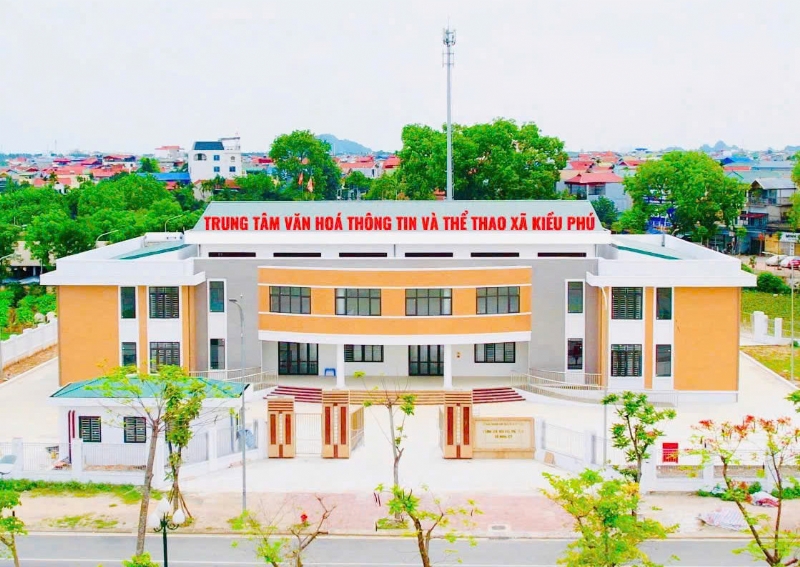
The newly constructed Culture, Information and Sports Center of Kieu Phu Commune, a key facility supporting modern rural development
Raising Production Value and Expanding Markets
In September 2026, Kieu Phu launched a production plan for 60 ha of winter crops, including 10 ha of corn, 40 ha of soybeans, and 10 ha of potatoes. The planned acreage was determined based on local farming conditions and household demand.
At a conference on September 9, the Commune General Service Center met with representatives of the Lien Thon, Liep Tuyet, Dong But, Phu My, and Liep Mai cooperatives to discuss production plans.
Organizing winter crop production provides an opportunity to use land after the rice harvest and generate additional income for farmers. The collaborative role of cooperatives and specialized agencies was reflected in initial field surveys, technical guidance and progress monitoring, moving beyond the mere assignment of acreage targets.
Earlier, during the first five months of 2026, the commune’s agricultural extension work focused on farming techniques, disease prevention, the use of tray seedlings and transplanting machines, and support for access to capital.
Alongside seasonal production, Kieu Phu has developed several concentrated fruit-growing areas, with average earnings of VND300 million to VND350 million (US$11,538 to US$13,462) per ha. The commune’s average per capita income reached VND85 million (US$3,269) in 2025. These results provide a foundation for the locality to continue improving living standards in the new phase.
Kieu Phu’s rural economy also includes residential carpentry in Ngoc Than, conical hat making in Phu My, and bamboo mat weaving in Muon and The Tru. Its location near Thang Long Boulevard, with Provincial Road 421B running through the area, supports trade in both agricultural products and handicrafts.
The OCOP program is implemented to improve product quality and strengthen the business capacity of participating entities. At a conference on June 26, 2026, the commune recorded 36 OCOP products, comprising 13 four-star products and 23 three-star products. Key discussion points covered production processes, raw material areas, packaging, branding, traceability, and consumption.
By 2030, Kieu Phu aims to develop, upgrade and complete 55 OCOP products rated three stars or higher. The commune also aims to provide training in production, business, quality, branding, and digital transformation for all participating organizations and individuals. Product upgrades are tied directly to the production management capabilities of each establishment.
Trade promotion activities were organized locally. A product showcase space at the 2026 Spring Flower Fair gathered nearly 100 booths from businesses and commercial establishments inside and outside Hanoi. Product categories included flowers, ornamental plants, traditional craft items, OCOP goods, and agricultural specialties, supporting shopping and creating opportunities to engage with customers.
Investing in Infrastructure for Better Community Services
Kieu Phu’s development takes place as Hanoi implements the 2026-2030 New Rural Commune Criteria Set, issued on August 28, 2026. According to Ngo Van Ngon, Deputy Chief of the Hanoi Coordination Office for National Target Programs, the set serves as a basis for evaluating current conditions, assessing compliance levels in each commune, and guiding appraisal for recognition of standards.
Kieu Phu assigns tasks across six clear areas: personnel, tasks, timelines, responsibilities, processes, and outputs. Clearly defined tasks help reduce overlaps while encouraging participation from residents and businesses.
Regarding infrastructure investment, on June 26, 2026, the commune broke ground on transport projects providing access to Facility 2 of the National Hospital of Obstetrics and Gynecology and the National Children’s Hospital, alongside a combined sports center and green park project. These ongoing projects focus on improving transport connectivity and providing public community spaces.
Phase 2 of the combined sports center and green park project alone has a total investment of over VND123 billion (US$4.73 million) and covers more than 4.6 ha. The project includes a soccer field, running track, multi-purpose sports yard, grandstands, park, lake, and walking paths.
Alongside new investments, local leadership has addressed existing shortcomings in administrative management and public services. During a working session with the Economic Department on early 2026 results, Commune People’s Committee Chairman Phung Huy Dien identified delays in processing land records that affected citizens’ rights.
Phung Huy Dien required strong action on backlog waste collection points, improved collection and transport efficiency, and systematic reviews of traffic signs and technical infrastructure to ensure traffic safety.
At a voter contact meeting preceding the mid-year session of Delegation No. 4 of the Commune People’s Council, residents raised petitions regarding land use right certificates, waste collection, canal upgrades, and sports field investments. These petitions reflect practical needs ranging from living spaces to production sites, providing a basis for the locality to set action priorities.
For Kieu Phu, new rural development results are reflected in production efficiency, goods distribution capacity, and public service quality. Ongoing efforts will continue to be assessed through project progress, household earnings, and the resolution of local public issues.
|
This special section is presented in collaboration with the Hanoi Coordination Office for National Target Programs |
By Dinh Bao, Vietnam Business Forum