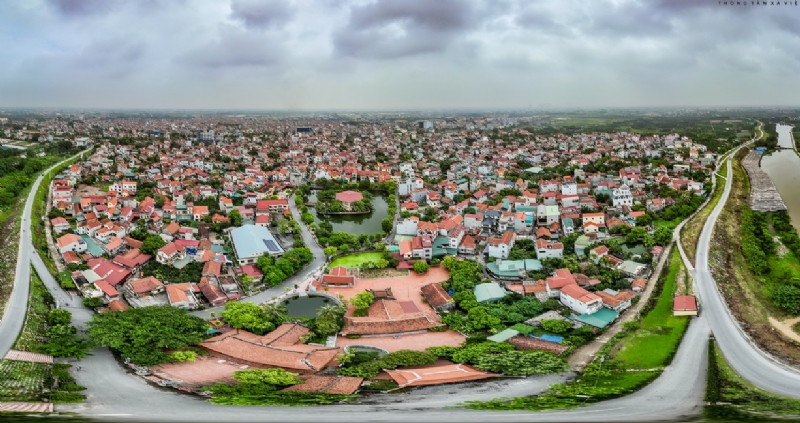
The Hanoi People’s Committee has recently issued the Criteria for New-Style Rural Communes in Hanoi for the 2026-2030 period. A notable feature of the criteria is that a single set of targets is not applied uniformly to all communes. For requirements involving quantitative targets, Group 1 communes are assigned higher thresholds than Group 2 communes, thereby ensuring greater alignment with development conditions and the process of urbanization.
Under the transport infrastructure criteria, both groups of communes must ensure that commune-level roads meet planning standards, are properly maintained, and have trees planted along at least 50% of their total length. However, roads in villages, alleys and residential areas in Group 1 communes must be fully paved, while Group 2 communes must achieve a rate of at least 90%. For irrigation, the proportion of agricultural production land with proactive irrigation and drainage must reach at least 90% in Group 1 communes and 80% in Group 2 communes; Group 1 communes must also apply advanced technologies appropriate to the development of urban agriculture.
In rural economic development, the annual growth rate of average per capita income in Group 1 communes must reach at least 10.5%, higher than the 9.5% required for Group 2 communes. Requirements for high-tech agriculture, the green economy and the circular economy are also differentiated: Group 1 communes must have at least three high-tech agricultural models, or at least one effective green-economy or circular-economy model; Group 2 communes need at least two high-tech agricultural models, or one effective green-economy or circular-economy model.
For farmers engaged in good production and business practices, the required proportion is at least 60% in Group 1 communes, compared with 50% in Group 2. Human resource training criteria are also differentiated: the proportion of workers who have undergone training and hold degrees or certificates must reach at least 40% in Group 1 communes and 35% in Group 2; the corresponding proportions of people of school age pursuing post-high-school education are 60% and 50%.
Differences are also clearly reflected in poverty reduction and social welfare criteria. Group 1 communes must keep the multidimensional poverty rate at no more than 1.5%, while the corresponding ceiling for Group 2 communes is 3%. The proportion of households using clean water meeting regulatory standards must reach at least 80% in Group 1 communes and 70% in Group 2, with both groups required to ensure that a proportion of households use clean water supplied by centralized water supply systems.
In science and technology and digital transformation, both groups of communes must ensure digital government, digitize agricultural and environmental data, and effectively implement e-commerce. However, the requirement for smart-village models is higher for Group 1: at least two models, compared with at least one model for Group 2.
Regarding the environment, common requirements apply to both groups, including ensuring that at least 80% of household solid waste is sorted, collected and treated; and at least 90% of livestock waste, organic waste and agricultural by-products are collected, treated and recycled. Communes must also ensure the collection and treatment of domestic wastewater and develop green, clean, attractive and safe landscapes.
Alongside the differentiated targets, many requirements are applied equally to both groups of communes, such as having appropriate planning; having an effectively operating cooperative; meeting criteria for culture, education and healthcare; ensuring that 100% of households have permanent housing; ensuring food safety; building a political system that fulfills its tasks well or better; ensuring the effective operation of the Public Administration Service Center; meeting legal-accessibility standards; and ensuring security, public order and national defense. In particular, both groups of communes must have an AI camera system for security surveillance covering the entire commune.
The division into two groups with different levels of requirements shows that Hanoi’s criteria for new-style rural communes for the 2026-2030 period aim to provide a more realistic assessment while creating a roadmap for gradually improving rural quality. Group 1 communes are subject to higher requirements for infrastructure, income, human resource quality, poverty reduction, clean water and digital transformation, thereby aiming to develop rural areas with a higher level of development that are modern, green and digitalized.
| This page is produced in coordination with the Hanoi Coordination Office for New-Style Rural Development |
By Do Ngoc, Vietnam Business Forum